 How-to
Marine Battery Identification Numbers: A Complete Decoder Guide
Last Updated: November 7, 2026
Quick Summary
A marine battery identification number is decoded by reading the BCI group size first, since that code defines case dimensions and terminal layout, not power output. Then compare CCA, MCA, amp-hours, and reserve capacity to match or exceed your old battery's ratings. Date codes and model numbers are manufacturer-specific and never standardized.
- The big number on a marine battery label is a size code, not a power rating.
- Group 27 dimensions run roughly 12.1 inches long, 6.8 inches wide, and 8.9 inches tall.
- Photograph the top label, side stamps, and case measurements before buying a replacement.
- Match the group size first, then meet or exceed the old CCA and MCA ratings.
- If chemistry is unknown, assume flooded lead-acid and charge at a flooded profile.
Table of Contents
- Why Marine Battery Identification Numbers Matter
- Decoding the Numbers and Codes on a Marine Battery Label
- Marine Battery Group Size Meaning Explained
- Boat Battery Size Chart: Common Group Sizes at a Glance
- Group 27 Marine Battery Dimensions and Physical Fit
- A Photo-Based Workflow for Identifying an Unknown Battery
- Cross-Referencing Your Battery Number with a Replacement
- Finding the Right Marine Battery at Bigtime Battery
- Frequently Asked Questions
Why Marine Battery Identification Numbers Matter
A dead battery at the dock teaches a hard lesson: the label matters more than the logo. This guide to marine battery identification numbers from Bigtime Battery explains the common codes stamped on a marine battery case, so you can match the right replacement the first time. The numbers tell you physical size, power output, and chemistry. Read them wrong and you buy a battery that won't fit the tray or won't start the engine.
Here's the part most boaters miss. The big number on the label is a size code, not a power rating. A Group 31 battery from one maker can outperform a Group 31 from another. The label only promises the case will fit.
The Battery Council International group size standards set the footprints that every manufacturer follows. Once you can read those codes, buying a battery stops being guesswork.
Decoding the Numbers and Codes on a Marine Battery Label
A marine battery label carries several different codes, and they do not all mean the same thing. The most common mistake is reading a model number as a group size, or a date code as a capacity rating. The table below separates what each code actually tells you from what it cannot.
Code on the label | What it tells you | What it cannot tell you |
|---|---|---|
BCI group size (24, 27, 31, 4D, 8D) | Case dimensions and terminal layout | Capacity, quality, or chemistry |
CCA (cold cranking amps) | Starting power at 0°F | Runtime or deep-cycle endurance |
MCA (marine cranking amps) | Starting power at 32°F | Runtime or deep-cycle endurance |
Amp-hours (Ah) | Capacity at a stated discharge rate | Starting power or physical fit |
Reserve capacity (RC) | Minutes of runtime at 25 amps | Cold-weather starting ability |
Date code | Month and year of manufacture | State of health or remaining life |
Model or part number | Manufacturer's internal identifier | Any standardized physical or performance spec |
Group Number vs. Model Number
A group number is a standardized physical envelope defined by the Battery Council International group size standards. A model number is the manufacturer's own identifier and follows no shared format. A label that reads "Group 31" is telling you the case will fit a Group 31 tray. A label that reads "31M-XHD" is a model number that may or may not correspond to a Group 31 case. When both appear, the group number is the one that governs fit.
Reading a Date Code
Date codes are manufacturer-specific. A common pattern is a letter for the month followed by a number for the year, but the format varies by brand. Look for a stamped or burned-in code near the terminals, on the case lid, or on a sticker on the side. If the code is a sticker rather than a stamp, treat it with suspicion, stickers can be replaced. A battery with an older date code may be a candidate for replacement, because batteries age even when unused.
What the Label Cannot Tell You
The label does not tell you the battery's state of health. A battery's printed ratings do not show its current state of health, since capacity declines with age and use. The label also does not tell you the chemistry unless a marking such as AGM, gel, or lithium appears. If no chemistry marking survives, assume flooded lead-acid until you confirm otherwise, and charge it accordingly.
Watch out: a model number that contains "31" is not proof of a Group 31 case. Measure the case before you buy a replacement.
Marine Battery Group Size Meaning Explained
Marine battery group size meaning comes down to one thing: it is the standardized case dimensions and terminal layout defined by BCI. It says nothing about how much power the battery holds.
How BCI Group Size Differs from Performance Ratings
Group size is a fit specification. Performance ratings are output specifications. A Group 27 case is always the same footprint, but its amp-hour rating can vary by manufacturer and chemistry.
That distinction matters when you cross-shop. Check both group size and reserve capacity before you buy.
U.S. Coast Guard boating safety guidance reminds boaters that battery selection should match the vessel's electrical load, not just the tray size.
Boat Battery Size Chart: Common Group Sizes at a Glance
The boat battery size chart below covers the group sizes most recreational boats use. Dimensions are approximate and can vary slightly by manufacturer, so measure your tray before buying.
Group Size | Typical Use |
|---|---|
Group 24 | Small boats, starting |
Group 27 | Trolling motors, dual-purpose |
Group 31 | Larger boats, deep-cycle banks |
4D | Big cruisers, house banks |
8D | Large yachts, commercial |
For a deeper look at matching capacity to your boat, read our deep cycle battery sizing guide for boats.
Group 27 Marine Battery Dimensions and Physical Fit
Group 27 marine battery dimensions run roughly 12.1 inches long, 6.8 inches wide, and 8.9 inches tall. That footprint suits many trolling motor setups and dual-purpose applications.
Physical fit is a common source of problems when buying a replacement. Battery compartments are tight, and terminal posts add height. Measure the compartment's length, width, and height with the lid closed.
- Check terminal layout: posts can sit on the top or the side
- Confirm polarity before connecting cables
- Leave room for hold-down straps and ventilation
Watch out: reversing polarity during install can damage connected equipment. Photograph your cable positions before you disconnect the old battery.
If you're confirming a Group 27 fit, our Group 27 dual-purpose marine lithium battery is one option built to that footprint.
A Photo-Based Workflow for Identifying an Unknown Battery
When the label is worn off, a photo workflow saves the day. Follow these steps before you buy anything.
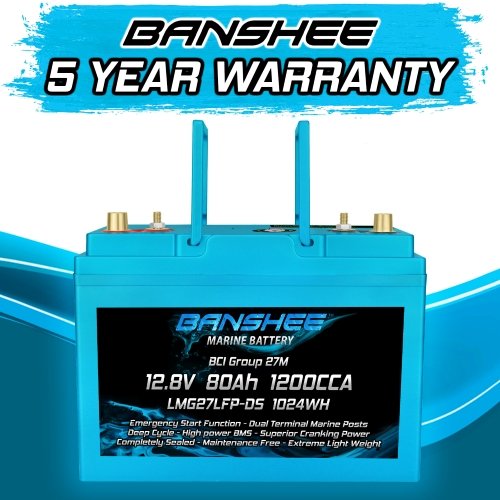
Find the right Marine battery for you
- Photograph the top label in bright light, straight on
- Photograph the side or end stamps, which often survive longer
- Measure the case with a tape: length, width, height
- Note the terminal layout and post positions
- Record the chemistry if any marking survives, such as AGM or flooded
- Check for a date stamp near the terminals or on the case lid
Decision Tree for a Faded or Missing Label
- Group number readable? Match the group size first, then compare ratings.
- Only a model number readable? Measure the case and match dimensions to the group size chart above.
- No markings at all? Measure length, width, and height, then compare to the chart. Terminal layout and post height narrow it further.
- Chemistry unknown? Assume flooded lead-acid and charge at a flooded profile until confirmed. AGM and gel batteries can be damaged by the wrong charge profile.
Where Date and Serial Stamps Hide
Manufacturers put date codes in different places. Check the top label, the case lid near the terminals, the side of the case, and the bottom edge. Some brands stamp the code into the plastic; others use a sticker. A serial number is not a date code, it identifies the unit, not the manufacture month. If you find only a serial number, contact the manufacturer with it; most can decode the build date from the serial.
Safety When Inspecting or Decoding a Battery
- Wear eye protection and gloves when handling a flooded battery
- Do not lean over a battery while it is on charge, hydrogen gas can accumulate
- Check for cracked cases, swollen lids, or leaking electrolyte before you touch terminals
- Disconnect the negative cable first and reconnect it last
- Treat a swollen lithium battery as a hazard and do not attempt to charge it
If the battery is underperforming after identification, our marine battery troubleshooting guide walks through the common failure points step by step. When you are ready to replace it, our Group 27 dual-purpose marine lithium battery shows a real product option built to a common footprint, and you can make your purchase at bigtimebattery.com.
Cross-Referencing Your Battery Number with a Replacement
Cross-referencing means matching your old battery's group size and ratings to a new one with equal or better output. Start with the group code, then compare CCA, MCA, and amp-hours.
- Match the group size first, always
- Meet or exceed the old CCA and MCA ratings
- Match amp-hours for deep-cycle and dual-purpose use
- Confirm the chemistry works with your charger
If you're ready to replace, our trolling motor battery guide helps you choose the right one for your setup. Weighing chemistries? Our marine battery brand comparison covers AGM versus lithium.
A common mistake is upsizing the group without checking the tray. A bigger case that doesn't fit is money wasted.
Finding the Right Marine Battery at Bigtime Battery
Matching a battery number is easier when the seller stocks the full range. At Bigtime Battery, we carry marine, specialty, and replacement batteries as a one-stop shop for single-cell battery needs. If your label is worn off, you can contact Bigtime Battery for help identifying what you need, and you can use Find the Right Battery to narrow down the options yourself. Make your purchase at bigtimebattery.com.
Don't let a worn label stall your season. Bigtime Battery offers a wide selection of replacement marine batteries, low prices, and a one-stop shop for your single-cell battery needs. Get started with Bigtime Battery and find the battery that fits your boat the first time.
Frequently Asked Questions
How do I know what type of marine battery I have?
Start with the label on the battery case. Look for the BCI group size (such as 24, 27, or 31), then the chemistry type listed as flooded lead-acid, AGM, gel, or lithium. Check whether the label says starting, deep-cycle, or dual-purpose. If the label is worn off, measure the length, width, and height and compare those dimensions to a boat battery size chart. Bigtime Battery's team can help you match an unreadable battery to a replacement.
What does group 27 mean on a marine battery?
Group 27 is a BCI group size, which is a physical footprint standard. It tells you the battery's length, width, and height so it fits your battery compartment and hold-down. Group 27 marine battery dimensions are roughly 12.1 inches long, 6.8 inches wide, and 8.9 inches tall, though exact figures vary slightly by manufacturer. Group size does not tell you cranking power or amp-hours, so always check those ratings separately on the label.
What does 1000 MCA mean on a marine battery?
MCA stands for marine cranking amps. It measures how much current the battery can deliver for 30 seconds at 32 degrees Fahrenheit while staying above 7.2 volts. A 1000 MCA rating means the battery can supply 1000 amps under those conditions, which suits larger outboard and inboard engines. MCA is a performance rating, not a size, so two batteries with the same group size can have very different MCA figures.
What is the difference between marine battery group size and capacity?
Group size is a physical standard covering length, width, height, and terminal layout, so it determines whether a battery fits. Capacity is a performance measure, expressed in amp-hours and reserve capacity, showing how long the battery can run your electrical load. Two Group 31 batteries can share identical dimensions but hold different amp-hour ratings. Match the group size first for fit, then compare capacity and cranking power to meet your boat's electrical demand.