 comparison
Best Group 27 Dual-Purpose Marine Lithium Battery
Last Updated: October 23, 2026
Quick Summary
A Group 27 dual-purpose marine lithium battery combines engine starting power with deep-cycle capacity in one unit built for standard battery compartments, delivering 900 MCA or higher cranking amps and 80 to 100 Ah of usable capacity while maintaining voltage consistency that lead-acid batteries cannot match.
- Group 27 batteries measure roughly 12.1 inches long, 6.8 inches wide, and 8.3 inches tall, fitting directly into existing marine compartments.
- Lithium Group 27 batteries typically weigh 25 to 30 pounds versus 60-plus for lead-acid at the same capacity.
- Lithium batteries last 10 years or more with 3,000 to 5,000 charge cycles versus 3 to 5 years and 500 to 1,000 cycles for lead-acid.
- Pair lithium batteries with a DC-to-DC charger rated 20 to 40 amps rather than connecting directly to a stock alternator.
- Expect roughly 10 to 20 percent less usable capacity near freezing versus 77°F, and confirm low-temperature charge cutoff behavior before winter use.
Table of Contents
- What Makes a Group 27 Dual-Purpose Marine Lithium Battery the Right Choice
- Group 27 Marine Battery Dimensions and Fitment
- Marine Lithium Battery Starting Amps and Engine Cranking Power
- Deep-Cycle Capacity and Reserve Power for Marine Electronics
- Lithium vs Lead-Acid Marine Battery: What You Need to Know
- Group 27 Lithium Battery Charger Requirements and Alternator Compatibility
- Cold-Weather Performance and Real-World Runtime
- Conclusion: Why Bigtime Battery's Group 27 Lithium Options Stand Out
- Frequently Asked Questions
What Makes a Group 27 Dual-Purpose Marine Lithium Battery the Right Choice
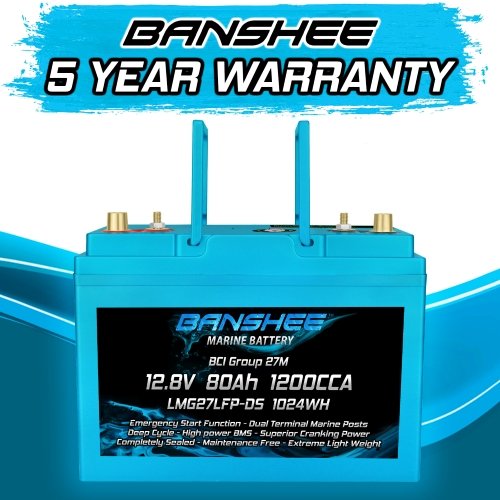
181
The appeal of a dual-purpose setup is straightforward: one battery handles your starting demands and your house loads.
What sets lithium apart from lead-acid is consistent performance across both functions without the usual trade-offs. A lithium Group 27 won't lose cranking power as it discharges, and it recovers quickly from deep cycles without sulfation damage.
Group 27 Marine Battery Dimensions and Fitment
Group 27 batteries measure roughly 12.1 inches long, 6.8 inches wide, and 8.3 inches tall, making them a direct replacement for standard Group 27 compartments on most boats. No custom brackets or extensive rewiring needed, the battery drops into existing spaces.
Terminal orientation matters more than many boat owners realize. Most Group 27 batteries use top terminals, which simplifies cable routing and keeps connections above bilge water.
Weight matters. Lithium Group 27 batteries typically weigh 25 to 30 pounds versus 60-plus for lead-acid at the same capacity. That difference affects handling, fuel efficiency, and installation ease, a genuine advantage when retrofitting older or weight-sensitive boats.
Verify compartment dimensions before purchasing. If you're unsure which battery fits your boat's specifications, Find the Right Battery at Bigtime Battery to match your exact compartment and power needs.
Marine Lithium Battery Starting Amps and Engine Cranking Power
Cranking amps measure a battery's ability to deliver high current during engine start. Cold cranking amps (CCA) and marine cranking amps (MCA) rate this at different temperatures, MCA at 32°F, CCA at 0°F.
A typical Group 27 lithium battery delivers 900 MCA or higher, which covers most outboard and inboard engines up to moderate displacement.
Lithium's advantage here is voltage stability. Lead-acid batteries sag under high starting loads, sometimes dropping below 9.6 volts during cranking. Lithium maintains voltage far better, so engine management systems and electronics get stable power during starts, reducing stress on starter motors and improving cold-weather reliability.
Deep-Cycle Capacity and Reserve Power for Marine Electronics
Deep-cycle capacity measures how much energy a battery delivers over extended use. Measured in amp-hours (Ah), a Group 27 lithium battery typically offers 80 to 100 Ah of usable capacity after safe discharge limits.
Reserve capacity (RC) describes how long a battery can supply 25 amps before dropping below 10.5 volts. Higher RC means longer runtime if the engine stops or the alternator fails. Lithium excels here, maintaining usable voltage across its full discharge range, unlike lead-acid, which loses voltage rapidly as it depletes.
For modern electronics, capacity matters enormously. A 100 Ah lithium battery sustains that for 5 to 10 hours depending on exact draw, plenty for serious fishing or cruising. Learn how to calculate your specific amp-hour requirements to right-size your battery.
Lithium vs Lead-Acid Marine Battery: What You Need to Know
The choice between lithium and lead-acid fundamentally changes your boating experience.
Lead-acid batteries suffer from sulfation when discharged deeply or left partially charged. This chemical buildup reduces capacity over time and eventually kills the battery.
Weight and space are secondary but real advantages.
The cost difference is real: lead-acid Group 27 batteries cost considerably less upfront. But that lower initial price ignores total cost of ownership.
Explore the detailed comparison between lithium and lead-acid options to understand which chemistry matches your boating style and budget.
12V 84Ah LiFePO4 Lithium Battery BCI Group 24, Trailer, RV, Motor Home, Marine →
Lithium and lead-acid batteries differ significantly in lifespan, weight, and total cost of ownership.
Factor | Lead-Acid | Lithium |
|---|---|---|
Typical lifespan | 3 to 5 years | 10 years or more |
Charge cycles | 500 to 1,000 | 3,000 to 5,000 |
Weight for Group 27 | 60+ pounds | 25 to 30 pounds |
Sulfation risk | Yes, from deep discharge | No, LiFePO4 chemistry resists degradation |
Upfront cost | Considerably less | Higher initial price |
Voltage consistency | Drops under load | Maintains voltage until nearly empty |
Group 27 Lithium Battery Charger Requirements and Alternator Compatibility
Lithium iron phosphate (LiFePO4) batteries do not follow the same charging logic as flooded, AGM, or gel lead-acid batteries.
Before you install a Group 27 lithium battery, confirm three things about your charging system:
- Charge profile support. The charger or shore-power unit should have a dedicated LiFePO4 mode or user-programmable voltages. If it only offers flooded/AGM/gel profiles, plan to replace it or add a lithium-compatible charger.
- Current limits. A Group 27 lithium battery in the 80 to 100 Ah range commonly accepts a charge current of 0.5C or more, meaning 40 to 50 amps is well within spec. Most onboard chargers are sized at 10 to 20 amps per bank, which is safe but slow; a 20-amp charger will take roughly four to five hours to replace a 50% depth-of-discharge on a 100 Ah battery.
- Termination behavior. Quality chargers stop or reduce current when the BMS signals full. Cheap chargers that keep pushing current rely entirely on the BMS to disconnect, which shortens cycle life over time.
Alternator charging is the part most owners underestimate. A stock marine alternator rated at 60 to 100 amps can deliver more current than a lithium battery should accept continuously without thermal management, and its internal regulator is set for lead-acid voltage.
Practical rule: if your charging system predates widespread LiFePO4 support, budget for a DC-to-DC charger rather than running the alternator directly.
Bigtime Battery's Group 27 lithium options include integrated battery management systems that handle overvoltage, overcurrent, and thermal cutoff, but the BMS is a safety layer, not a charging strategy. Pair the battery with a lithium-profile charger or DC-to-DC unit, and verify the combined system before your first trip. Make your purchase at bigtimebattery.com.
Cold-Weather Performance and Real-World Runtime
Cold weather affects lithium batteries in two distinct ways. Discharge performance drops modestly as temperatures fall, but charging below freezing is the real constraint: LiFePO4 cells shouldn't be charged below 32°F because lithium plating can form on the anode, permanently reducing capacity. Most quality Group 27 marine lithium batteries include a low-temperature charge cutoff in the BMS that blocks charging below that threshold while still allowing discharge.
Some premium units add internal heating, using a small amount of battery energy to warm the cells so charging can begin. If you boat in northern climates or store where temperatures routinely drop below freezing, prioritize self-heating. If you winterize and store the battery indoors, a standard low-temperature cutoff is sufficient.
Runtime is where marketing claims and real use diverge most. A Group 27 lithium battery rated at 100 Ah delivers roughly 80 to 90 Ah of usable energy if you discharge to about 10% state of charge, a safe everyday limit. To translate that into real boating, build a load list:
- A modern fish finder with sonar and GPS draws about 1 to 2 amps.
- A VHF radio on standby draws under 1 amp, but transmitting can spike to 5 amps.
- LED cabin and navigation lighting typically draws 1 to 3 amps total.
- A small 12-volt refrigerator cycles between 3 and 6 amps when running.
- A trolling motor is the wild card: a 55-pound-thrust unit can pull 40 to 50 amps at full power.
Add those loads, multiply by hours of use, and compare the total to usable amp-hours.
Temperature shifts those numbers: expect roughly 10 to 20% less usable capacity near freezing versus 77°F, and plan charging windows accordingly. Get specific tips on charging and maintaining marine batteries during winter months to keep your system reliable in cold climates.
Bigtime Battery's Group 27 lithium batteries are built for marine duty with BMS protection that includes low-temperature charge cutoff, and our team can help you match capacity to your real load profile. Make your purchase at bigtimebattery.com.
Conclusion: Why Bigtime Battery's Group 27 Lithium Options Stand Out
A Group 27 dual-purpose marine lithium battery simplifies your power system while delivering the reliability modern boaters need. Genuine starting power, deep-cycle capacity, and long lifespan make lithium the logical choice for serious boat owners.
Bigtime Battery stocks quality Group 27 lithium batteries including the 12V 84Ah LiFePO4 Lithium Battery and Banshee Battery 12V 84Ah INT Battery, both engineered for marine duty with integrated battery management systems and 5-year warranties. These batteries deliver consistent performance across starting and deep-cycle applications, backed by reliable support and competitive pricing.
Make your purchase at bigtimebattery.com and upgrade your marine power system with lithium reliability that lasts.
Frequently Asked Questions
Can a Group 27 lithium battery start a boat engine and power accessories at the same time?
Yes. A Group 27 dual-purpose marine lithium battery is engineered to handle both engine starting and deep-cycle loads. The starting power (measured in cranking amps) handles engine ignition, while the amp-hour capacity supports accessories like fish finders, navigation systems, and cabin lighting. This dual role eliminates the need for two separate batteries, saving space and weight on smaller boats. Bigtime Battery's 12V 84Ah lithium options deliver this versatility with reliable performance.
What charger do you need for a 12V marine lithium battery?
A 12V marine lithium battery requires a charger designed for lithium chemistry, not a standard lead-acid charger. Lithium chargers use a different voltage profile and charging curve to safely manage the battery's internal battery management system (BMS). Most marine lithium batteries, including Bigtime Battery's Group 27 options, are compatible with modern alternators in boats, but a dedicated lithium charger ensures faster, safer charging when docked. Always verify your charger's lithium compatibility before use.
Can you replace a lead-acid Group 27 marine battery with lithium?
In most cases, yes. A Group 27 lithium battery fits the same space as a traditional lead-acid Group 27, making it a drop-in replacement. However, verify terminal orientation and check that your boat's charging system is compatible with lithium chemistry. Lithium batteries are lighter and deliver more usable capacity than lead-acid, but they require a compatible charger and BMS monitoring. Bigtime Battery's Group 27 lithium batteries are designed for this transition, offering superior cycle life and reliability.
What should you compare when choosing a Group 27 dual-purpose marine battery?
Focus on four key factors: cold cranking amps (CCA) for starting power, amp-hour capacity (Ah) for deep-cycle runtime, weight and dimensions for fitment, and warranty length for long-term protection. Compare the usable capacity (not just rated Ah), battery management system features like Bluetooth monitoring, and whether the battery is certified for marine use. Price matters, but total cost of ownership—factoring in cycle life and durability—often favors lithium over lead-acid for serious boaters.
Feature | Group 27 Lithium | Group 27 Lead-Acid |
|---|---|---|
Typical Capacity | 80-100 Ah usable | 50 Ah usable |
Weight | 25-30 lbs | 60+ lbs |
Lifespan | 10+ years | 3-5 years |
Cold-Weather Starts | Excellent | Good |
Deep-Cycle Tolerance | Unlimited | 500-1,000 cycles |
Charging Time | 2-4 hours | 8-12 hours |