 comparison
5 Cold-Weather Battery Challenges That Snowmobile Riders Face
Last Updated: October 24, 2026
Quick Summary
A snowmobile battery must handle extreme cold, rapid starting loads, and subzero charging limits. AGM batteries charge safely below freezing and cost less upfront, while LiFePO4 batteries weigh less and last longer but cannot be charged below 32°F without risking permanent damage.
- LiFePO4 batteries cannot be charged below 32°F or lithium plating will permanently reduce capacity and void the warranty.
- AGM batteries tolerate freezing temperatures during charging and discharging with no special procedures required.
- LiFePO4 batteries typically last 8-10 years compared to AGM's 3-4 year lifespan, lowering long-term cost of ownership.
- A healthy 12-volt AGM rests around 12.6-12.8 volts when fully charged, while LiFePO4 typically rests around 13.2-13.4 volts.
- Most modern snowmobiles use YTX or YTZ series batteries; check your owner's manual to confirm the correct size and terminal type.
Table of Contents
- Why Snowmobile Battery Type Matters in Winter
- LiFePO4 Snowmobile Battery Cold Weather Performance
- AGM Batteries: The Traditional Cold-Weather Choice
- Snowmobile Battery Size and Fitment: Getting the Right Fit
- Snowmobile Battery Charging Requirements and Subzero Limits
- Cost, Cycle Life, and Total Value Over Time
- Choose Your Snowmobile Battery at Bigtime Battery
- Frequently Asked Questions
Why Snowmobile Battery Type Matters in Winter
When you're riding in subzero conditions, your snowmobile battery faces challenges that few other applications encounter. Cold temperatures drain power faster, starting loads spike dramatically, and a weak battery can leave you stranded miles from help. Choosing the right snowmobile battery chemistry matters more than most riders realize.
The two main options, AGM and LiFePO4, handle winter differently. Each has real strengths and genuine limitations in cold weather. Understanding those differences helps you pick a battery that won't fail when you need it most.
The choice between AGM and LiFePO4 comes down to your priorities: upfront cost and proven reliability, or lighter weight and longer lifespan.
LiFePO4 Snowmobile Battery Cold Weather Performance
LiFePO4 batteries behave very differently from lead-acid in subzero conditions, and the differences matter most at the moment you hit the starter.
The real appeal for riders is weight and usable capacity. A LiFePO4 battery of comparable group size typically weighs meaningfully less than an AGM equivalent, which improves handling and reduces the mass hanging off the tunnel. LiFePO4 also tolerates deeper discharges without the sulfation damage that shortens AGM life, so you get more usable capacity from the same nominal amp-hour rating.
Here is the mechanism most reviews skip: LiFePO4 must not be charged below freezing. Charging a lithium iron phosphate cell below 32°F (0°C) can cause lithium plating on the anode, which permanently reduces capacity and can create an internal short.
What that means on the snow: a LiFePO4 battery can often start a cold engine because discharge is permitted below freezing, but if the pack itself is cold-soaked, you should not plug in a charger until it warms above the cutoff. Many riders bring the battery indoors overnight or use a temperature-controlled garage before recharging.
A common pattern riders report is stronger recovery after a hard start: LiFePO4 tends to bounce back from a deep voltage sag faster than AGM, which helps on repeated restart cycles during a cold ride. That recovery speed is genuinely useful for snowmobiles that get shut off and restarted frequently in extreme cold.
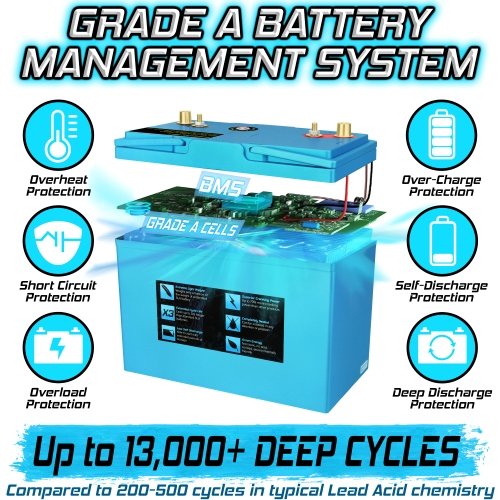
The Banshee YTX20H-BS LiFePO4 battery from Bigtime Battery is purpose-built for snowmobile applications, with high cold-cranking amps, a compact form factor that fits standard mounting points, and a BMS that manages charge and discharge protection. It comes with a 2-year replacement warranty and a 30-day money-back guarantee, so you can test it on your machine with confidence. Make your purchase at bigtimebattery.com.
AGM Batteries: The Traditional Cold-Weather Choice
AGM (absorbed glass mat) batteries have been the standard for snowmobiles for decades, and there's a reason: they work reliably in cold. Batteries Plus recommends AGM specifically for snowmobiles, and Lifeline describes its AGM products as heavy-duty with thick casings that protect against low temperatures Batteries Plus snowmobile battery selection guide.
AGM batteries tolerate freezing temperatures during charging and discharging. You can charge one in your garage in January without worrying about internal damage. That simplicity appeals to riders who want to maintain their battery without special procedures.
Banshee YTX20H-BS LiFEPO4 Sealed Battery High CCA ATV UTV Snowmobile Motorcycle →
The trade-off is weight and longevity. An AGM battery is heavier than LiFePO4, which affects your snowmobile's handling and fuel economy. The cycle life is also shorter, after several seasons of regular use, you'll likely need replacement.
AGM has an advantage in standby applications. If your snowmobile sits unused for weeks between rides, AGM self-discharge is modest (roughly 1-3% per month), so your battery won't drain dangerously during storage. That matters for seasonal riders who store machines for months at a time.
The PowerStar RBC4 12V 15Ah SLA sealed lead-acid AGM battery from Bigtime Battery delivers the reliability AGM riders expect. At 9.6 pounds, it fits standard battery boxes and comes with a 3-year warranty. For riders who value simplicity and proven cold-weather performance, this is the straightforward choice.
Snowmobile Battery Size and Fitment: Getting the Right Fit
Your snowmobile's electrical system was engineered for a specific battery size and terminal configuration. Installing the wrong battery can cause starting problems, poor charging, or terminal corrosion.
Most modern snowmobiles use YTX or YTZ series batteries, which are compact and sealed. Older machines may use larger Group 27 or Group 30 batteries. Check your owner's manual or the original battery label for the correct designation.
Terminal type matters too. Some snowmobiles use T2 or F2 terminals, while others use stud terminals. A mismatch means you'll need adapters, which add resistance and reduce starting power. Measure twice before ordering.
Both the Banshee LiFePO4 and PowerStar AGM options available at Bigtime Battery fit standard YTX20H-BS applications. If your machine uses a different size, our team can help you identify the right fit, check our Find the Right Battery guide to match your specific model and year.
Snowmobile Battery Charging Requirements and Subzero Limits
Your snowmobile's charging system typically regulates to roughly 14-15 volts, which is compatible with both AGM and LiFePO4 batteries, but the similarities end there once temperatures drop. The charging voltage is not the problem; the battery's internal temperature is.
AGM batteries can be charged at any temperature a rider is likely to encounter. If the battery is cold, charging still works safely, though charge acceptance slows. That simplicity is why AGM remains the default for riders who charge in an unheated garage or shed.
LiFePO4 batteries cannot be charged below freezing. The BMS on a quality pack will block charge current when the internal temperature sensor reads below the safe threshold, commonly around 32°F (0°C), though the exact cutoff varies by manufacturer. If the BMS does not block it, charging a cold lithium pack causes lithium plating on the anode, permanently reducing capacity and potentially creating an internal short.
This creates a practical winter workflow. If you ride in deep cold and the battery cold-soaks, bring it indoors overnight or place it in a temperature-controlled space before plugging in a charger. Do not rely on a heat lamp aimed at the case, uneven heating can leave internal cells colder than the case surface, and the BMS reads cell temperature, not case temperature.
Seasonal storage is where the two chemistries diverge again. AGM self-discharge is modest, roughly 1-3% per month, so a fully charged AGM battery stored in a cool, dry place will usually hold enough charge for a spring start. LiFePO4 self-discharge is even lower, but the storage rule is different: store a LiFePO4 pack at a partial charge (many manufacturers recommend roughly 50-60% state of charge for long storage) rather than full, and never store it fully discharged.
Before the first ride of the season, check resting voltage with a multimeter. A healthy 12-volt AGM should rest around 12.6-12.8 volts fully charged; a 12-volt LiFePO4 typically rests higher, often around 13.2-13.4 volts, because of its flatter discharge curve. A pack that reads well below those figures after a full charge is a candidate for replacement, not another season of hope.
If you plan to charge outside or in an unheated garage through winter, AGM is the lower-friction choice. If you can warm your battery before charging and want the weight and lifespan benefits, LiFePO4 works well, provided the pack has low-temperature charge protection. The Banshee YTX20H-BS LiFePO4 and the PowerStar RBC4 AGM, both available at Bigtime Battery, cover those two paths. Make your purchase at bigtimebattery.com.
Banshee YTX20H-BS LiFEPO4 Sealed Battery High CCA ATV UTV Snowmobile Motorcycle →
How to Safely Store Powersports Batteries guide covers best practices for maintaining either battery type through winter storage.
Cost, Cycle Life, and Total Value Over Time
Upfront price is where AGM wins decisively. The PowerStar RBC4 costs $48.35, making it an affordable entry point for riders on a budget. You can replace it every few seasons without major expense.
The Banshee LiFePO4 costs $185.88, nearly four times more. That higher price reflects the chemistry: lithium batteries cost more to manufacture, and they last longer.
Over a decade, the math shifts. An AGM battery might need replacement every 3-4 years, while a LiFePO4 battery often lasts 8-10 years or longer under normal use. If you keep your snowmobile for a long time, the LiFePO4 total cost of ownership can be lower despite the higher initial price.
Cycle life, how many charge and discharge cycles a battery survives, is where LiFePO4 shines. These batteries tolerate deep discharges far better than AGM. If you regularly run your battery down and recharge it, LiFePO4 holds up better.
For casual riders who use their snowmobile a few times per season, AGM is the practical choice. The lower upfront cost and simpler maintenance offset the shorter lifespan. For enthusiasts who ride frequently and keep machines for many years, LiFePO4 makes financial sense over time.
| Feature | AGM (PowerStar) | LiFePO4 (Banshee) |
|---|---|---|
| Upfront Cost | $48.35 | $185.88 |
| Cold-Weather Charging | Safe below freezing | Requires warmth above 32°F |
| Weight | 9.6 lbs | Lighter (lithium) |
| Cycle Life | 3-4 years typical | 8-10 years typical |
| Maintenance | Minimal | Battery management system |
| Best For | Budget-conscious, seasonal riders | Frequent riders, long-term ownership |
Choose Your Snowmobile Battery at Bigtime Battery
Picking the right snowmobile battery means matching the chemistry to how you ride and what you can afford. AGM batteries offer proven cold-weather reliability and low cost. LiFePO4 batteries deliver lighter weight, longer life, and faster recovery after starting, if you're willing to manage the subzero charging limitation.
At Bigtime Battery, we stock both options so you can choose what fits your machine and your riding style. The Banshee YTX20H-BS LiFePO4 battery delivers lithium performance for serious riders. The PowerStar RBC4 AGM battery provides traditional reliability at an affordable price. Both come with warranties and our 30-day money-back guarantee.
Make your purchase at bigtimebattery.com and get the battery your snowmobile needs for winter riding. Whether you choose AGM or LiFePO4, you'll have the power to start reliably in subzero conditions.
Frequently Asked Questions
What kind of battery does a snowmobile use?
Most snowmobiles use either AGM (absorbed glass mat) or LiFePO4 (lithium iron phosphate) batteries. AGM batteries are the traditional choice and are recommended by many snowmobile manufacturers due to their proven cold-weather reliability and rugged construction. LiFePO4 batteries offer lighter weight and longer cycle life but require compatible charging systems. Both types come in standardized sizes like YTX20H-BS to fit common snowmobile models. Check your owner's manual or current battery for the correct size and chemistry for your specific machine.
Are AGM or LiFePO4 batteries better for snowmobiles?
AGM batteries are highly recommended for snowmobiles because they tolerate extreme cold, handle the vibration and shock of off-trail riding, and work with standard snowmobile charging systems without modification. LiFePO4 batteries offer advantages in weight reduction and usable capacity, making them appealing for riders who upgrade their electrical systems. The better choice depends on your riding style, budget, and willingness to upgrade your charger. AGM provides proven reliability; LiFePO4 provides modern performance if your snowmobile's alternator supports it.
How does cold weather affect LiFePO4 snowmobile batteries?
LiFePO4 batteries lose usable capacity in subzero temperatures because chemical reactions slow down in extreme cold. Most LiFePO4 batteries include low-temperature cutoff protection that prevents charging below 32°F to avoid internal damage. This means you cannot charge a LiFePO4 battery outdoors during a snowmobiling trip if the air temperature is freezing. AGM batteries, by contrast, tolerate cold charging and discharging better, making them more practical for backcountry use where you cannot control charging conditions.
Can a snowmobile charge a LiFePO4 battery?
The Banshee YTX20H-BS LiFEPO4 battery at bigtimebattery.com is engineered for high-CCA applications and comes with guidance on compatible charging systems.