 comparison
How to Compare ATV Replacement Battery Types
Table of Contents
- ATV Battery Types: Lead-Acid, AGM, and Lithium Compared
- Flooded vs. AGM ATV Battery: Which Chemistry Fits Your Ride?
- AGM vs. Lithium ATV Battery: Weighing Weight, Cost, and Cold Starts
- ATV Battery Group Size and Fitment: Reading the Label Correctly
- ATV Battery Cold Cranking Amps: Why CCA Matters for Starting Power
- Charging System Compatibility and Total Cost of Ownership
- Seasonal Storage, Extreme Temperatures, and Safe Installation
- Conclusion: Picking the Right ATV Replacement Battery
- Frequently Asked Questions
Last Updated: October 16, 2026
ATV Battery Types: Lead-Acid, AGM, and Lithium Compared
Learning how to compare ATV replacement battery types starts with one hard fact: three chemistries dominate the market, and each fails differently.
An ATV battery is a 12-volt rechargeable power source that stores energy for starting the engine and running accessories. The chemistry inside determines how well it handles vibration, cold, and sitting unused.
The Battery Council International overview of lead battery types explains how these chemistries differ at a basic level.
Conventional Lead-Acid (Flooded) Batteries
A conventional flooded battery holds liquid electrolyte you top off with distilled water. They are cheapest upfront but maintenance-hungry: they lose water faster in summer, struggle in cold starts, and self-discharge if your ATV sits for weeks.
AGM (Absorbed Glass Mat) Batteries
An AGM battery suspends the electrolyte in fiberglass mats instead of free liquid, delivering no water checks, no spills, and strong vibration resistance. Sealed and angle-mountable, AGM holds a charge longer in storage and cranks harder in cold than flooded units, the chemistry most riders should default to. Our Shotgun YTX5L-BS AGM battery is a sealed, maintenance-free 12V 4Ah unit rated at 70 CCA for ATVs, motorcycles, and snowmobiles.
Lithium-Ion Batteries
A lithium-ion battery replaces lead plates with lithium cells and adds a battery management system to control voltage. The payoff is dramatic weight savings and fast recovery after discharge. The catch is cost and charging-system compatibility: lithium needs charging voltage within a specific range, and older ATV systems may not deliver it. In extreme cold, cranking stays weak until the battery warms up.
Battery Type | Maintenance | Weight | Cold Cranking | Typical Cost |
|---|---|---|---|---|
Flooded lead-acid | Water top-offs | Heaviest | Weakest in cold | Lowest |
AGM | None | Moderate | Strong | Moderate |
Lithium-ion | None | Lightest | Varies with temperature | Highest |
Flooded vs. AGM ATV Battery: Which Chemistry Fits Your Ride?
Flooded versus AGM comes down to how much maintenance you will actually do. Check water levels monthly and ride in mild conditions, and flooded works. Want to install it and forget it?
The differences that matter most:
- Electrolyte: flooded uses free liquid; AGM traps it in glass mats.
- Maintenance: flooded needs water top-offs; AGM needs none.
- Spill risk: flooded can leak if tipped; sealed AGM cannot.
A common mistake is buying flooded to save a few dollars, then letting the water level drop. That shortens service life fast. For most trail riders, AGM is the smarter buy.
AGM vs. Lithium ATV Battery: Weighing Weight, Cost, and Cold Starts
AGM versus lithium is a trade between price and performance. Lithium weighs far less and recharges quickly, which matters on race quads where every pound counts.
Where lithium falls short is cold-weather performance and charging compatibility. Many stock ATV charging systems were designed around lead-acid voltage ranges, so a lithium battery may need a compatible charger or regulator. AGM simply drops in.
For most recreational riders, AGM delivers the best balance. For weight-obsessed racers, lithium earns its price.
ATV Battery Group Size and Fitment: Reading the Label Correctly
Group size and fitment decide whether a battery physically fits and connects properly.
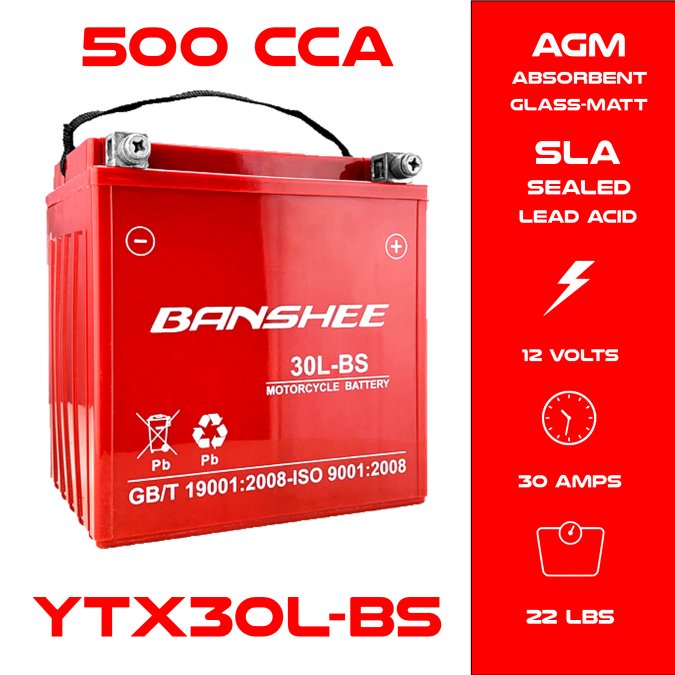
Start with the reference code stamped on the old battery, such as YTX5L-BS, it tells you case dimensions and terminal arrangement. Then measure your battery box and confirm the terminal layout.
Banshee YTX30L-BS YIX30L-BS AGM Battery ForPowersports Atv/Utv & Harley Davidson →
Terminal Layout and Polarity
Polarity refers to which side the positive and negative posts sit on. Our Shotgun YTX5L-BS uses a [- +] terminal layout, negative left, positive right as marked. Reverse the cables and it will not connect without modification. Always match the label, not just the size.
ATV Battery Cold Cranking Amps: Why CCA Matters for Starting Power
Cold cranking amps measure how much current a battery delivers at cold temperatures for 30 seconds. Higher CCA means stronger cold starts; too little may crank slowly or fail entirely on a frosty morning.
Match CCA to your engine size and climate. The PowerStar 12V 9Ah SLA battery offers higher amp-hour capacity for accessories and comes with a two-year warranty.
Do not chase the highest CCA blindly. Oversized batteries add weight and may not fit.
Charging System Compatibility and Total Cost of Ownership
Total cost of ownership goes beyond sticker price: how long the battery lasts, how much maintenance it needs, whether your charging system supports it, and what you spend on chargers and replacements over several seasons. Two riders can buy the same chemistry and end up with very different cost-per-season results based on how they ride and store the machine.
Charging Voltage: The Spec That Decides Compatibility
Every ATV charging system is built around a target voltage range, and the chemistry you install must live inside it.
- Flooded lead-acid and AGM are designed for a charging system that holds roughly 13.8 to 14.4 volts during operation. Most stock ATV regulators are set up for this window, which is why AGM is effectively a drop-in replacement.
- Lithium-ion needs a narrower, more tightly controlled charging profile. Many lithium powersport batteries rely on an internal battery management system (BMS) to balance cells and cut off overcharge, but the BMS can only work with the voltage it receives. If your regulator pushes voltage above the lithium battery's accepted ceiling, the BMS may disconnect the battery to protect it, and you get a no-start.
A common pattern: a rider installs lithium on an older ATV, gets great results for a season, then the battery refuses to crank after a long high-RPM ride.
Before buying lithium, check three things:
- Your ATV's regulated charging voltage at the battery terminals with the engine running.
- The lithium battery's stated maximum charging voltage.
- Whether the manufacturer recommends a lithium-specific regulator or charger.
If you cannot confirm all three, AGM is the safer choice. Our Shotgun YTX5L-BS AGM battery is built for stock charging systems, so it drops in without regulator changes.
A Simple Cost-Per-Season Framework
Purchase price alone tells you almost nothing. Compare chemistries on cost per riding season:
Cost Factor | Flooded Lead-Acid | AGM | Lithium-Ion |
|---|---|---|---|
Upfront price | Lowest | Moderate | Highest |
Expected service life | Shortest | Long | Longest |
Maintenance cost | Water, recharges | None | None |
Charger requirement | Basic maintainer | Basic maintainer | Often lithium-specific |
Replacement frequency | Highest | Moderate | Lowest |
A flooded battery that costs the least but needs replacing every couple of seasons can cost more per year than an AGM that lasts several seasons with no attention. Lithium wins on lifespan and weight but only pays off if your charging system supports it and you keep the machine long enough to amortize the higher upfront price.
The Charging Equipment You Actually Need
- Flooded and AGM: a standard 12-volt maintainer keeps them topped off during storage. No special profile required.
- Lithium: a charger with a lithium-specific profile. A lead-acid charger can overcharge a lithium battery or fail to bring it to full charge, and either outcome shortens life.
If you already own a lead-acid maintainer, factor a lithium-compatible charger into your decision, that accessory often erases lithium's long-term savings for casual riders.
For riders who want a no-headache replacement, our PowerStar 12V 9Ah SLA battery offers higher amp-hour capacity for accessories and comes with a two-year warranty, a straightforward upgrade path when you are not ready to re-engineer the charging system.
Seasonal Storage, Extreme Temperatures, and Safe Installation
Most ATV batteries do not die from wear, they die from how they are stored and installed. Heat, cold, parasitic drain, and a sloppy cable order all shorten service life in ways the chemistry comparison alone will not show you.
12V 28Ah (PbEq) 680CCA LiFePO4 Lithium Motorcycle Battery, Replaces YTX30HL-BS & YTX30L-BS →
How Temperature Actually Affects Each Chemistry
- Heat accelerates self-discharge and grid corrosion in flooded and AGM batteries. A battery left in a hot garage all summer loses charge faster and ages quicker than one kept cool.
- Cold reduces the chemical reaction rate inside every chemistry, lowering available cranking amps. A flooded battery that cranks fine at 70°F may struggle at 20°F. AGM holds up better in cold because its electrolyte is immobilized and its internal resistance is lower. Lithium delivers reduced cranking power until the cells warm up.
- Parasitic drain is the silent killer. Clocks, ECUs, and accessories pull a small current even when the ATV is off. Over weeks of storage, that drain can take a battery below the voltage it needs to crank.
Storage Charge Targets by Chemistry
Storing a battery at the wrong state of charge is the most common storage mistake. Targets differ by chemistry:
- Flooded lead-acid: charge fully, then top off with a maintainer. Check water level before storage and top off with distilled water if low.
- AGM: charge fully and connect a maintainer. AGM holds charge longer than flooded, but it still self-discharges over months.
- Lithium-ion: store at a partial charge rather than full, following the manufacturer's recommendation. Leaving a lithium battery at 100% for months can stress the cells, and leaving it fully drained can damage the BMS.
A maintainer is the simplest way to handle all three: it keeps the battery at the correct voltage without overcharging, which a trickle charger can do if left connected too long.
A Storage Checklist That Works for Any Chemistry
- Remove the battery from the ATV if the machine will sit for more than a month.
- Clean the terminals and case with a dry cloth, never let moisture sit on the posts.
- Charge to the correct storage level for the chemistry.
- Store in a cool, dry place away from direct sun and temperature swings.
- Connect a maintainer, or recharge every few weeks if you do not have one.
- Check voltage before reinstalling. If it has dropped noticeably, recharge before cranking.
Safe Removal and Installation
Cable order matters more than most riders realize. Disconnect the negative cable first and reconnect it last. That sequence prevents a wrench from bridging the positive post to the frame and causing a short.
Other installation basics:
- Wear eye protection and gloves. Lead-acid batteries contain sulfuric acid, and even sealed AGM batteries can vent under fault conditions.
- Never lay a tool across the terminals. A dropped wrench across both posts can arc, melt metal, and rupture the case.
- Match the terminal layout to the old battery. Our Shotgun YTX5L-BS uses a [- +] layout, meaning negative on the left and positive on the right as marked. Reversed polarity can damage the ATV's electrical system.
Disposal and Recycling
Lead-acid batteries, flooded and AGM, are among the most recycled products in the country. Most auto parts stores and many battery retailers accept them for recycling. Never put a lead-acid battery in household trash.
Lithium-ion batteries need different handling. Do not place them in curbside recycling. Take them to a retailer or facility that accepts lithium batteries, and tape the terminals before transport to prevent shorts.
When you are ready to replace, our Shotgun YTX5L-BS AGM battery is a sealed, maintenance-free 12V 4Ah unit rated at 70 CCA, built for ATVs, motorcycles, and snowmobiles, and it stores and installs with none of the water-level or spill concerns of a flooded battery. Make your purchase at bigtimebattery.com.
Conclusion: Picking the Right ATV Replacement Battery
Choosing the right ATV replacement battery comes down to matching chemistry, group size, terminal layout, and CCA to how you actually ride.
We built Bigtime Battery to make that match simple. Our one-stop shop carries a wide selection of replacement batteries, from sealed AGM powersport units to SLA batteries for accessories, each shipping with the specs you need to confirm fitment before you buy.
Ready to stop guessing? Make your purchase at bigtimebattery.com and get reliable power for your ATV.
Frequently Asked Questions
What is the best ATV battery for the money?
For most riders, an AGM battery offers the best balance of price and performance. Sealed AGM options resist vibration and never need water top-offs. The Shotgun YTX5L-BS delivers 12V, 4Ah, and 70 CCA for $34.70. The PowerStar 12V 9Ah SLA offers more capacity at $40.80. Both are available at bigtimebattery.com.
Can you replace an ATV lead-acid battery with a lithium battery?
Yes, but check your charging system first. Lithium batteries need a charger that matches their voltage profile, and some older ATV regulators do not. Confirm the lithium battery fits your group size and terminal layout before buying. If your charging system is not compatible, a sealed AGM battery is the safer drop-in choice.
How long do ATV batteries typically last?
A conventional flooded battery usually lasts 2 to 3 years with regular maintenance. AGM batteries often reach 3 to 5 years because they resist vibration and self-discharge. Lithium batteries can last longer but cost more upfront. Seasonal storage habits and charging-system health affect lifespan more than chemistry alone.
How can you tell the difference between ATV battery types?
Check the label and case. Flooded batteries have removable caps for water. AGM batteries are sealed with no caps and often say absorbed glass mat. Lithium batteries are noticeably lighter and list lithium-ion chemistry. The reference code, such as YTX5L-BS, also tells you the group size and terminal layout.