 comparison
LiFePO4 Marine Battery Bulk Review: 2026 Guide
Table of Contents
- Why LiFePO4 Marine Batteries Matter for Bulk Orders
- Best Marine LiFePO4 Battery Options: Capacity and Voltage Breakdown
- 12V 100Ah LiFePO4 Marine Battery Review: Performance vs. Lead-Acid
- Marine Lithium Battery BMS Features and Monitoring
- LiFePO4 Marine Battery Charging Requirements and Compatibility
- Bulk Purchasing Economics: Volume Discounts and Total Cost of Ownership
- Installation, Safety, and Marine Environment Considerations
- Frequently Asked Questions
Last Updated: October 8, 2026
Why LiFePO4 Marine Batteries Matter for Bulk Orders
In a marine operation, every decision compounds. A single battery choice affects runtime, weight, maintenance costs, and replacement cycles for years, and for bulk orders, that multiplication factor is critical. LiFePO4 marine battery technology has changed what's possible at scale.
LiFePO4 battery packs are estimated to account for 38.0% of marine battery-pack chemistry demand in 2026, according to Future Market Insights' Marine Battery Packs Market analysis. This shift isn't accidental. The chemistry delivers three times the energy density of lead-acid while weighing one-third as much. For fleets, ferries, or commercial operations, that weight reduction translates directly to fuel savings and increased payload capacity.
The real advantage emerges in volume. Bulk purchasing of LiFePO4 marine batteries unlocks economies of scale single-unit pricing can't match, but it means restructuring your power infrastructure, which requires understanding capacity options, voltage configurations, and BMS features before you commit.
Below: the options, the performance metrics that matter, and the total cost of ownership math.
Best Marine LiFePO4 Battery Options: Capacity and Voltage Breakdown
Marine applications demand specific voltage and capacity combinations. The most common are 12V for smaller vessels and auxiliary power, and 36V for trolling motors and primary house batteries. Each voltage class serves distinct use cases; capacity within it determines runtime.
36V 105Ah Deep Cycle Option
The 36V 105Ah configuration is the workhorse capacity for serious marine operations, supporting high-power trolling motors and primary propulsion on mid-sized vessels. At 105 amp-hours, runtime stays substantial even under heavy load.
The Banshee Lithium 36V 105Ah Deep Cycle Marine Trolling Motor Single Battery and Charger delivers this capacity with internal battery management system protection and a 5-year warranty. At $765.55 per unit, it offers eight times the cycle life of equivalent lead-acid batteries.
Weight savings matter: a 36V 105Ah LiFePO4 system weighs roughly one-third of a comparable lead-acid bank, freeing payload and cutting fuel consumption on larger vessels.
36V 100Ah Replacement Option
The Banshee Replacement for Skinny Water Marine 36V 100AH DEEP CYCLE LiFePo4 BATTERY is a direct substitute for legacy marine systems. At $699.00, it undercuts the 105Ah variant while delivering nearly identical performance for most applications.
This option suits retrofits: 100Ah maintains compatibility with original system designs while upgrading from lead-acid to lithium, so you gain the weight and cycle-life advantages without redesigning your electrical layout.
It's especially valuable for bulk orders standardizing a mixed fleet, one SKU simplifies inventory and reduces maintenance-crew training overhead.
12V 84Ah Starting and House Battery
The Banshee Battery 12V 84Ah INT Battery Replaces BCI Group 24M Starting Marine & RV fills the gap for smaller vessels, auxiliary systems, and hybrid applications. At $299.55, it's the entry point for LiFePO4 marine battery adoption.
This 12V configuration works as a house battery for lighting, navigation, and cabin power, or as a starting battery for auxiliary engines. Its 84Ah capacity delivers 1,000+ watt-hours, a day of moderate use on most recreational boats, and multiple units wire in parallel for commercial capacity.
The BCI Group 24M form factor fits existing battery boxes on many vessels with no structural modification, making this the fastest upgrade path for existing fleets.
12V 100Ah LiFePO4 Marine Battery Review: Performance vs. Lead-Acid
Comparing LiFePO4 to lead-acid shows why the chemistry now dominates marine applications: cycle life, weight, maintenance, and total cost of ownership all diverge.
Lead-acid delivers 300-500 cycles before severe degradation; a LiFePO4 marine battery achieves 3,000-5,000 under equivalent conditions, a 10x difference. At 200 cycles annually, lead-acid needs replacement every 2-3 years while LiFePO4 lasts 15-25 years. Fewer replacements mean lower total cost despite higher upfront investment.
Banshee Lithium 36V 105Ah Deep Cycle Marine Trolling Motor Single Battery →
Weight savings compound: a 12V 100Ah lead-acid battery weighs about 60 pounds versus 25 for the LiFePO4 equivalent. Across multiple banks, that 35-pound-per-unit savings multiplies, lighter boats accelerate faster, burn less fuel, and carry more payload.
Maintenance diverges sharply. Lead-acid demands water top-ups, terminal cleaning, and equalization charging; LiFePO4 requires none of it, with a built-in BMS handling charge regulation automatically. For fleets managing dozens of vessels, that elimination alone justifies the upgrade.
Marine Lithium Battery BMS Features and Monitoring
The battery management system is the invisible component that makes LiFePO4 marine batteries safe and reliable, monitoring voltage, current, and temperature in real time against overcharge, over-discharge, and thermal runaway.
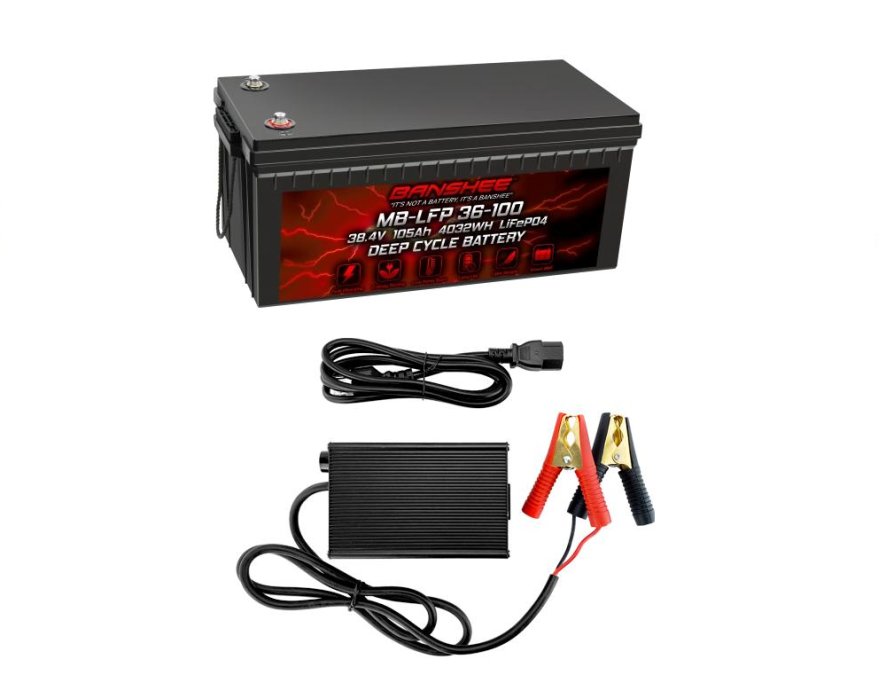
The Banshee Bluetooth LiFePO4 Battery Smart 36V 105Ah includes integrated Bluetooth and mobile app monitoring, so you can check state of charge, voltage, and temperature anywhere on the vessel or from shore.
Low-temperature protection blocks charging below safe ranges, high-temperature protection limits discharge current if the battery overheats, and internal heating circuits on premium models maintain optimal temperature in cold water.
Peak current capacity matters for starting applications. The Banshee 36V 105Ah system delivers 500A peak current, sufficient for trolling motor acceleration and auxiliary engine starting. This specification ensures the battery responds instantly to demand without voltage sag.
A quality BMS also guards against overcharge and over-discharge. Unlike lead-acid, where overcharging just wastes energy as heat, LiFePO4 overcharge permanently damages the chemistry, the BMS prevents it by cutting charge current at full capacity.
LiFePO4 Marine Battery Charging Requirements and Compatibility
LiFePO4 batteries need a different charging profile than lead-acid. Standard lead-acid chargers apply voltage too high for lithium, causing overcharge and premature failure, use a LiFePO4-configured charger or a smart charger with switchable profiles.
The Banshee systems from Bigtime Battery ship with compatible chargers that match the battery's requirements. This removes guesswork. If you're retrofitting existing systems, verify your charger supports LiFePO4 charging before connecting a new battery.
Charging efficiency affects energy cost: LiFePO4 charges at 95-98% efficiency versus 80-85% for lead-acid, and over thousands of cycles that gap compounds into significant operational savings.
Charging time varies by charger capacity: a 50A charger fills a 12V 84Ah battery in roughly 2 hours, a 20A charger in 5. Faster charging means higher availability and lower idle time, so bulk purchases should include appropriately sized chargers.
Temperature during charging affects longevity. LiFePO4 charges most safely between 32°F and 104°F; outside that range the BMS slows or pauses charging automatically, preventing damage that would shorten cycle life.
Bulk Purchasing Economics: Volume Discounts and Total Cost of Ownership
Bulk orders change the cost structure fundamentally. Single-unit pricing rarely reflects what you pay when ordering 10, 50, or 100 batteries; volume discounts typically range from 5% to 20% depending on order size and supplier terms.
At Bigtime Battery, bulk pricing scales with commitment. A 10-unit order of the Banshee 36V 105Ah at $765.55 each costs $7,655.50 before discount. A 50-unit order typically qualifies for volume pricing that reduces per-unit cost by 10-15%, bringing the effective price to $650-690 per battery. That's $32,500-34,500 for 50 units, a savings of $3,800-5,775 versus retail pricing.
Total cost of ownership extends beyond battery price: chargers, installation labor, shipping, and replacement scheduling. A single 36V system needs three chargers for independent charging, and a 50-unit pallet might cost $500-800 to deliver, $10-16 per battery.
Replacement scheduling creates predictability: at 200 cycles annually, a 3,000-cycle battery lasts 15 years, so plan to replace 1/15th of your fleet each year, steady-state budgeting that prevents sudden capital spikes.
The break-even analysis favors LiFePO4 decisively. A 12V 84Ah lead-acid system costs roughly $150-200 and lasts 3 years. That's $50-67 per year in battery cost. The equivalent LiFePO4 from Bigtime Battery costs $299.55 and lasts 15+ years, or $20 per year. Over a 15-year horizon, the lithium option saves $450-705 per battery location. Scale that across a 50-vessel fleet, and you're looking at $22,500-35,250 in total savings.
Banshee Lithium 36V 105Ah Deep Cycle Marine Trolling Motor Single Battery →
Installation, Safety, and Marine Environment Considerations
Marine environments stress battery systems with salt spray, vibration, temperature swings, and moisture. LiFePO4 chemistry is inherently more stable than lead-acid under these conditions, but installation still matters.
Proper ventilation prevents heat buildup.
Vibration isolation protects the battery and vessel.
Saltwater exposure requires regular inspection. Lithium terminals don't corrode like lead-acid, but salt spray degrades connectors and monitoring cables, rinse terminals annually with fresh water and apply dielectric grease.
Temperature management extends cycle life.
Grounding and electrical safety follow standard marine practice: ground the battery bank to the vessel's electrical system and use marine-grade cables rated for peak current.
During installation, disconnect existing power sources before swapping batteries. LiFePO4 is safer than lead-acid, but electrical hazards remain, follow manufacturer instructions for your charger and BMS configuration.
Choosing the right LiFePO4 marine battery for bulk orders means matching capacity and voltage to your operational requirements, then calculating total cost of ownership across your fleet's lifecycle. The Banshee options at Bigtime Battery cover the most common configurations: 36V 105Ah for trolling motors and primary power, 36V 100Ah for direct lead-acid replacements, and 12V 84Ah for auxiliary systems and smaller vessels.
The economics strongly favor LiFePO4. Higher upfront cost is offset by cycle life 10 years longer than lead-acid, weight reduction that improves fuel efficiency, and maintenance elimination that cuts overhead.
Volume purchasing amplifies these advantages: bulk orders unlock per-unit pricing that makes the transition affordable, and standardized SKUs simplify training, inventory, and maintenance.
Start with your current power requirements: identify the voltage and capacity you need, then reach out to Bigtime Battery to discuss fleet size and usage patterns.
Battery Model | Voltage | Capacity | Price | Best For | Cycle Life |
|---|---|---|---|---|---|
Banshee 36V 105Ah Deep Cycle | 36V | 105Ah | $765.55 | Trolling motors, primary house power | 3,000-5,000 cycles |
Banshee 36V 100Ah Replacement | 36V | 100Ah | $699.00 | Direct lead-acid replacements | 3,000-5,000 cycles |
Banshee 12V 84Ah Starting/House | 12V | 84Ah | $299.55 | Auxiliary power, smaller vessels | 3,000-5,000 cycles |
The choice to upgrade is ultimately about operational efficiency and cost control. LiFePO4 marine batteries from Bigtime Battery deliver both.
Frequently Asked Questions
What is the best marine LiFePO4 battery for bulk orders?
The best marine LiFePO4 battery depends on your vessel's power needs and starting vs. house battery requirements. For deep-cycle trolling motors and house banks, the Banshee 36V 105Ah option ($765.55 per unit) offers three times the energy and one-third the weight of lead-acid, with an eight-times longer lifespan. For dual-purpose starting and house applications, the 12V 84Ah option ($299.55) provides reliable performance in a compact form factor. LFP batteries are estimated to account for 38% of marine battery-pack chemistry demand in 2026, reflecting their growing adoption for reliability and cost efficiency over time.
Do marine LiFePO4 batteries require special charging equipment?
Yes, LiFePO4 marine batteries require a compatible charger with the correct charge profile. Unlike lead-acid, LiFePO4 uses constant voltage charging at a lower final voltage (typically 14.4V for 12V systems). Most modern marine chargers support LiFePO4 profiles, but you must verify compatibility before purchasing. Banshee batteries come with appropriate chargers designed for their voltage and capacity specifications. Always confirm your existing charger's LiFePO4 compatibility or invest in a dedicated charger to ensure safe, efficient charging and protect your battery investment.
What BMS features matter most in a marine LiFePO4 battery?
Critical BMS features for marine use include low-temperature and high-temperature protection, overcharge and over-discharge protection, and Bluetooth monitoring. The Banshee Bluetooth-enabled options include mobile app monitoring, allowing you to track voltage, state of charge, and temperature remotely. Internal heating is essential for cold-water operations, ensuring reliable performance in winter conditions. These features prevent damage from saltwater corrosion, thermal stress, and overcharging—common challenges in marine environments. Quality BMS also includes cell balancing to extend cycle life across the entire battery bank.
How much weight do I save switching from lead-acid to LiFePO4 marine batteries?
LiFePO4 marine batteries deliver one-third the weight of equivalent lead-acid systems while providing three times the usable energy. For example, a 36V 105Ah LiFePO4 battery bank is significantly lighter than the lead-acid equivalent, improving fuel efficiency, handling, and speed on vessels. This weight reduction is particularly valuable for smaller boats and trolling motor applications where every pound affects performance. Over a battery bank's lifespan, the weight savings combine with reduced maintenance and longer cycle life to deliver substantial operational advantages.