 listicle
Best Marine Battery Charger for LiFePO4
Table of Contents
- Why LiFePO4 Batteries Need a Specialized Marine Charger
- Understanding LiFePO4 Charging Profile Requirements
- Onboard vs. Portable Chargers for Boat Batteries
- How to Charge Lithium Boat Batteries Safely
- Top Marine Battery Chargers for LiFePO4 Systems
- Installation, Mounting, and Marine-Grade Durability
- Common Mistakes When Charging LiFePO4 Marine Batteries
- Conclusion
- Frequently Asked Questions
Last Updated: August 24, 2026
Why LiFePO4 Batteries Need a Specialized Marine Charger
LiFePO4 batteries operate under fundamentally different electrical parameters than lead-acid or AGM batteries. Using an incompatible charger can damage lithium batteries, reduce their lifespan, and void their warranty. The best marine battery charger for LiFePO4 is engineered to respect the specific voltage thresholds, charge curve, and thermal requirements that lithium chemistry demands.
The global smart boat battery charger market reached USD 1.27 billion in 2024 and is projected to expand at a CAGR of 7.4% from 2025 to 2033, reaching USD 2.40 billion by 2033, driven largely by rapid technological advancements in marine battery charging systems Smart Boat Battery Charger Market Research Report 2033. The U.S. electric boat market recorded 16,290 units in 2025 and is estimated to reach 38,331 units by 2033 with an 11.6% CAGR, with lithium-ion batteries projected to capture 72% market share by 2025.
At Bigtime Battery, we understand that boat owners upgrading to LiFePO4 systems face a critical decision: which charger actually protects their investment? Below, we'll show you exactly how to evaluate marine chargers and why the cheapest option is often the most expensive choice you can make.
Understanding LiFePO4 Charging Profile Requirements
A charging profile is the specific sequence of electrical parameters a charger applies to bring a battery from empty to full. LiFePO4 batteries demand precision that lead-acid batteries do not. The best marine chargers follow a 3-4 stage sequence: bulk charging, absorption, float, and sometimes storage mode.
Constant Current and Constant Voltage Stages
During the constant current stage, the charger delivers maximum amperage at a controlled rate, typically 0.5C to 1C of the battery's capacity (50-100 amps for a 100Ah battery). The voltage rises naturally as the battery fills.
Once the battery voltage reaches the LiFePO4 cutoff (typically 3.65V per cell, or 14.6V for a 12V pack), the charger switches to constant voltage mode. It holds that voltage steady while current tapers off, preventing overcharging and protecting cell chemistry. LiFePO4's narrow voltage window, roughly 10V to 14.6V for a 12V system, leaves no room for error.
:::pro_tip A charger that can't distinguish between LiFePO4 and lead-acid chemistry will charge lithium too high or too low. Always verify that your charger has a dedicated LiFePO4 mode, not a generic "lithium" setting. :::
Float Mode and Trickle Charging
After absorption, a properly designed charger enters float mode. The voltage drops to a maintenance level (around 13.6V for 12V systems), and the charger supplies only enough current to replace natural self-discharge. This is where your battery lives when fully charged and idle.
Trickle charging keeps a stored battery topped up without damage. For LiFePO4, this is critical during off-season storage. Some advanced chargers add a fourth stage: storage mode, which brings the battery to an optimal voltage for long-term storage (around 50% state of charge, or 12.8V for 12V LiFePO4).
Onboard vs. Portable Chargers for Boat Batteries
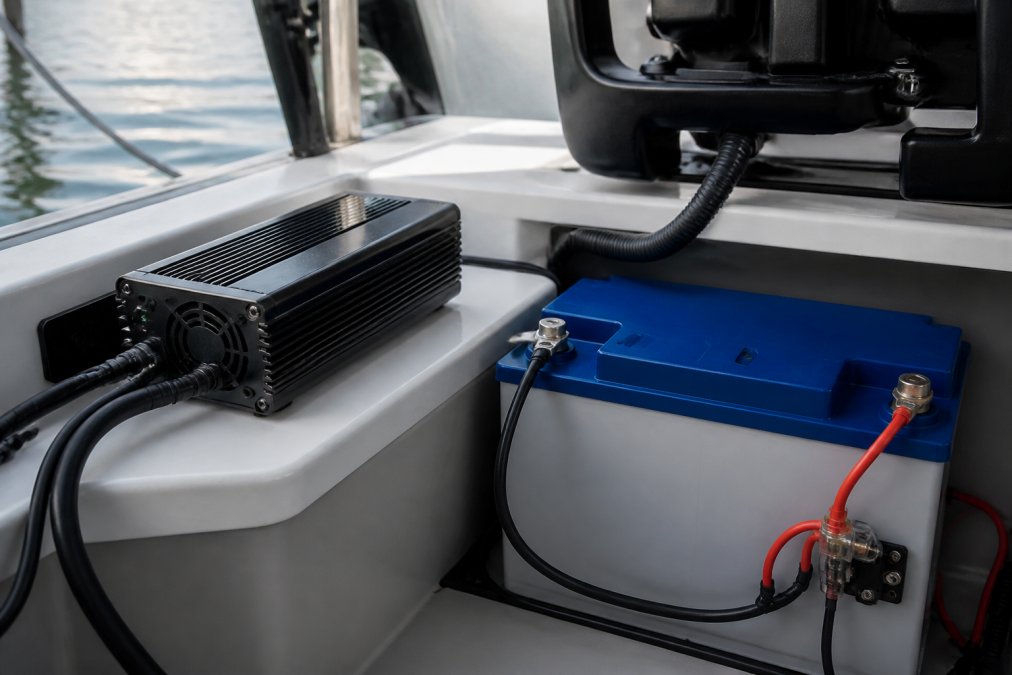
Onboard chargers are permanently mounted and hardwired into your boat's AC shore power system. They charge while docked, require no manual intervention, and typically offer higher amperage (10-40A per bank) for faster charging. Installation requires electrical work and significant upfront cost.
Portable chargers offer flexibility, you can charge at home, at a marina, or anywhere with AC power. They're compact and easy to store, but lower amperage means slower charging.
For LiFePO4 systems, onboard is almost always the better choice. Lithium batteries benefit from intelligent, consistent charging. An onboard charger with temperature compensation and multi-stage algorithms will extend your battery's lifespan by years.
North America remains the largest regional market for smart boat battery chargers, with a market value of USD 430 million in 2024, attributed to its well-developed recreational boating industry, high disposable income, and strong emphasis on technological innovation Smart Boat Battery Charger Market Research Report 2033.
How to Charge Lithium Boat Batteries Safely
Charging LiFePO4 safely comes down to three rules: match your voltage, respect your amperage limits, and monitor temperature.
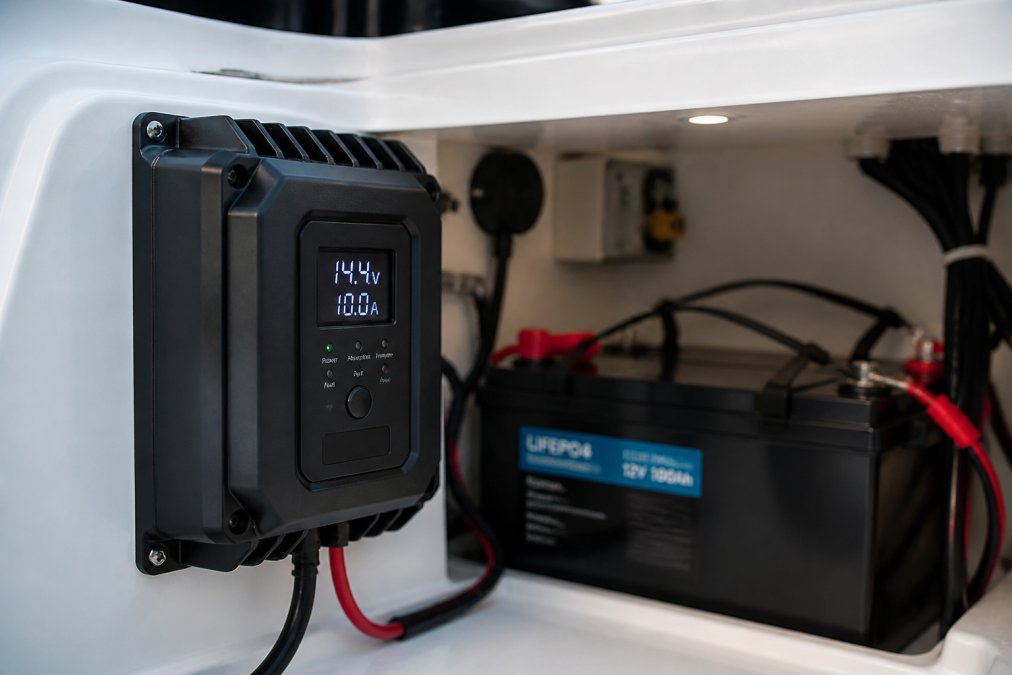
Voltage and Amperage Matching for Your System
Your boat's electrical system is either 12V, 24V, or 36V. LiFePO4 batteries come in matching voltages. A 12V battery has four cells in series (each nominally 3.2V). Never mix voltages, a 24V charger will destroy a 12V battery instantly.
Every LiFePO4 battery has a maximum charge rate, typically expressed as a C-rate. A 100Ah battery with a 1C rating can safely accept 100 amps. A charger delivering 200 amps would exceed the battery's BMS (battery management system) limits and trigger shutdown or damage. Most marine chargers are sized conservatively: 10-20 amps per bank for smaller boats, 40+ amps for larger systems.
Temperature compensation is critical. LiFePO4 chemistry is temperature-sensitive. A charger without thermal sensing will overcharge in summer or undercharge in winter. The best marine chargers include an external temperature sensor or internal thermal protection.
Temperature Compensation and Thermal Protection
LiFePO4 batteries perform best between 32°F and 104°F (0°C to 40°C). A charger without temperature compensation will charge at the same rate regardless of ambient conditions, which is dangerous.
Professional marine chargers include either a temperature sensor wire that runs to the battery or built-in thermal monitoring. As temperature rises, the charger reduces voltage slightly to prevent overcharging. If a charger detects the battery overheating (above ~140°F or 60°C), it should cut output immediately and alarm.
According to Craig Shaffer, Director of Product Development at ProMariner, quoted in Salt Water Sportsman, "New electronic and digital technologies are allowing us to build lighter and smaller marine chargers while also boosting the efficiency levels to reduce the consumption of AC power during the charging process."
Top Marine Battery Chargers for LiFePO4 Systems
Multi-Bank Chargers for Complex Systems
Multi-bank chargers are the professional standard. They charge 2, 3, or 4 separate battery banks independently, each with its own charging profile. This is essential if your boat runs a starter battery (lead-acid) and a house battery (LiFePO4).
The NOCO Genius GENPRO10X4 is a four-bank, 40-amp onboard charger (10 amps per bank) with dedicated LiFePO4 mode, IP68 waterproof rating, and thermal sensing. It reliably wakes deeply discharged LiFePO4 batteries and charges them safely at $424.95.
The ProMariner ProNauticP Series starts at $302.56 for a 2-bank, 10-amp model. It offers up to 12 selectable 4-stage charging profiles, including LiFePO4-specific algorithms, with real-time status display and Distributed-On-Demand technology for efficient power sharing.
The Mastervolt ChargeMaster Plus at $559.99+ combines charger, power distribution, and system integration into one unit. It supports LiFePO4, Gel, AGM, and flooded batteries simultaneously and integrates with other marine electronics for centralized control.
The Blue Sea Systems P12 Battery Charger at $761.19 offers a four-stage, three-output design with user-configurable charge profiles. It's built for reliability in harsh environments and includes a PreFloat stage to prevent overcharging.
Single-Bank Options for Simpler Setups
The Minn Kota Precision On-Board Charger (PCL Series) starts at $159.99 for a 1-bank, 10-amp model. It's specifically optimized for LiFePO4 batteries with automatic temperature compensation and can wake LiFePO4 batteries from standby mode.
The Renogy 12V 20A DC-DC Battery Charger with MPPT at $104.99 charges house batteries from your vehicle's alternator while driving or from solar panels. It supports LiFePO4 and includes reverse polarity protection and over-temperature shutdown.
The Victron Energy Blue Smart IP65 Charger offers Bluetooth monitoring and configurable charging profiles for LiFePO4 at around $215.90. It's portable, waterproof, and ideal for remote monitoring via smartphone.
A fishing boat owner on the Great Lakes equipped their small boat with LiFePO4 batteries and reported fewer interruptions due to battery issues. A user of a 12V 100Ah LiFePO4 battery with a 10A charger on a Minn Kota 30lb thrust motor reported the battery lasted 2-3 days of fishing without recharging and weighed about a third of a lead-acid battery Using LiFePO4 Batteries for Marine Applications.
| Charger | Type | Best For | Starting Price |
|---|---|---|---|
| NOCO GENPRO10X4 | 4-bank onboard | Multiple battery types | $424.95 |
| ProMariner ProNauticP | 2-4 bank onboard | Customizable profiles | $302.56 |
| Minn Kota PCL Series | 1-bank onboard | LiFePO4 focus | $159.99 |
| Renogy DC-DC 20A | DC-DC / solar | Alternator charging | $104.99 |
| Victron Blue Smart | Portable | Remote monitoring | ~$215.90 |
| Mastervolt ChargeMaster | Premium multi-bank | System integration | $559.99+ |
Installation, Mounting, and Marine-Grade Durability
A charger is only as good as its installation. Poor wiring, inadequate ventilation, or saltwater exposure will degrade even premium equipment.
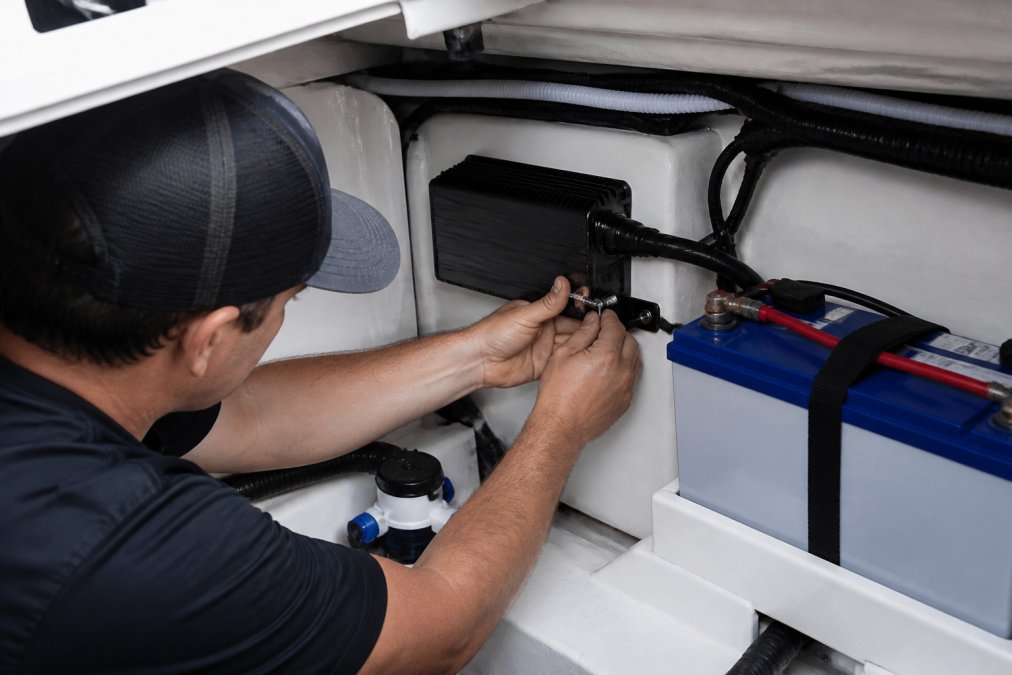
IP67 Waterproof Ratings and Corrosion Resistance
Marine environments demand waterproof ratings. For boat chargers, IP67 is the minimum acceptable standard, it means the charger can withstand temporary immersion (up to 3 feet for 30 minutes) without water damage.
Saltwater environments are harsher. Chargers exposed to salt spray corrode rapidly unless built with corrosion-resistant materials. Look for chargers with stainless steel hardware, powder-coated aluminum cases, or marine-grade epoxy coating.
The North America Lithium Iron Phosphate Marine Battery Market is projected to grow from USD 1.9 billion in 2025 to USD 4.8 billion by 2032, driven by electrification of near-shore marine applications and increasing environmental compliance pressures North America Lithium Iron Phosphate Marine Marine Battery Market Size and Forecasts 2032.
Wiring, Mounting Brackets, and Short-Circuit Protection
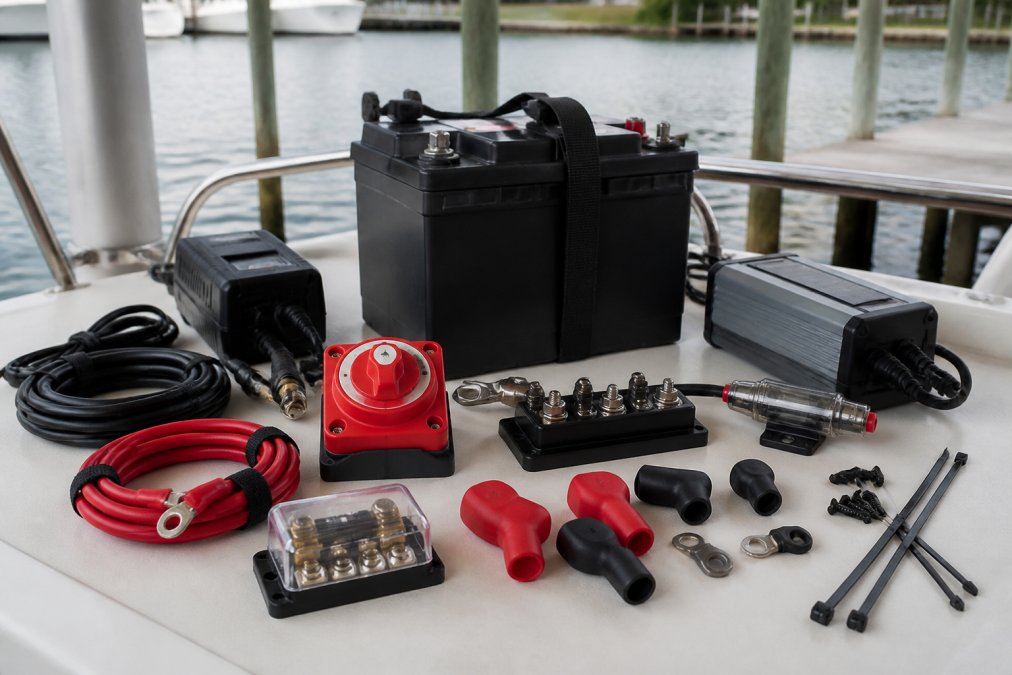
Installation requires proper gauge marine-grade wiring. Undersized wiring creates voltage drop and heat. Use marine cable (tinned copper), which resists corrosion in salt air. Automotive cable oxidizes quickly.
Mounting brackets matter more than they seem. Use stainless steel brackets and secure the charger away from engine heat, exhaust, and water spray. Ventilation is critical, chargers generate heat, and poor airflow reduces lifespan.
Short-circuit protection is non-negotiable. Every charger should include an inline fuse or circuit breaker between the battery and charger. This protects against accidental shorts that could damage the charger or start a fire.
Common Mistakes When Charging LiFePO4 Marine Batteries
Using a lead-acid charger on LiFePO4: Lead-acid chargers charge too high (often 14.8V or higher), overcharging LiFePO4 and damaging cells.
Ignoring amperage limits: Overcharging at too-high amperage triggers the BMS to shut down. Repeated shutdowns degrade the battery.
Skipping temperature monitoring: Charging a cold LiFePO4 battery at full amperage can trigger internal plating, reducing capacity permanently.
Mixing battery types in one bank: If you have a starter battery (lead-acid) and a house battery (LiFePO4) on the same charger without multi-bank capability, the charger will compromise both.
Poor wiring and ventilation: A charger mounted in a hot, poorly ventilated engine compartment will overheat and fail.
Neglecting storage mode: Leaving a LiFePO4 battery fully charged for months degrades it. Store at 50% state of charge (around 12.8V for 12V systems).
Most marine lithium batteries are designed for deep-cycle applications, not as starting batteries. Marine starting batteries produce short bursts of high energy using lead-acid technology. Most lithium batteries are designed for lower levels of energy over long periods and might damage marine engines if employed in starting applications.
Conclusion
Choosing the best marine battery charger for LiFePO4 isn't about picking the cheapest option or the one with the most features. It's about matching the charger's charging profile, amperage, and temperature compensation to your specific battery and boat.
If you're serious about protecting a LiFePO4 investment, Bigtime Battery offers a wide selection of marine-grade replacement batteries and charging solutions at competitive prices. Whether you're upgrading a single trolling motor battery or building a complex multi-bank system, Bigtime Battery's one-stop shop for specialty batteries ensures you have access to the best replacement batteries and reliable power solutions for your marine applications. Get started with Bigtime Battery and maximize the lifespan and performance of your LiFePO4 system.
Frequently Asked Questions
Q: Do you need a special charger for LiFePO4 lithium marine batteries?
A: Yes. LiFePO4 batteries require a charger specifically designed for lithium chemistry because they have different charging profiles than lead-acid or AGM batteries. Using an incompatible charger can damage lithium batteries, reduce their lifespan, and void the warranty. A proper LiFePO4 charger applies constant current and constant voltage stages, then float mode, which is essential for battery health and safety.
Q: What is the best charging profile for LiFePO4 boat batteries?
A: The optimal LiFePO4 charging profile includes three main stages: constant current (bulk charging at maximum safe amperage), constant voltage (absorption phase when voltage reaches the target), and float mode (maintenance charging at lower voltage). Temperature compensation is critical, the charger should adjust voltage based on battery temperature to prevent overcharging in warm conditions or undercharging in cold conditions. Most marine-grade chargers include a trickle charge or maintenance mode to keep the battery at full capacity without damage.
Q: Can I use a standard lead-acid charger on a LiFePO4 marine battery?
A: No. Standard lead-acid chargers apply higher voltage and different charging algorithms that can permanently damage LiFePO4 batteries. Using the wrong charger risks battery failure, thermal runaway, or loss of warranty coverage. Always select a charger explicitly rated for LiFePO4 or multi-chemistry compatibility.
Q: What amperage should I use to charge a LiFePO4 trolling motor battery?
A: Amperage depends on your battery's capacity and the charger's output. A common rule is to charge at 0.5C (half the battery's amp-hour rating). For example, a 100Ah LiFePO4 battery charges safely at 50 amps maximum. Many boaters use 10-20 amp chargers for trolling motor batteries because they allow for slower, safer charging that extends battery life. Check your battery's manual and charger specifications to match voltage (12V, 24V, or 36V) and amperage correctly. Mismatched amperage can damage the battery management system (BMS) or reduce performance.