 listicle
Best Solar Chargers for Marine Batteries
Table of Contents
- How Solar Chargers Work for Marine Batteries
- Solar Panel Sizing for Deep Cycle Batteries
- Marine Battery Charge Controller Requirements
- Key Features to Look for in Marine Solar Panels
- Best Practices for Marine Battery Maintenance
- Real-World Performance in Saltwater Environments
- Lithium vs. Deep Cycle Batteries: Charging Compatibility
- Frequently Asked Questions
Last Updated: September 30, 2026
How Solar Chargers Work for Marine Batteries
The best solar chargers for marine batteries convert sunlight into electrical energy to replenish deep cycle battery banks on boats. Unlike grid-powered chargers, solar systems generate power continuously during daylight hours, making them invaluable for vessels spending extended periods away from shore.
Photovoltaic panels capture sunlight and convert it to direct current (DC) electricity, which flows through a charge controller that regulates voltage and amperage. The charge controller is critical, without it, unregulated solar output can overcharge batteries in minutes, causing permanent damage and fire hazards.
Most recreational boats have complex electrical systems with battery isolators and VSR switches that create integration challenges. When a solar panel connects to a battery bank feeding a VSR switch, the charger can inadvertently trigger the isolator to connect a second battery, creating parallel charging paths that confuse voltage sensing. Proper integration requires installing the charge controller downstream of the battery isolator to monitor only the designated battery bank, preventing feedback loops.
A 35-watt solar charger delivers approximately 2 amps in full sun, working best for maintenance. The real advantage emerges over weeks and months: solar panels keep your deep cycle battery topped off year-round without manual intervention or generator runtime.
Modern marine solar kits integrate smart MPPT (Maximum Power Point Tracking) charge controllers that optimize efficiency automatically. MPPT controllers are 20-30% more efficient than older PWM designs, extracting significantly more usable energy from the same panel array, a gain that justifies the higher cost for boats with limited deck space.
Lithium battery chemistry introduces additional complexity that standard solar systems cannot handle safely. Lead-acid batteries tolerate float charging at 13.2-13.8 volts indefinitely; lithium cells (LiFePO4) require lower float voltages around 13.0-13.2 volts and must disconnect from charging once full. Connecting a standard lead-acid charge controller to lithium cells risks overcharging and permanent damage. Bigtime Battery's Banshee lithium chargers are engineered specifically for LiFePO4 batteries and include automatic circuit protection that prevents the overcharging damage that would destroy lithium cells. When integrating solar panels with lithium battery banks, pairing them with a LiFePO4-compatible charge controller ensures safe, efficient charging and prevents the voltage spikes that damage modern battery chemistry.
Solar Panel Sizing for Deep Cycle Batteries
Solar panel wattage depends on battery capacity, daily power consumption, and regional sunlight hours. A boat drawing 50 amps daily from a 200-amp-hour battery needs roughly 100-150 watts of solar capacity to maintain charge.
Determine your daily amp-hour requirement. If your boat systems consume 50 amps daily, you need that much charging capacity during peak sun hours. Most coastal regions receive 4-6 hours of effective sunlight daily, so a 100-watt panel produces roughly 20-25 amps during that window.
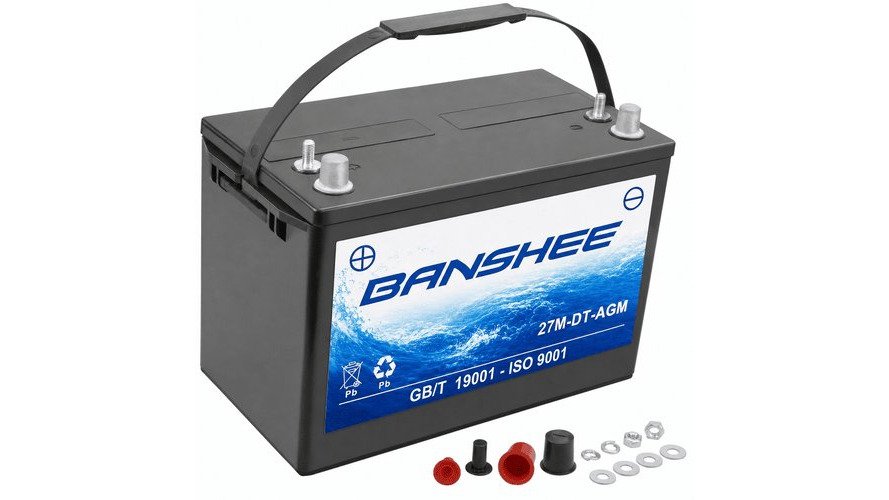
Banshee 12V Lithium LiFeP04 Marine →
Monocrystalline panels are preferred for marine applications where space is limited. These panels deliver higher output per square foot than polycrystalline designs, making them ideal for boats with limited deck space. A 60-watt monocrystalline panel occupies roughly 5 square feet while a 100-watt polycrystalline panel requires nearly 8 square feet.
| Battery Capacity | Daily Draw | Recommended Panel Size | Best For |
|---|---|---|---|
| 100 Ah | 25 amps | 50-75W | Small boats, auxiliary power |
| 200 Ah | 50 amps | 100-150W | Mid-size boats, moderate use |
| 300 Ah | 75 amps | 150-200W | Larger vessels, extended cruising |
| 400+ Ah | 100+ amps | 200-300W | Live-aboard boats, heavy loads |
Marine Battery Charge Controller Requirements
The charge controller is the critical link between your solar panels and battery bank, monitoring voltage continuously and reducing charging current as the battery approaches full capacity. Without proper regulation, solar panels can overcharge and damage deep cycle batteries.
Two main controller types serve marine applications: PWM (Pulse Width Modulation) and MPPT (Maximum Power Point Tracking). PWM controllers are simpler and less expensive for systems under 400 watts. MPPT controllers extract 20-30% additional power by continuously optimizing the voltage-current relationship.
According to Battery Tender's integration guidelines, modern marine solar kits feature built-in smart MPPT controllers that prevent overcharging while monitoring voltage in real time. The SUNER POWER 30W system exemplifies this approach, delivering professional-grade reliability for DC boat lift motors and remote battery maintenance (Lake Lifter case study, 2026).
For lithium marine batteries, controller selection becomes even more critical. Lithium cells require different charging profiles than lead-acid deep cycle batteries. Bigtime Battery's Banshee lithium chargers are engineered specifically for LiFePO4 batteries and include automatic circuit protection that prevents the overcharging damage that would destroy lithium cells. When integrating solar panels with lithium battery banks, pairing them with a LiFePO4-compatible charge controller ensures safe, efficient charging.
Key Features to Look for in Marine Solar Panels
Durability in saltwater environments separates quality marine solar panels from generic models. Look for panels with IP67 waterproof ratings, which resist complete submersion in water up to 1 meter for 30 minutes, protecting against spray, rain, and deck washing.
Junction boxes are the primary failure point in saltwater. Standard aluminum boxes corrode within 6-12 months, reducing efficiency by 15-25%. Marine-grade panels use stainless steel or potted junction boxes that eliminate moisture ingress. Use marine-specific MC4 connectors with gold-plated contacts and silicone gaskets; avoid unplated brass connectors that oxidize within weeks.
Low-iron tempered glass transmits 91-93% of incident light versus 88-90% for standard glass. Over 10 years, this 3% difference compounds to roughly 3 additional watts per 100-watt panel. Anti-reflective coatings boost transmission to 94-96% but require periodic cleaning in salt spray environments.
Banshee 12V Lithium LiFeP04 Marine →
Modern monocrystalline panels achieve 18-22% efficiency under standard test conditions.
Best Practices for Marine Battery Maintenance
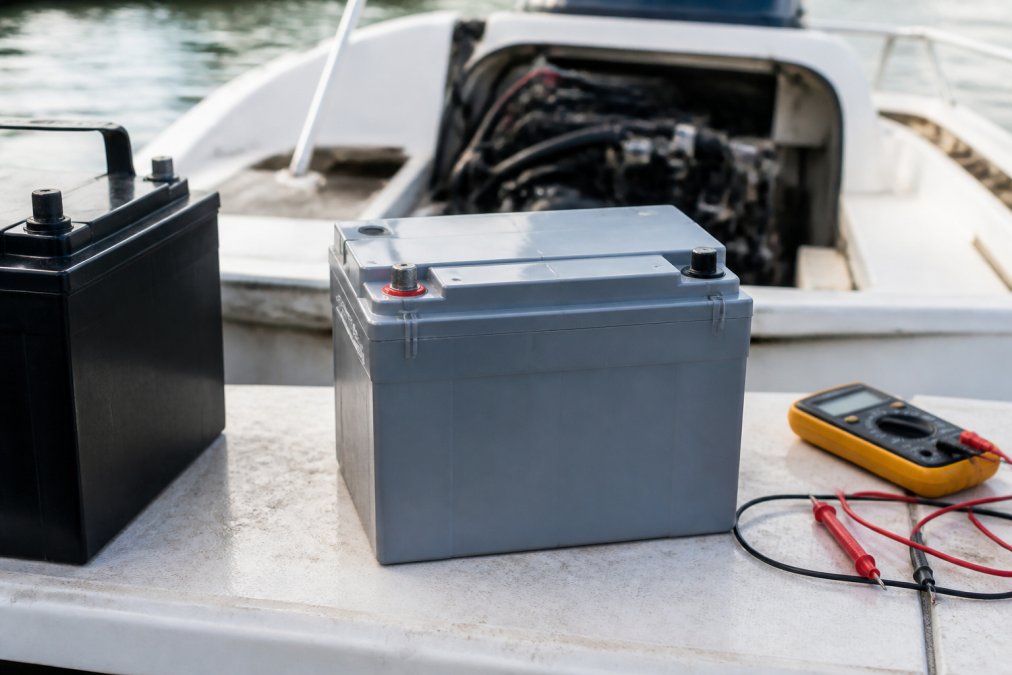
Solar charging systems work best when paired with disciplined battery maintenance. Check battery voltage monthly using a multimeter. A healthy 12V deep cycle battery should read 12.6-12.8 volts at rest; below 12.4 volts indicates partial discharge.
Real-World Performance in Saltwater Environments
Lithium vs. Deep Cycle Batteries: Charging Compatibility
Lithium batteries (LiFePO4 chemistry) accept charge at higher voltages than lead-acid and reach full charge faster. A 100-watt solar array charges a lithium battery 20-30% faster than an equivalent lead-acid bank.
Frequently Asked Questions
What size solar panel do I need to charge a marine battery?
Panel size depends on your battery capacity and charging speed goals. A 35-watt solar charger delivers approximately 2 amps in full sun conditions, suitable for trickle charging and maintenance. For faster charging of deep cycle batteries, calculate based on your battery's amp-hour capacity, typically a 100Ah battery needs 10-20 watts minimum for maintenance. Consider your boat's location and seasonal sunlight availability when sizing. Bigtime Battery offers LiFePO4-compatible chargers at various voltage levels (12V, 24V, 36V) to match your system requirements.
Do I need a charge controller for a marine solar charger?
Yes, a charge controller is essential for marine battery systems. It regulates voltage and prevents overcharging, protecting both traditional lead-acid and lithium batteries. Modern systems use MPPT (Maximum Power Point Tracking) or PWM controllers to optimize charging efficiency. Intelligent charge control technology monitors voltage and prevents damage. If you're upgrading to lithium LiFePO4 batteries, ensure your charger is LiFePO4-compatible, like the Banshee marine battery chargers available at bigtimebattery.com, which include built-in circuit protection.
Can solar chargers work in cloudy conditions or low light?
Solar chargers produce reduced output on cloudy days, typically 25-50% of rated capacity depending on cloud density. Low-light efficiency is where monocrystalline panels excel; they outperform polycrystalline panels in overcast conditions. For reliable year-round charging in regions with frequent cloud cover, combine solar with a backup charging source or select a larger panel to compensate for seasonal variation. Solar chargers work best for maintenance charging (trickle charging) rather than recovering deeply discharged batteries after heavy use.
How do I prevent sulfation and maintain my marine battery with solar charging?
Float charging, maintaining a steady, low-level charge, prevents sulfation buildup that degrades deep cycle batteries. Solar chargers provide ideal float charging for marine batteries left idle during off-season storage. Keep batteries fully charged and use a charger with voltage regulation to maintain proper state of charge. For lithium LiFePO4 batteries, use a LiFePO4-compatible charger like those from Banshee at bigtimebattery.com to prevent overcharging. Regular maintenance includes monitoring voltage, checking connections for corrosion, and ensuring proper wiring for your 12V, 24V, or 36V system.
What's the difference between a solar charger and a solar maintainer?
A solar charger actively charges a depleted battery, while a solar maintainer (trickle charger) keeps a fully charged battery topped off during storage or low-use periods. Maintainers deliver lower amperage and are ideal for boats, RVs, and vehicles stored seasonally. Chargers provide higher current for active charging. Most marine applications benefit from maintainers for off-season battery preservation. Banshee marine battery chargers function as both automatic chargers and maintainers, offering versatility for different charging scenarios and battery types.