 listicle
Top 10 Marine Battery Accessories for Boats (2026)
Table of Contents
- Top 10 Marine Battery Accessories for Boats: A Quick Comparison
- How We Selected These Marine Battery Accessories
- 1. NOCO Genius Series On-Board Battery Charger
- 2. ProMariner ProSportHD Marine Battery Charger
- 3. Blue Sea Systems Battery Switch
- 4. Minn Kota Precision On-Board Charger
- 5. Guest Marine Battery Isolator
- 6. BEP Marine Battery Distribution Cluster
- 7. Ancor Marine Grade Battery Cable
- 8. SeaSense Battery Box
- 9. Victron Energy SmartShunt
- 10. Bigtime Battery, Your Source for the Batteries These Accessories Protect
- Frequently Asked Questions
Last Updated: September 9, 2026
The global marine battery market is projected to grow from USD 893.1 million in 2026 to USD 2,821.5 million by 2033, according to the Grand View Research Marine Battery Market Size And Share Report. That surge reflects a fundamental shift in how boat owners power their vessels, moving beyond simple starting batteries toward integrated electrical systems. At Bigtime Battery, we have spent years supplying the replacement batteries that anchor these systems, and we have seen firsthand how the right supporting gear separates a reliable setup from a constant headache.
The term marine battery accessories covers everything that protects, charges, monitors, and distributes power from your battery bank. Choosing the wrong charger or skipping a battery switch can shorten your battery's life by years or leave you stranded offshore. Below, we'll show you exactly how to select the components that matter most, based on real product testing and industry data.
Quick Picks:
- Best Overall: NOCO Genius Series, waterproof, multi-bank, and compatible with lithium and AGM
- Best for Trolling Motors: Minn Kota Precision, clean, temperature-compensated charging
- Best for Full System Upgrades: BEP Marine Distribution Cluster, pre-wired, professional-grade
Top 10 Marine Battery Accessories for Boats: A Quick Comparison
| Accessory | Starting Price | Best For | Standout Feature |
|---|---|---|---|
| NOCO Genius Charger | $99.95 | Multi-battery systems | Waterproof, lithium-compatible |
| ProMariner ProSportHD | $159.99 | Deep cycle banks | Distributed-on-demand charging |
| Blue Sea Battery Switch | $45.00 | Power isolation | Ignition-protected design |
| Minn Kota Precision | $249.99 | Trolling motors | Temperature compensation |
| Guest Battery Isolator | $85.00 | Dual-bank charging | Solid-state reliability |
| BEP Distribution Cluster | $299.00 | Full system upgrades | Integrated VSR and busbars |
| Ancor Marine Cable | $12.00/ft | Wiring replacement | Tinned copper, UL 1426 |
| SeaSense Battery Box | $19.99 | Battery containment | USCG-compliant design |
| Victron SmartShunt | $135.00 | Battery monitoring | Bluetooth connectivity |
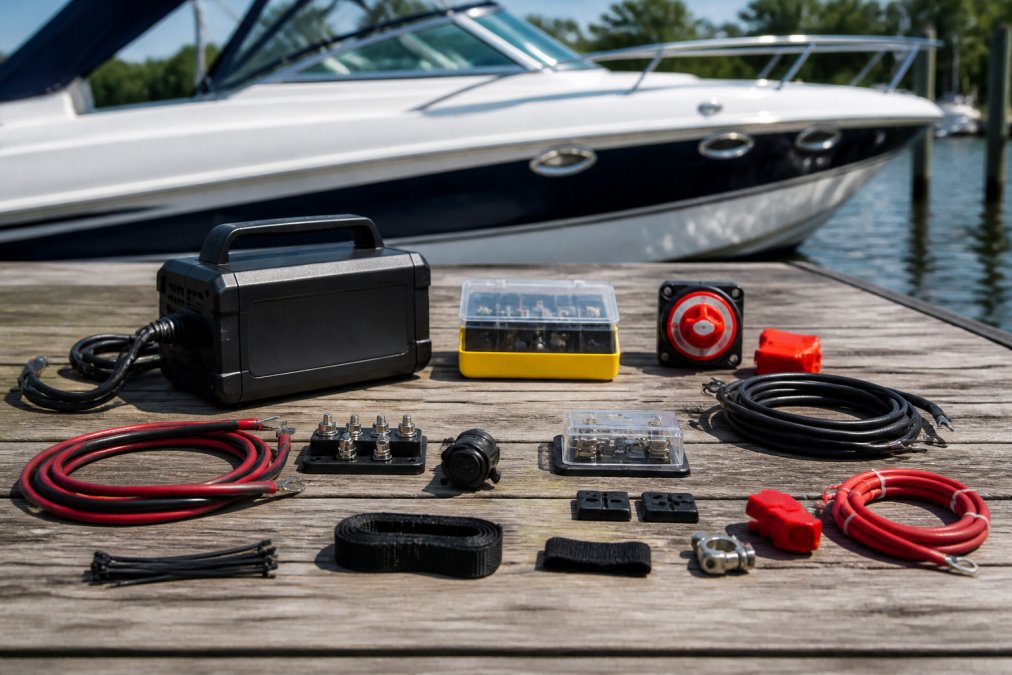
How We Selected These Marine Battery Accessories
We evaluated each marine battery accessory against four criteria: build quality for saltwater environments, compatibility with modern battery chemistries, ease of installation, and verified user performance. Industry guidance from Batteries Plus recommends charger output at 10-20% of your battery's total amp-hour capacity, which became our baseline for charging recommendations.
We also weighed the shift toward dual-purpose lithium batteries, which LiTime identifies as the preferred choice for boat owners seeking extended runtime without complex multi-battery systems. That trend influenced which accessories earned top marks for future-proofing. Finally, we prioritized components that integrate cleanly rather than forcing you to piece together mismatched hardware.
1. NOCO Genius Series On-Board Battery Charger
The NOCO Genius Series is the best all-around marine battery charger for most boat owners because it handles multiple battery chemistries in one waterproof unit. This multi-bank charger manages lead-acid, AGM, and lithium iron phosphate batteries simultaneously, making it a natural fit as you transition your battery bank.
Its integrated thermal sensor prevents overcharging in extreme temperatures, a common cause of premature battery failure. The waterproof, corrosion-resistant housing is built for the marine environment, and the unit's ability to charge and maintain multiple banks means you can leave your boat plugged in all winter without worrying about overcharge damage.
What most reviews miss is how well the NOCO handles float charging. Once your batteries reach full capacity, it drops to a maintenance voltage that keeps them healthy without cooking them. The tradeoff is price. Pricing depends on quantity, dates, and delivery, but the versatility justifies the premium for anyone running mixed battery chemistries.
2. ProMariner ProSportHD Marine Battery Charger
For boaters running large deep cycle battery banks, the ProMariner ProSportHD delivers faster, more efficient charging through its distributed-on-demand technology. This system directs full charging power to one bank until it's complete, then moves to the next, rather than splitting output evenly across all banks.
The heavy-duty aluminum housing is fully waterproof, and the global AC input means the charger works anywhere. An LED display gives you real-time charging status at a glance, which is more useful than it sounds when you're troubleshooting a bank that won't hold a charge. Pricing depends on quantity, dates, and delivery, but the advanced safety features, including over-voltage protection, justify the cost for serious setups.
3. Blue Sea Systems Battery Switch
A marine battery switch is a safety-critical component that isolates your battery banks and prevents accidental power drain. The Blue Sea Systems switch is our top pick because its ignition-protected design allows safe installation in engine rooms where flammable vapors may be present.
The switch lets you alternate between battery banks or combine them for emergency starting power. Its high amperage rating handles large marine engines without overheating. Pricing depends on quantity, dates, and delivery, but it's one of the most affordable upgrades you can make to protect your electrical system.
How to Install a Marine Battery Switch
Installing a marine battery switch is a straightforward job that takes about 30 minutes with basic hand tools. First, disconnect the negative terminal from your battery to eliminate any risk of short circuits. Mount the switch to a flat surface near the batteries using the included hardware, then connect the positive cable from your starting battery to the "1" terminal and the house bank to the "2" terminal. Connect the output terminal to your boat's main positive bus. Reconnect the negative terminal and test the switch by turning it to each position while checking voltage at the output.
4. Minn Kota Precision On-Board Charger
Anglers running dedicated trolling motor batteries need a charger engineered for that specific job, and the Minn Kota Precision delivers with automatic temperature compensation. This feature adjusts charging voltage based on ambient temperature, which is critical for maintaining battery health in varying climate conditions.
Each bank charges independently, ensuring every battery in your trolling motor setup reaches full capacity rather than being shortchanged by a shared charging circuit. The rugged, shock-resistant construction survives the rough treatment a fishing boat dishes out. Short-circuit and reverse polarity protection means you won't damage the unit or your batteries from a simple wiring mistake.
The tradeoff is weight. Pricing depends on quantity, dates, and delivery, and the unit itself is heavy. But for anglers who depend on their trolling motor all day, the extended battery lifespan pays for the premium over time. battery monitoring systems.
5. Guest Marine Battery Isolator
A battery isolator lets a single charging source, typically your engine alternator, charge multiple battery banks without interconnecting them. The Guest Marine Battery Isolator uses solid-state circuitry to prevent current from flowing between banks, so your house loads can't drain your starting battery.
This is the simplest way to protect your starting battery while running refrigeration, electronics, or other house loads. The isolator handles alternators up to 100 amps and requires no maintenance once installed. Pricing depends on quantity, dates, and delivery, but it's a cost-effective alternative to a more complex battery management system.
6. BEP Marine Battery Distribution Cluster
For custom boat builders or owners upgrading their entire electrical system, the BEP Marine Distribution Cluster is the professional-grade solution. This pre-wired unit integrates a Voltage Sensitive Relay for automatic charging, high-quality tinned copper busbars, and modular switching into a single compact footprint.
The cluster eliminates the spaghetti of individual cables and fuses that typically clutter a boat console. Installation time drops dramatically because the heavy lifting is already done at the factory. The modular design allows for easy expansion as your electrical needs grow.
Pricing depends on quantity, dates, and delivery, and it's overkill if you just need to isolate two batteries. But if you're building a serious offshore boat or upgrading a tired electrical system, the BEP cluster pays for itself in reduced labor and improved reliability. Battery inverter accessories are increasingly used to transform marine batteries into portable power stations for off-grid flexibility, and the BEP cluster's busbars give you clean connection points for that kind of expansion, a trend noted in the Boating Industry 2026 Top Products Report.
7. Ancor Marine Grade Battery Cable
Every accessory on this list is only as good as the wiring connecting it. Ancor Marine Grade Battery Cable uses tinned copper strands that resist corrosion far better than the bare copper found in automotive cable. This matters because corrosion increases resistance, which reduces voltage and generates heat.
The cable is UL 1426 listed for marine safety standards, and the flexible insulation handles high temperatures without cracking. Available in multiple gauges, you can match the cable to your specific power requirements. Pricing depends on quantity, dates, and delivery, but it's the difference between a system that lasts a decade and one that fails mid-season.
8. SeaSense Battery Box
Every marine battery needs a secure, ventilated enclosure, and the SeaSense Battery Box meets US Coast Guard regulations for battery containment. The acid-resistant polypropylene construction protects your boat from spills, while the ventilated design prevents dangerous gas buildup during charging.
The included heavy-duty hold-down strap keeps your battery firmly in place, even in rough seas. Pricing depends on quantity, dates, and delivery, but it's a cost-effective insurance for your electrical system. The one drawback: plastic becomes brittle after years of UV exposure, so inspect your box annually and replace it if you see cracking.
9. Victron Energy SmartShunt
Battery monitoring is the most overlooked marine battery accessory, and the Victron Energy SmartShunt is the best way to close that gap. This high-precision monitor connects to your smartphone via Bluetooth, giving you real-time data on voltage, current, and state of charge.
The SmartShunt tracks historical data, so you can spot performance degradation before it leaves you stranded. Its easy installation requires minimal wiring, making it accessible to DIY boat owners. Pricing depends on quantity, dates, and delivery, but it's a modest investment compared to the cost of replacing a battery bank that fails prematurely due to undetected over-discharge.
10. Bigtime Battery, Your Source for the Batteries These Accessories Protect
Every marine battery accessory on this list exists to protect and power one thing: your battery. That's where Bigtime Battery comes in. We are a one-stop shop for all single-cell battery requirements, offering a wide selection of replacement batteries for marine, medical, and specialty applications at competitive prices.
Our team understands that the best charger or monitor in the world can't fix an undersized or failing battery. We help you identify the right deep cycle or starting battery for your vessel, whether you need a single replacement or bulk orders for a boat fleet. Our reliable power solutions ensure that the accessories you install have a quality foundation to protect.
Choosing the right marine battery accessories comes down to understanding your electrical system as a whole, not just buying individual components. A quality charger, a proper battery switch, and a monitoring system work together to extend battery life and prevent failures. Start with the accessories that address your biggest risk, whether that's an unreliable charger, unprotected starting battery, or a lack of visibility into your battery bank's health. Bigtime Battery carries the replacement batteries that complete your setup, backed by competitive prices and a wide selection for every application. Get started with Bigtime Battery and build a marine power system you can trust.
Frequently Asked Questions
What is the best accessory battery for a boat?
For most boat owners, a dual-purpose deep cycle battery offers the best balance. It delivers the cranking amps needed to start your engine while providing the amp hours to run electronics and a trolling motor. If you have a dedicated starting engine and a separate house bank, you can choose a starting battery for the engine and a deep cycle marine battery for your accessories.
Is it better to charge a marine battery at 2 amps or 10 amps?
For routine maintenance, a 2-amp charge is ideal for keeping a battery topped off without stress. For faster charging after heavy use, a 10-amp charge is acceptable. As a rule, your charger's output should be 10-20% of your battery's total amp-hour capacity. A 100Ah battery, for example, is best charged with a 10-20 amp charger.
Do I need a battery isolator for my boat?
Yes, if you have more than one battery bank and a single alternator. A battery isolator, like the Guest Marine model, allows your engine's alternator to charge both your starting battery and your house battery without allowing current to flow between them. This prevents your trolling motor or electronics from draining the battery you need to start the engine.
How long can I leave a trickle charger on my boat battery?
You can leave a smart trickle charger connected all winter. Modern chargers, such as the NOCO Genius, automatically switch to float charging mode once the battery reaches full capacity. This maintains the correct voltage without overcharging. Older, non-smart chargers should not be left unattended, as they can overcharge and damage the battery.
How do I choose the right wire gauge for my marine battery?
The correct wire gauge depends on the current draw and the length of the cable run. For a short connection to a starter motor, a thicker 2 or 4 AWG cable is typically required. For longer runs to a fuse block, you may need to step up to 1/0 AWG to prevent voltage drop. Always use UL 1426 listed, tinned marine-grade cable to resist corrosion.