 listicle
Affordable Marine Battery Alternatives That Beat Premium Prices
Table of Contents
- Why Premium Marine Batteries Are Not Always Worth It
- Quick Comparison: Budget to Mid-Range Marine Batteries
- Flooded Lead-Acid: The Low-Cost Workhorse
- AGM Alternatives: Maintenance-Free Middle Ground
- Budget Lithium Options: Best Value Deep Cycle Marine Battery
- AGM vs Lithium Marine Battery Cost Comparison
- Charging Compatibility and Real-World Failure Rates
- Marine Battery Maintenance Tips for Longevity
- Frequently Asked Questions
Last Updated: September 5, 2026
Premium marine batteries carry a purchase price two to three times higher than comparable VRLA options, according to HZH Marine's cost analysis. Yet for many boaters, that premium fails to deliver proportional value. The market for affordable alternatives to premium marine batteries has expanded dramatically, with entry-level lithium iron phosphate (LiFePO4) drop-in replacements now available for under $300 and flooded lead-acid workhorses starting near $100. This guide from Bigtime Battery breaks down when paying less makes sense, where budget brands cut corners, and how to choose the best value deep cycle marine battery for your specific setup without sacrificing reliability.
Below, we compare flooded, AGM, and budget lithium options across cost-per-cycle, weight, and maintenance demands, then show how to match a battery to your charging system and usage patterns.
Why Premium Marine Batteries Are Not Always Worth It
Premium brands justify their price tags with military-grade construction, faster recharge rates, and vibration resistance. Those attributes matter for commercial fishing or rough open water; for a weekend angler on a 17-foot skiff, they're overkill.
The math favors budget options for lighter use. Premium marine batteries generally offer a service life of 3 to 5 years, per user-reported benchmarks on r/boating. A $450 premium AGM lasting five years costs $90 per year. A $130 flooded battery lasting three years costs roughly $43 per year. You'd need to replace the flooded battery twice before the premium unit breaks even, and that's before factoring in that many boaters replace premium batteries on a fixed schedule regardless of condition.
Quick Comparison: Budget to Mid-Range Marine Batteries
Choosing an affordable marine battery means understanding what each chemistry offers. Flooded lead-acid gives you the lowest upfront cost but demands maintenance. AGM removes the watering chore but costs more per amp-hour. Budget lithium delivers the longest cycle life and lightest weight but requires a compatible charging profile.
| Battery Type | Price Range | Maintenance | Cycle Life | Best For |
|---|---|---|---|---|
| Flooded Lead-Acid | $100-$180 | Regular watering | 300-500 cycles | Budget boaters, trolling motors |
| AGM | $200-$500 | None | 500-800 cycles | Maintenance-free convenience |
| Budget LiFePO4 | $250-$600 | None | 2,000+ cycles | Long-term value, weight savings |
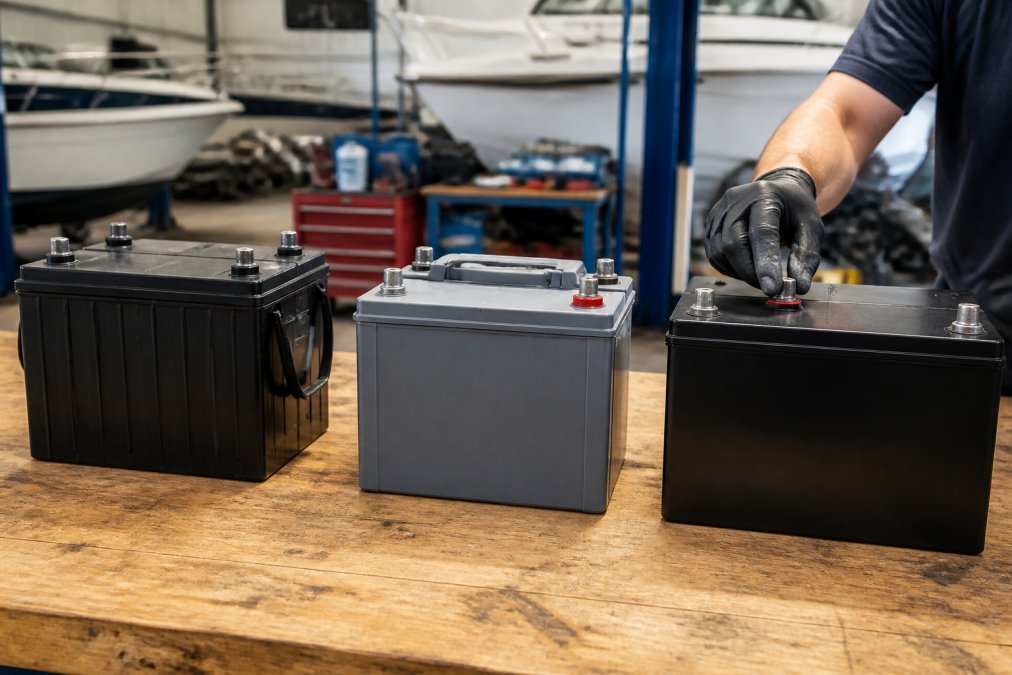
Flooded Lead-Acid: The Low-Cost Workhorse
Flooded lead-acid remains the default for budget-conscious boaters willing to perform routine maintenance; you trade your time for the savings.
Duracell Ultra Flooded Marine Batteries are identified as a primary affordable alternative to premium options, provided the user accepts the watering and terminal-cleaning routine, according to Batteries Plus's boat battery brand guide. These batteries deliver reliable starting power and steady deep cycle performance for standard marine electrical systems.
EverStart Marine 29DC vs. Duracell Ultra Flooded
The EverStart Marine 29DC is the value king. Available at Walmart for roughly $100 to $130, it offers a deep cycle design for trolling motors and accessories. Its flooded construction means regular water checks, but nothing beats its price-to-performance ratio.
Duracell Ultra costs $120 to $180, and that premium buys versatility: starting, deep cycle, or dual-purpose configurations. Its consistency makes it the safer pick if you're unsure which type your setup requires.
AGM Alternatives: Maintenance-Free Middle Ground
AGM batteries sit between flooded and lithium on price and convenience. They're sealed, handle vibration better than flooded units, and offer a set-and-forget solution.
The Fullriver DC Series AGM ($250 to $400) offers high vibration resistance and genuine deep cycle performance, but is heavy. The Victron Super Cycle AGM ($200 to $350) is optimized for frequent deep discharge and fits tighter spaces.
Budget Lithium Options: Best Value Deep Cycle Marine Battery
Budget lithium has reshaped the market. LiFePO4 brands like LiTime, Vatrer, and Goldenmate are gaining adoption as alternatives to premium-priced lithium options, per Marine How To's lithium battery analysis. The Goldenmate Lithium 12V 100Ah Orion 1000 has been highlighted as a top budget lithium marine battery choice for 2026, offering a lower-cost entry point than premium lithium brands, according to Wired2Fish's marine battery buyers guide.
LiTime's LiFePO4 Marine Battery ($250 to $500) exemplifies the value proposition. Its integrated BMS protects against overcharge, over-discharge, and thermal runaway. Its 2,000-plus cycle lifespan crushes lead-acid, and its weight savings (often 50% to 60% less) can improve boat performance and fuel efficiency.
AGM vs Lithium Marine Battery Cost Comparison
The upfront price gap between AGM and lithium is shrinking. A quality AGM like the Lifeline runs $350 to $500; a budget lithium option from LiTime or Epoch sits at $250 to $600.
Life Cycle Cost Analysis (LCCA) from MDPI's Journal of Marine Science and Engineering indicates that LFP batteries are the most cost-efficient battery type for electric-propulsion vessels. The study, published in 2023, examined all-electric fishing vessels and found lithium's longer cycle life and higher efficiency offset its higher initial cost over the vessel's operating life.
For trolling motors, the decision hinges on charging compatibility. Lithium requires a charger with a LiFePO4 profile; if your boat has an older lead-acid-only charger, factor a new one into the cost.
Charging Compatibility and Real-World Failure Rates
Two questions dominate every budget battery forum thread: "Will this work with my current setup?" and "How long will it actually last?"
Charging Compatibility: The Alternator Problem
The most common failure pattern for budget lithium isn't the battery, it's the charging source. Most alternators output a fixed 13.8V to 14.4V, fine for AGM and flooded but a problem for LiFePO4.
A LiFePO4 BMS disconnects the battery when cell voltage hits its upper limit (typically 14.6V for a 12V pack). If the alternator pushes 14.2V, the BMS may see that as full and disconnect, causing the battery to appear dead while the alternator voltage spikes.
What to check before you buy:
- Alternator output voltage: Measure it at the battery terminals with the engine running at cruising RPM. If it exceeds 14.4V, you need a regulator or a DC-to-DC charger.
- Charger profiles: Your onboard charger must have a LiFePO4 setting. Many dual-profile chargers (like those from NOCO or ProMariner) now include this. If your charger is older than 2018 and only has "Gel" or "AGM" settings, plan to replace it, a $50 charger can kill a $300 battery in one season.
- BMS disconnect behavior: Some budget BMS units latch into a disconnected state until you apply a proper charging voltage. Others auto-recover. Read the spec sheet or ask the manufacturer directly. If you're on a boat with a solar panel, a BMS that latches can leave you stranded until you find a compatible charger.
Real-World Failure Rates: What the Data Shows
Most articles on budget batteries are promotional. Community-sourced data from forums like The Hull Truth and Cruisers Forum, plus retailer return-rate disclosures, paint a more nuanced picture.
Budget flooded lead-acid batteries fail at roughly the same rate as premium units when properly maintained. The difference is in failure mode: budget units fail from plate shedding and internal shorting after 2 to 3 years of heavy cycling; premium units fail more from user error.
For budget lithium, the most frequently reported failure mode is BMS failure, not cell failure. A BMS that shuts down under load, fails to balance cells, or dies after a season of vibration is the #1 complaint. The core chemistry is solid; the electronics are the weak link.
What this means for your buying decision:
- For flooded: Budget is fine if you commit to the maintenance routine. The failure rate difference is small.
- For AGM: Mid-range brands (like Fullriver or Odyssey) show notably lower failure rates than no-name imports, particularly in vibration-heavy applications.
- For lithium: Buy from a brand with a documented BMS warranty and a U.S.-based support line. A $250 battery with a dead BMS after 8 months is worthless if the warranty claim takes 6 weeks.
The Warranty Claim Reality Check
Warranty language is easy to write; claims are hard to file. Flooded batteries from major retailers are typically replaced over the counter with a receipt. AGM brands vary: some require you to ship the battery back at your own expense, costing $40 to $60.
Budget lithium brands are the wildcard. Some offer 5-year warranties but require email troubleshooting; others cross-ship replacements after a video call. Before buying, search the brand plus "warranty claim" on YouTube or Reddit to gauge response times.
Marine Battery Maintenance Tips for Longevity
Maintenance is where budget batteries either earn their keep or become false economy. A $100 flooded battery lasting three seasons costs less per year than a $400 AGM that dies in two from chronic undercharging. The difference is maintenance habits, not manufacturing quality.
Flooded Lead-Acid: The Weekly Check
Flooded batteries are the only chemistry that requires regular physical maintenance. The routine is simple but non-negotiable:
- Water level check: Every 4 to 6 weeks during the season, or more often in hot climates. Remove the vent caps and look at the plates. They must be covered by electrolyte. If any plate is exposed, add distilled water immediately, never tap water, which introduces minerals that accelerate sulfation.
- Voltage check: With the battery rested (no load for at least 6 hours), a healthy flooded battery reads 12.6V to 12.7V. Below 12.4V means it's only 50% charged, and leaving it there for more than a few days causes permanent capacity loss.
- Terminal cleaning: Corrosion on terminals is a leading cause of voltage drop and poor starting. Clean terminals with a wire brush and a baking soda-water solution every 2 months. Apply a thin coat of dielectric grease after cleaning.
- Equalization charge: Once per season, if your charger has an equalization mode, run it. This high-voltage charge (typically 15.5V for 12 hours) breaks up sulfate crystals that form on plates. Skip this on sealed batteries, it will destroy them.
AGM: Less Work, But Not Zero
AGM batteries are sealed, so the watering chore is gone. But they have their own failure modes:
- Charge voltage matters: AGM batteries prefer a charging voltage of 14.4V to 14.6V. If your charger outputs only 13.8V (common on older units), the battery will never reach full charge, and sulfation will slowly kill it. Check your charger's spec sheet.
- Avoid deep discharges: While AGM can handle 500 to 800 cycles, those cycles are rated at 50% depth of discharge. Discharging to 80% routinely cuts cycle life in half. Keep your AGM above 50% state of charge whenever possible.
- Temperature sensitivity: AGM batteries lose about 10% of capacity for every 15°F below 70°F. In cold climates, store them indoors during the off-season.
Lithium (LiFePO4): The Set-and-Forget Myth
Lithium batteries are marketed as maintenance-free, and that's mostly true. But "mostly" hides three real requirements:
- Storage voltage: If you store your boat for more than 30 days, disconnect the battery and store it at 50% to 80% state of charge. A fully charged lithium battery stored for months at high temperatures will degrade faster than one stored at 50%.
- BMS self-discharge: The BMS itself draws a small current (typically 20 to 50 mA) even when the battery is off. Over 3 months of winter storage, that can drain a 100Ah battery to 80% or lower. Charge it to 80% before storage, not 100%.
- Cold weather charging: Never charge a LiFePO4 battery below 32°F. The BMS will block charging to protect the cells, but if you force it (some chargers bypass the BMS), you risk permanent cell damage. If your boat is in a cold climate, bring the battery indoors for winter.
The Off-Season Storage Protocol
Regardless of chemistry, the off-season is where most batteries die. Here's the protocol that works:
- Fully charge the battery before storage. For flooded, top off water levels first.
- Disconnect the battery from the boat entirely. Parasitic loads (clock, radio memory, bilge pump) will drain it.
- Store in a cool, dry place, ideally between 40°F and 60°F. A garage floor is fine; a freezing shed is not.
- Check voltage monthly. If it drops below 12.4V (flooded/AGM) or 13.0V (lithium), recharge it. For flooded and AGM, a trickle charger with automatic shutoff is worth the $30 investment.
- Clean terminals before storage and apply dielectric grease to prevent corrosion over the winter.
Maintenance Cost Comparison
Maintenance isn't free, it's time and materials. Here's what it actually costs per year:
- Flooded: $5 to $10 per year in distilled water and terminal cleaner, plus 30 to 60 minutes of labor per season.
- AGM: $0 in materials, but you must verify charger output and avoid deep discharges. A $30 digital multimeter is a one-time cost.
- Lithium: $0 in materials, but you must manage storage voltage and cold-weather charging. A $15 battery maintainer with a lithium profile is recommended.
Adding these costs narrows the gap: a $130 flooded battery with $10/year in maintenance and a 3-year life costs $53/year; a $400 AGM with zero maintenance and a 5-year life costs $80/year. The flooded battery is still cheaper, but the margin is smaller than the upfront price suggests.
Frequently Asked Questions
Are budget-friendly lithium marine batteries reliable?
Yes, when you choose a reputable budget brand. Entry-level LiFePO4 batteries, such as the Goldenmate Lithium 12V 100Ah Orion 1000, are built with prismatic cells and include a battery management system (BMS) to protect against overcharge and overheating. The main difference from premium brands is often the casing material: budget options may use ABS plastic instead of polycarbonate. For most boaters, this is a minor trade-off given the weight savings and longer cycle life.
What is the best budget marine battery for trolling motors?
For trolling motors, a deep cycle battery is required. Flooded lead-acid options like the EverStart Marine 29DC offer the lowest upfront cost, but they need regular maintenance. If you want maintenance-free operation, a mid-range AGM like the Fullriver DC Series provides good vibration resistance. For frequent or all-day use, a budget lithium option from LiTime or Epoch delivers consistent power without the voltage drop that lead-acid batteries experience as they discharge.
How do I compare the AGM vs lithium marine battery cost over time?
Compare cost-per-cycle, not just the purchase price. A flooded battery may cost $130 but last 300 cycles. A premium AGM might cost $350 and last 700 cycles. A lithium battery can cost $500 but deliver over 2,000 cycles. Doing the math, lithium often ends up cheaper per cycle. Research from MDPI confirms lithium iron phosphate is the most cost-efficient option over an electric vessel's lifetime despite the higher initial investment.
How long should a mid-range AGM marine battery last?
A quality AGM battery, such as the Fullriver DC Series or Victron Super Cycle, typically lasts 4 to 7 years when properly maintained. This is longer than the 3 to 5 year average for standard flooded batteries. To achieve this lifespan, keep the battery at full charge when stored, use a charger with the correct AGM profile, and avoid discharging below 50% depth of discharge. AGM batteries are also sealed, so you avoid the watering maintenance of flooded types.
Can I replace my premium marine battery with a cheaper one without modifying my boat?
Usually, yes. Flooded and AGM batteries are direct drop-in replacements because they use the same charging profiles. Most budget lithium batteries are also designed as drop-in replacements, but you must first verify your charging system is compatible. Your alternator or charger needs a lithium-specific profile, or you risk triggering the battery's BMS protection. Check the voltage limits: standard lead-acid chargers may not charge lithium batteries to the correct level.