 ultimate-guide
How to Maintain Lithium Marine Batteries: 2026 Guide
Table of Contents
- Why Lithium Marine Batteries Need a Different Maintenance Routine
- Lithium Marine Battery Storage Temperature: What the BMS Can Handle
- LiFePO4 Battery Charging Best Practices for Daily Use
- How to Store Lithium Batteries for Winter Without Damage
- State of Charge and Depth of Discharge: The 80/20 Rule in Practice
- BMS Troubleshooting and Legacy Charger Compatibility
- Frequently Asked Questions
Last Updated: September 20, 2026
Why Lithium Marine Batteries Need a Different Maintenance Routine
Lithium marine batteries are rechargeable power systems that use lithium iron phosphate (LiFePO4) chemistry to store and deliver energy on boats, and they demand a fundamentally different maintenance routine than the flooded lead-acid batteries most owners grew up with. According to the American Boat and Yacht Council's study guide, many owners wrongly assume lithium is a simple "drop-in" swap that needs no attention at all. It isn't.
Lithium Marine Battery Storage Temperature: What the BMS Can Handle
The ideal storage temperature for lithium marine batteries is 50°F to 77°F (10°C to 25°C), and most battery management systems will tolerate brief exposure outside that band without permanent harm. Heat is the real enemy. Sustained temperatures above 113°F accelerate capacity loss, while charging below freezing can damage cells permanently.
Ideal Storage Range and Extreme Temperature Limits
Store your bank in a cool, dry, well-ventilated compartment whenever the boat sits idle. For long-term storage over 90 days, industry guidance recommends keeping the battery between 40% and 50% state of charge in a stable environment (Abyss Battery storage guidance). A battery management system, or BMS, protects cells from over-discharge, short circuit, and thermal runaway, but it cannot undo heat damage. Ventilation matters as much as temperature.
LiFePO4 Battery Charging Best Practices for Daily Use
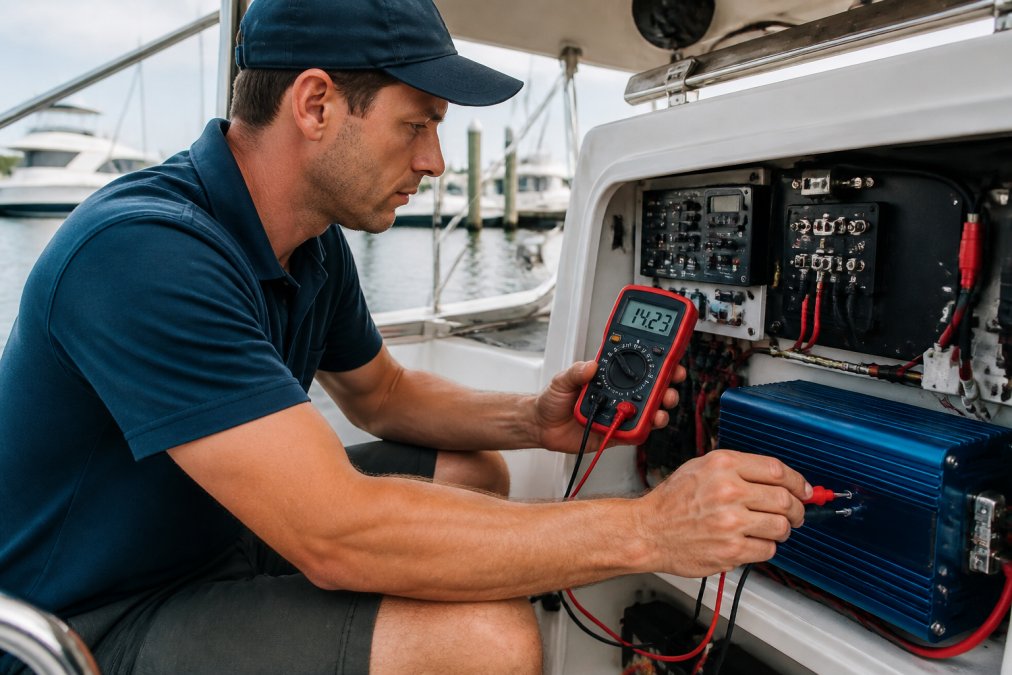
The best daily charging routine for LiFePO4 marine batteries is a three-stage profile: bulk charge to roughly 14.2 to 14.6 volts, absorption hold, then float at 13.4 to 13.6 volts. Unlike lead-acid, lithium does not need a finishing trickle charge, and holding it at full voltage actually stresses the cells.
Bulk, Absorption, and Float Voltage Settings
Match your charger's profile to the battery's spec sheet, not to a lead-acid preset. Lithium-ion cells perform best with partial discharge rather than deep discharge, and complete discharge should be avoided (United States Antarctic Program vessel operations SOP). A few practical rules:
- Charge to 100% before a trip, not after every short run
- Avoid leaving the bank on a constant trickle charge at the dock
- Confirm your charge controller supports lithium profiles before connecting it
How to Store Lithium Batteries for Winter Without Damage
Winter storage is where most lithium banks lose their edge, not because the cells fail, but because owners store them at the wrong state of charge, in the wrong place, or with a parasitic load still attached. The correct approach is to discharge to roughly 50%, disconnect all loads, and store the battery in a cool, dry, well-ventilated space away from freezing.
Step-by-Step Winterization Sequence
Work through these steps in order at haul-out, before the boat sits:
- Charge to 100% first. A full charge lets the BMS top-balance the cells before you put the bank to sleep. Skipping this step is the single most common cause of a cell imbalance that shows up in spring.
- Discharge to 50% SoC. Run a load, a DC fridge, a resistive heater, or the boat's house loads, until the app or shunt reads 50%. Do not guess. A 100Ah bank at 50% is 50Ah remaining, not "half a gauge."
- Disconnect the negative terminal or open the battery switch. Bilge pumps, clocks, stereo memory, and CO detectors can pull a bank to zero over a long winter, and a BMS that cuts off at low voltage still leaves the cells vulnerable to slow self-discharge.
- Verify the BMS is asleep, not faulted. A BMS in low-voltage cutoff is protecting the cells; a BMS in a fault state is telling you something is wrong. Check the app before you walk away.
- Store in a stable, dry compartment. Ideal storage temperature is 50°F to 77°F. Avoid unheated garages that swing below freezing and engine rooms that bake in the sun. Bring the bank indoors if the boat will sit in a hard-freeze climate.
Storage Temperature and Self-Discharge Limits
LiFePO4 cells self-discharge slowly, typically 1% to 3% per month at room temperature, but that rate climbs with heat. A bank stored at 95°F can lose several times the capacity of one stored at 70°F over the same six months. Cold storage is far gentler than hot storage, but charging below freezing is what actually damages cells, so never wake a frozen bank with a charger.
| Storage Condition | Effect on a LiFePO4 Bank |
|---|---|
| 50°F-77°F, 50% SoC | Ideal, minimal capacity loss |
| Below freezing, disconnected | Safe for storage; do not charge until warmed |
| Above 95°F for months | Accelerated capacity fade, even at 50% SoC |
| 100% SoC in heat | Worst case, fastest calendar aging |
| Fully drained, any temp | Risk of cell damage and BMS lockout |
Recommissioning in Spring
Before you trust the bank for a trip, do a short wake-up cycle. Reconnect the negative terminal, charge to 100%, then run a moderate load down to about 70% SoC. This confirms the BMS is reading correctly, the cells are balanced, and your charger is still holding the right absorption voltage. If the app shows a cell group drifting more than about 0.05V from the rest, run a full balance cycle before relying on the bank.
State of Charge and Depth of Discharge: The 80/20 Rule in Practice
The 80/20 rule for lithium marine batteries means keeping routine discharges to about 80% depth of discharge and avoiding 100% discharges except for occasional calibration. Discharged to 80%, lithium marine batteries can last more than 2,000 cycles (RELiON Battery cycle life data), and total lifespan commonly runs 10 to 15 years depending on use (LiTime battery maintenance guide).
| DoD Per Cycle | Typical Cycle Life | Best For |
|---|---|---|
| 50% | 3,000+ cycles | Daily cruising, house loads |
| 80% | 2,000+ cycles | Weekend fishing, mixed use |
| 100% | Under 1,000 cycles | Emergency backup only |
BMS Troubleshooting and Legacy Charger Compatibility
Most "dead" lithium marine batteries aren't dead. They've been shut off by the BMS, and that distinction saves owners a lot of money. The BMS disconnects the bank to protect cells from over-discharge, over-voltage, short circuit, or extreme temperature, and it will reconnect once conditions return to normal. The hard part is knowing which of those four triggered the cutoff, and whether your old charging hardware is the reason it keeps happening.
Reading BMS Fault Codes and Bluetooth Monitoring
Modern lithium batteries ship with Bluetooth monitoring apps that report SoC, cell voltage, internal resistance, and active fault codes in real time. When a bank goes dark, open the app before you reach for a multimeter. A low-voltage cutoff, a cell imbalance warning, or a temperature fault each points to a different fix. Cell balancing issues, where one group drifts from the rest, often show up as reduced capacity retention long before the bank fails outright.
A practical way to read the data:
- Cell voltage spread under 0.03V at rest, healthy and balanced.
- Spread of 0.05V to 0.10V, drift is starting; run a full charge and let the BMS balance.
- Spread above 0.10V, a cell group is failing or the BMS balance circuit is struggling; stop deep-cycling until you diagnose it.
- Internal resistance climbing trip over trip, a sign of aging or a loose internal connection, not a charging problem.
- SoC that drops sharply under light load, capacity loss, not a BMS fault.
Symptoms Checklist: Dying Battery vs. BMS Reset
Before you replace anything, run this triage. It separates a battery that needs a reset from one that is genuinely at end of life.
| Symptom | Likely Cause | First Move |
|---|---|---|
| Bank reads 0V, app shows low-voltage cutoff | BMS protection, not failure | Charge with a lithium-profile charger to wake it |
| Bank charges then cuts off mid-cycle | Over-voltage or cell imbalance | Check absorption voltage and cell spread in app |
| Bank works cold, cuts out when warm | Temperature fault | Verify compartment ventilation and charge current |
| Capacity drops a little every month | Normal aging or parasitic draw | Load-test and check for hidden loads |
| Bank won't accept charge at all | BMS lockout or charger mismatch | Confirm charger profile, then try a known-good lithium charger |
| App shows one cell group far below the rest | Cell failure | Contact the manufacturer; do not bypass the BMS |
Legacy Charger and Alternator Compatibility
Legacy charging systems are the other common pain point. Older alternators and shore chargers built for lead-acid often lack a lithium profile, and some send voltage spikes the BMS reads as a fault. Before upgrading batteries, load test your charging system and confirm it can hold a stable float voltage.
A quick compatibility check:
- Flooded, gel, or AGM preset only, do not use it on lithium. The absorption phase runs too long and can trip the BMS.
- Adjustable or user-defined profile, set bulk to 14.2-14.6V, absorption to the same band, and float to 13.4-13.6V.
- Smart alternator with external regulator, confirm the regulator can be set to a lithium curve; many stock marine alternators cannot.
- Old shore charger with a "desulfation" or equalize mode, never run it on a lithium bank. Equalize voltages will trip the BMS or damage cells.
- No temperature compensation, lithium does not want the voltage shifts lead-acid chargers apply in cold or heat.
Frequently Asked Questions
What are the disadvantages of lithium marine batteries?
Lithium marine batteries cost more upfront than lead-acid and require compatible charging hardware. According to the American Boat and Yacht Council (2024), many owners wrongly assume they are a drop-in replacement. Cold charging below freezing can damage cells without a BMS with low-temp cutoff. They are also less tolerant of full discharge, so over-discharge protection is essential. Finally, lithium marine batteries need a charger with the correct absorption and float voltage profiles; legacy chargers often overcharge them.
Do lithium batteries go bad from sitting?
Yes, if left at the wrong state of charge. For long-term storage over 90 days, keep lithium marine batteries at 40% to 50% SoC in a cool, dry, well-ventilated area to prevent premature wear (Abyss Battery, 2026). Leaving them fully charged or fully drained for months accelerates capacity loss. If a battery sits unused, cycle it every 6 to 12 months: charge to 100%, discharge to 100% DoD, then return to 50% SoC (Power Sonic, 2026).
How do I keep my lithium-ion battery healthy?
Partial discharge beats deep discharge for lithium-ion cells (United States Antarctic Program, 2024). Keep Depth of Discharge at or below 80% for daily use; RELiON Battery (2024) reports lithium marine batteries can exceed 2,000 cycles at that level. Use a charger with the correct LiFePO4 absorption and float voltages, avoid charging below freezing, and check terminals for corrosion every few months. Bluetooth monitoring helps you catch a weak cell before it becomes a failure.
Can you leave lithium marine batteries on a charger all the time?
Only with a charger designed for lithium. LiFePO4 batteries prefer a float voltage around 13.4V to 13.6V for a 12V pack; a legacy lead-acid float of 13.8V or higher will shorten cycle life. If your charger has a lithium profile with float and storage modes, leaving it connected is fine. Otherwise, charge to 100%, disconnect, and let the battery rest. For long-term storage, drop to 40% to 50% SoC instead of floating.
Maintaining lithium marine batteries comes down to respecting temperature, charge profile, and the BMS that guards the cells. Get those three right and a properly sized bank will outlast two or three lead-acid sets. Bigtime Battery stocks a full range of marine replacement batteries, backed by a one-stop selection and competitive pricing, so you can match chemistry and capacity to your boat without guesswork. Get started with Bigtime Battery and keep your power reliable season after season.