 ultimate-guide
Deep Cycle Battery Sizing Guide for Boats
Table of Contents
- Understanding Deep Cycle Battery vs Starting Battery
- BCI Group Sizes and Marine Battery Dimensions
- Calculating Marine Battery Amp-Hour Requirements
- Battery Chemistry: Lead-Acid vs Lithium for Marine Use
- Marine Battery Maintenance Best Practices
- Sizing Your Battery Bank for Extended Cruising
- Conclusion
- Frequently Asked Questions
Last Updated: August 28, 2026
Understanding Deep Cycle Battery vs Starting Battery
A deep cycle battery is designed to be regularly discharged to 50% or lower and recharged repeatedly, while a starting battery delivers a large burst of current for short periods to crank an engine, then relies on the alternator to recharge immediately. Starting batteries use thin lead plates that maximize surface area for rapid current delivery. Deep cycle batteries use thicker plates that withstand repeated partial discharges. Installing a starting battery where you need a deep cycle unit will fail within weeks.
According to the National Marine Manufacturers Association, nearly 60% of boaters reported relying on deep cycle batteries for their onboard equipment, navigation systems, refrigeration, lighting, and communication gear. Your boat's house bank needs deep cycle chemistry, not starting battery technology. If your battery dies prematurely despite proper charging, you likely chose the wrong type.
BCI Group Sizes and Marine Battery Dimensions
The Battery Council International (BCI) standardized battery group sizes to make selection predictable. Each group size has fixed terminal configurations, physical dimensions, and typical amp-hour ratings.
Group 24 and Group 27 Batteries
Group 24 batteries measure 10.25 inches long, 6.8 inches wide, and 8.9 inches tall, delivering approximately 70-85 amp-hours in lead-acid chemistry. They fit mid-sized boats and dual-battery setups where space is limited.
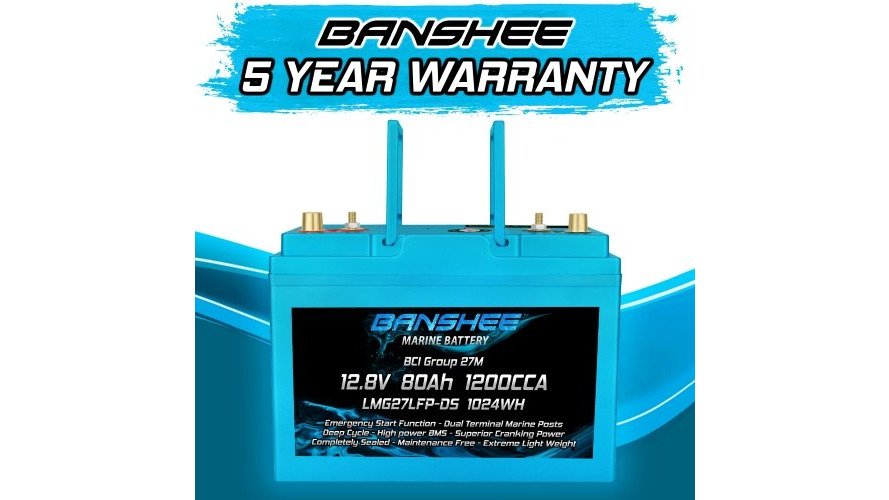
Group 27 batteries measure 12.1 inches long, 6.8 inches wide, and 8.9 inches tall, offering 85-105 amp-hours in lead-acid or AGM chemistry. This is the sweet spot for many sailboats and mid-sized powerboats with moderate house loads. A Group 27 lead-acid battery delivering 100 amp-hours gives you approximately 50 usable amp-hours when you limit discharge to 50%. A Group 24 at 85 amp-hours yields only about 42 usable amp-hours under the same constraint. Bigtime Battery offers a wide selection of marine deep cycle batteries, including both sizes for easy replacement.
Group 31, 4D, and 8D Batteries
Group 31 batteries measure 13 inches long, 6.8 inches wide, and 9.4 inches tall, offering 100-130 amp-hours. This is the most widely used battery group size in recreational marine applications requiring serious capacity. A 120 amp-hour Group 31 lead-acid battery provides approximately 60 usable amp-hours, enough to run a 10-amp refrigerator for 6 hours plus navigation and lighting.
Lithium Group 31 batteries in the same physical case offer 100 amp-hours of usable capacity with substantially lower weight and the ability to use 80-90% depth of discharge rather than only 50% as with lead-acid batteries.
4D and 8D batteries are large-format units used on larger powerboats, motorsailers, and cruising sailboats with substantial house loads. AGM 4D batteries typically offer 180-220 amp-hours, while 8D batteries range from 230-300 amp-hours. These are usually wired in parallel to create massive battery banks and make sense only if your boat has the physical space and electrical load to justify them.
Calculating Marine Battery Amp-Hour Requirements
Sizing a marine battery bank starts with calculating your daily amp-hour load by adding up every electrical device on your vessel, multiplying its current draw in amps by the hours it runs each day.
Step-by-Step Load Calculation
Step 1: List every electrical device. Write down every item that draws power: navigation lights, VHF radio, GPS, autopilot, refrigerator, cabin lights, water pump, and bilge pump.
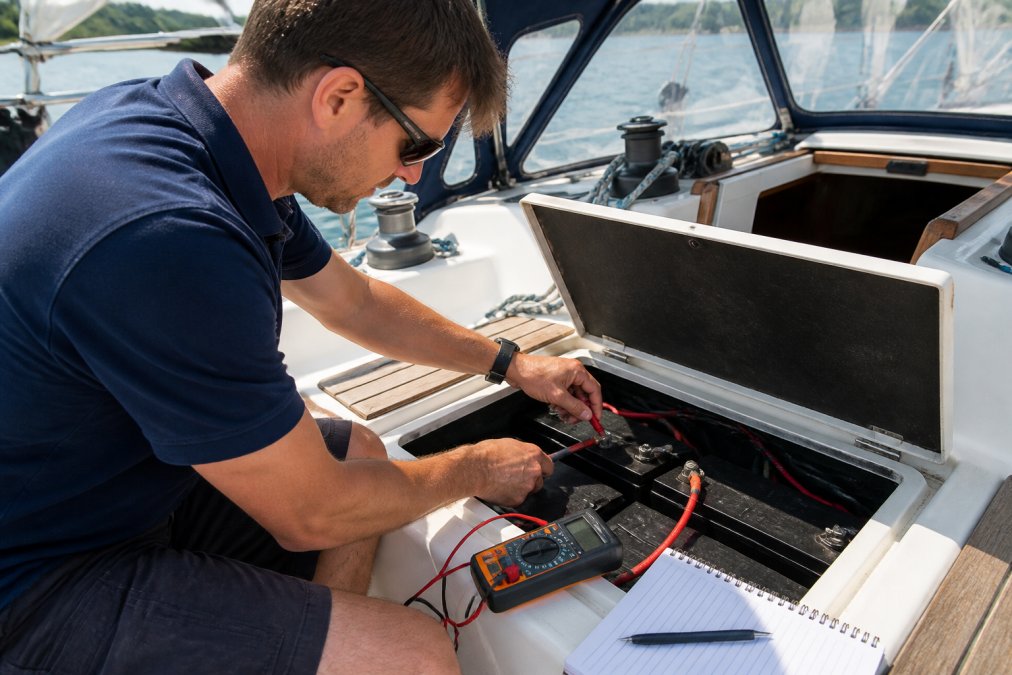
Step 2: Find the current draw for each device. Check the manufacturer's specification or measure with a digital multimeter. A typical VHF radio draws 5 amps. A cabin LED light draws 1-2 amps. A refrigerator draws 10-15 amps while the compressor runs.
Step 3: Estimate daily run time. How many hours per day does each device actually operate? Navigation lights run 12 hours overnight. Refrigerator compressors cycle on and off, running maybe 8 hours total per day. Be realistic.
Step 4: Calculate daily amp-hours. Multiply amps × hours for each device, then add them together.
Example:
- Navigation lights: 3 amps × 12 hours = 36 Ah
- Refrigerator: 12 amps × 8 hours = 96 Ah
- VHF radio: 5 amps × 4 hours = 20 Ah
- Cabin lights: 2 amps × 6 hours = 12 Ah
- Water pump: 8 amps × 0.5 hours = 4 Ah
- Total daily load: 168 Ah
Accounting for Depth of Discharge
Depth of discharge (DoD) is how much of your battery's rated capacity you actually use before recharging. It's the single most important factor in battery lifespan.
Lead-acid batteries should not discharge below 50% of rated capacity. A 100 amp-hour lead-acid battery safely delivers approximately 50 usable amp-hours. This means your actual battery bank must be twice your daily load to stay within the 50% discharge window. If your daily load is 168 amp-hours, you need a 336 amp-hour lead-acid battery bank.
Lithium iron phosphate (LiFePO4) batteries tolerate 80-90% depth of discharge without degradation. A 100 amp-hour LiFePO4 battery delivers 80-100 usable amp-hours. For the same 168 amp-hour daily load, you'd need only a 168-210 amp-hour lithium bank, roughly half the physical space and weight of lead-acid.
The research from U.S. Department of Energy on energy storage systems emphasizes that proper discharge management is critical for battery longevity in renewable energy applications. The same principle applies to marine systems.
Battery Chemistry: Lead-Acid vs Lithium for Marine Use
The chemistry you choose determines weight, maintenance, lifespan, and cost.
Flooded Lead-Acid and AGM Performance
Flooded lead-acid batteries are affordable and forgiving of overcharging. They require regular maintenance: checking water levels, cleaning corrosion, and equalizing charge across cells. Flooded lead-acid delivers approximately 500-1,000 charge cycles before capacity drops to 80%. At one cycle per day, that's 1.5-3 years of life.
AGM (Absorbed Glass Mat) batteries seal the electrolyte in a fiberglass mat. No water to check, no fumes, better vibration resistance. AGM tolerates overcharging better than flooded lead-acid, making it safer in marine environments. AGM delivers similar cycle life to flooded lead-acid but costs 20-30% more for the same capacity.
Lithium Iron Phosphate (LiFePO4) Advantages
Lithium iron phosphate (LiFePO4) delivers 3,000-5,000 charge cycles, 8-15 years of daily cycling, compared to 1-3 years for lead-acid. A 100 amp-hour LiFePO4 battery provides 80-100 usable amp-hours versus only 50 usable amp-hours for lead-acid. Weight savings matter on sailboats: a 100 amp-hour LiFePO4 battery weighs 25-30 pounds versus 60-70 pounds for lead-acid.
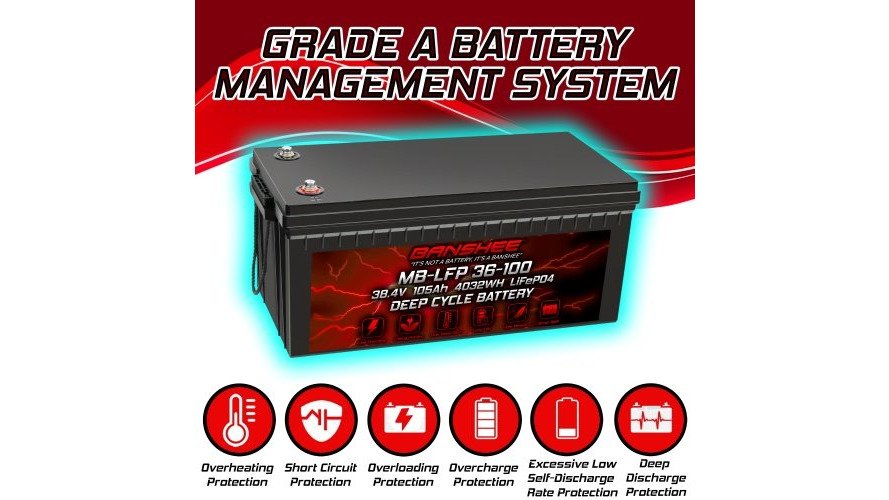
Lithium requires a compatible battery management system (BMS) to prevent overcharging and monitor cell balance. Most marine-grade LiFePO4 batteries include an integrated BMS. Your charging system must also be compatible; older three-stage chargers sometimes cause problems with lithium.
A quality LiFePO4 battery costs 3-4 times more than lead-acid for the same rated capacity. But over a decade of use, the total cost of ownership often favors lithium because you're not replacing lead-acid batteries every 2-3 years.
Marine Battery Maintenance Best Practices
Battery lifespan depends as much on maintenance as on chemistry.
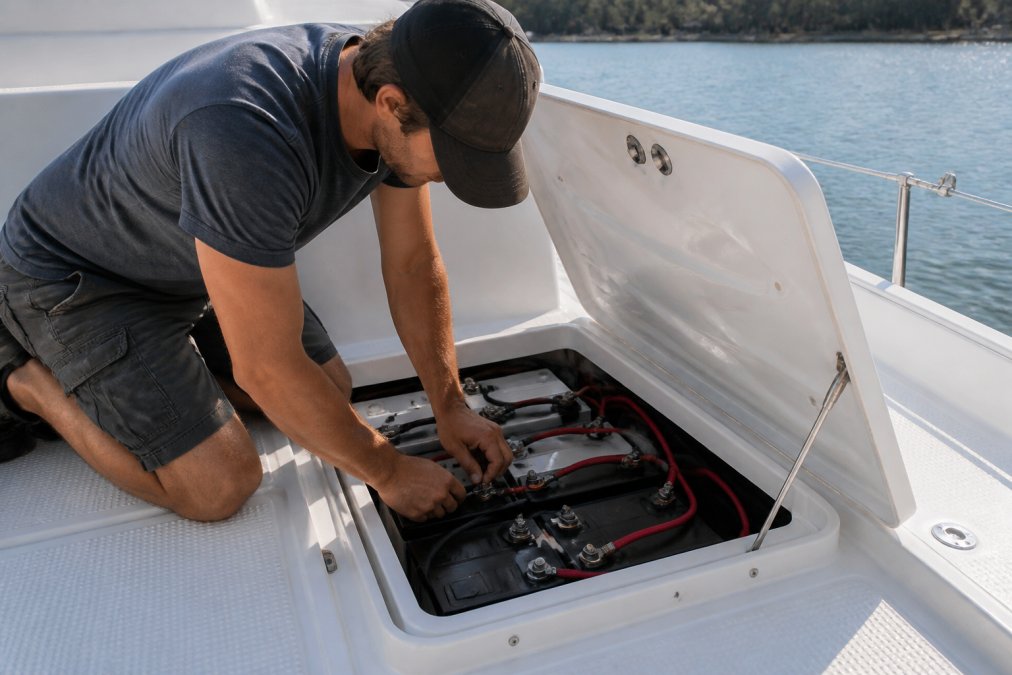
Lead-acid batteries require monthly attention. Check water levels in flooded cells and top up with distilled water if needed. Clean corrosion off terminals with baking soda and water. Test the specific gravity with a hydrometer to catch problems early. preventing battery drain.
AGM batteries need less maintenance but still require monitoring. Check terminal connections monthly; corrosion causes voltage drop and charging problems. Test voltage weekly with a multimeter.
Lithium batteries are maintenance-free in the traditional sense. The integrated BMS handles cell balancing automatically. Monitor the BMS display and charging voltage. If the BMS shows fault codes, address them immediately.
All battery types benefit from proper charging. Use a three-stage charger (bulk, absorption, float) that matches your battery chemistry. Temperature matters: batteries deliver less capacity in cold water and degrade faster in heat. Shade the battery box or install ventilation if your boat sits in direct sun.
According to the U.S. Electric Marine Market Report, hybrid-electric systems held 63.72% of the marine battery market share in 2025, reflecting the growing sophistication of onboard power management. Proper maintenance ensures your battery system performs reliably within these modern configurations.
Sizing Your Battery Bank for Extended Cruising
Extended cruising demands a different approach than day trips. Your battery bank must sustain you for days or weeks between charging opportunities.
Start with your daily load calculation and add a safety margin. If your calculation shows 168 amp-hours daily, plan for 200 amp-hours to account for forgotten equipment, higher loads than estimated, and real-world inefficiencies.
Consider your charging sources. A 400-watt solar array in good sun generates 25-30 amp-hours daily. Running your diesel engine 2 hours daily charges the battery bank at 60-100 amps, recovering 120-200 amp-hours daily.
For cruisers relying primarily on solar with minimal engine use, the battery bank must cover 3-5 days of autonomy. Multiply your daily load by 3-5 and apply the 50% discharge limit for lead-acid (or 80% for lithium).
Example for extended cruising with solar:
- Daily load: 168 Ah
- Autonomy goal: 4 days
- Total capacity needed: 168 × 4 = 672 Ah
- With lead-acid (50% DoD): 672 ÷ 0.5 = 1,344 Ah rated capacity
- With lithium (80% DoD): 672 ÷ 0.8 = 840 Ah rated capacity
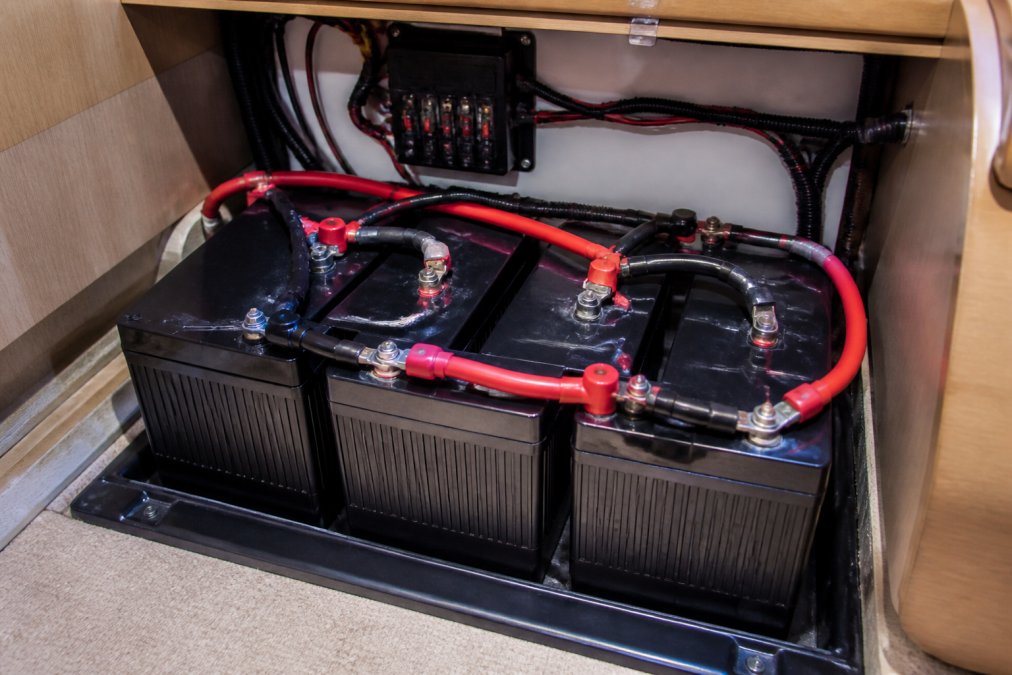
This is why many long-distance cruisers switched to lithium. A 1,344 amp-hour lead-acid bank would require eight 168 amp-hour 4D batteries, weighing nearly 600 pounds. An 840 amp-hour lithium bank fits in a quarter of the space and weighs 250 pounds.
Wire sizing becomes critical with large battery banks. Heavy-gauge cables (4/0 or larger) prevent voltage drop between the battery and the electrical panel. Use the ABYC Standards for marine electrical systems to size conductors correctly for your bank capacity.
Conclusion
Selecting the right deep cycle battery sizing for boats requires understanding three core concepts: the difference between deep cycle and starting chemistry, the BCI group sizes that fit your space, and the amp-hour load calculation that matches capacity to actual need.
Lead-acid batteries remain affordable and widely available, but they demand twice the rated capacity to stay within safe discharge limits and require regular maintenance. Lithium iron phosphate batteries cost more upfront but deliver double the usable capacity, weigh half as much, and last 8-15 years instead of 2-3 years.
Your extended cruising plans determine everything. A weekend trip requires a modest battery bank sized for 1-2 days of autonomy. A six-month passage demands 5+ days of capacity, which almost always points toward lithium as the practical choice.
Start with your load calculation. Be honest about daily usage. Choose your chemistry based on budget and cruising duration. Size your bank conservatively; you'll always find uses for extra capacity. Bigtime Battery offers a wide selection of marine deep cycle batteries, ensuring you'll find the exact chemistry and group size your boat needs, with the reliability and performance that serious boaters demand.
=== FAQ ANSWERS (audit these too, same rules) ===
[1] Q: How do I determine what size battery I need for my boat? A: Calculate your daily amp-hour (Ah) load by listing every electrical device on your boat, multiplying its current draw in amps by the hours it runs daily, then summing all values. For lead-acid batteries, size to twice your daily Ah usage to protect lifespan, a 100Ah lead-acid delivers only ~50 usable amp-hours. Lithium LiFePO4 batteries deliver 80-100 usable Ah from a 100Ah rating, making them twice as efficient. Account for your boat's typical usage patterns and reserve capacity needs.
[2] Q: What does BCI group size mean for marine batteries? A: BCI (Battery Council International) group size is a standardized classification that defines battery dimensions, terminal configuration, and approximate amp-hour capacity. Common marine sizes include Group 24 (85-105 Ah), Group 27 (100-130 Ah), Group 31 (100-130 Ah), 4D (180-220 Ah), and 8D (230-300 Ah). Your boat's battery tray dimensions and electrical requirements determine which group size fits your application. Larger groups provide more capacity for extended trips and refrigeration systems.
[3] Q: How long will a 100Ah battery run a 55lb trolling motor? A: A 55-pound trolling motor typically draws 45-60 amps at full throttle. A 100Ah lead-acid battery at 50% usable depth delivers ~50 usable amp-hours, providing roughly 50-67 minutes of continuous operation. A 100Ah lithium LiFePO4 battery delivers 80-100 usable amp-hours, extending runtime to 80-133 minutes. Actual runtime varies with throttle setting, water conditions, and motor efficiency. For extended fishing trips, consider a larger battery bank or parallel-connected batteries.
[4] Q: What is the difference between a group 24 and group 27 marine battery? A: Group 24 batteries are smaller (10.2" × 6.8" × 8.9") and deliver 85-105 amp-hours, suitable for mid-sized powerboats and dual-battery setups. Group 27 batteries are larger (13" × 6.8" × 8.9") and deliver 100-130 amp-hours, better for sailboat house banks and larger trolling motor systems. Group 27 offers more capacity in a similar footprint. Choose based on your battery tray dimensions, daily load requirements, and available space. Both are available in lead-acid, AGM, and lithium chemistries.
Frequently Asked Questions
How do I determine what size battery I need for my boat?
Calculate your daily amp-hour (Ah) load by listing every electrical device on your boat, multiplying its current draw in amps by the hours it runs daily, then summing all values. For lead-acid batteries, size to twice your daily Ah usage to protect lifespan, a 100Ah lead-acid delivers only ~50 usable amp-hours. Lithium LiFePO4 batteries deliver 80-100 usable Ah from a 100Ah rating, making them twice as efficient. Account for your boat's typical usage patterns and reserve capacity needs.
What does BCI group size mean for marine batteries?
BCI (Battery Council International) group size is a standardized classification that defines battery dimensions, terminal configuration, and approximate amp-hour capacity. Common marine sizes include Group 24 (85-105 Ah), Group 27 (100-130 Ah), Group 31 (100-130 Ah), 4D (180-220 Ah), and 8D (230-300 Ah). Your boat's battery tray dimensions and electrical requirements determine which group size fits your application. Larger groups provide more capacity for extended trips and refrigeration systems.
How long will a 100Ah battery run a 55lb trolling motor?
A 55-pound trolling motor typically draws 45-60 amps at full throttle. A 100Ah lead-acid battery at 50% usable depth delivers ~50 usable amp-hours, providing roughly 50-67 minutes of continuous operation. A 100Ah lithium LiFePO4 battery delivers 80-100 usable amp-hours, extending runtime to 80-133 minutes. Actual runtime varies with throttle setting, water conditions, and motor efficiency. For extended fishing trips, consider a larger battery bank or parallel-connected batteries.
What is the difference between a group 24 and group 27 marine battery?
Group 24 batteries are smaller (10.2" × 6.8" × 8.9") and deliver 85-105 amp-hours, suitable for mid-sized powerboats and dual-battery setups. Group 27 batteries are larger (13" × 6.8" × 8.9") and deliver 100-130 amp-hours, better for sailboat house banks and larger trolling motor systems. Group 27 offers more capacity in a similar footprint. Choose based on your battery tray dimensions, daily load requirements, and available space. Both are available in lead-acid, AGM, and lithium chemistries.