 ultimate-guide
AGM Marine Battery Bulk Purchase: 2026 Buyer's Guide
Table of Contents
- Why Bulk AGM Marine Battery Purchase Makes Sense in 2026
- AGM Marine Battery Specs That Decide a Bulk Order
- Wholesale Marine Battery Pricing: What Moves the Number
- Bulk Procurement Logistics and Shipping Rules
- AGM Battery Storage Best Practices for Bulk Inventory
- Marine Battery Maintenance Guide for Fleet and Shop Use
- Conclusion
- Frequently Asked Questions
Last Updated: September 21, 2026
Why Bulk AGM Marine Battery Purchase Makes Sense in 2026
The global marine battery market reached $775.9 million in 2025 and is projected to hit $893.1 million in 2026, according to Grand View Research's marine battery market report. With roughly 67% of households owning at least one boat, demand for reliable deep cycle power has never been higher. For fleet operators and marine shops, an AGM marine battery bulk purchase is no longer just a convenience. It's a cost-control strategy.
Upfront Cost vs. Five-Year Ownership Cost
The sticker price is the least important number in a bulk order. Commercial buyers increasingly evaluate five-year ownership costs rather than upfront purchase prices, according to Bigtime Battery's 2026 procurement analysis. AGM batteries cost less initially than lithium (LiFePO4) alternatives, but they cycle fewer times and weigh more. Run the math before you commit:
| Cost Factor | AGM | LiFePO4 |
|---|---|---|
| Upfront per unit | Lower | Higher |
| Cycle life | Moderate | 3-5x longer |
| Weight penalty | Significant | Minimal |
| Maintenance | Low | Very low |
AGM Marine Battery Specs That Decide a Bulk Order
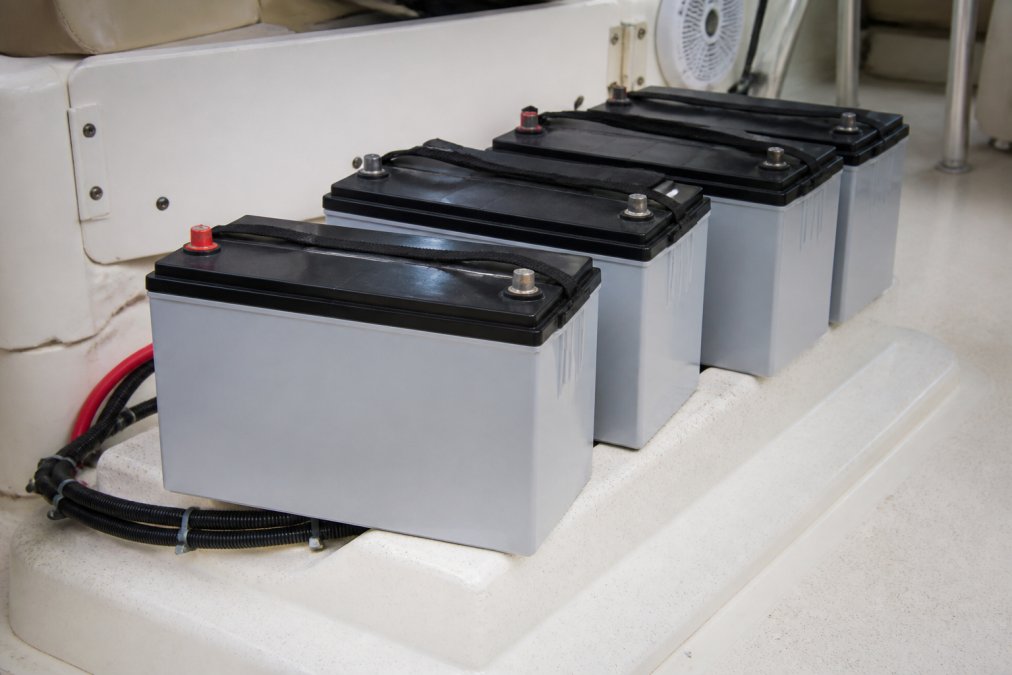
An AGM marine battery is a sealed lead-acid battery that suspends its electrolyte in a fiberglass mat, making it spill-proof, vibration-resistant, and maintenance-free. Those traits matter at scale: a pallet of leaking batteries is a liability, not inventory.
Amp Hour Ratings and Group Size
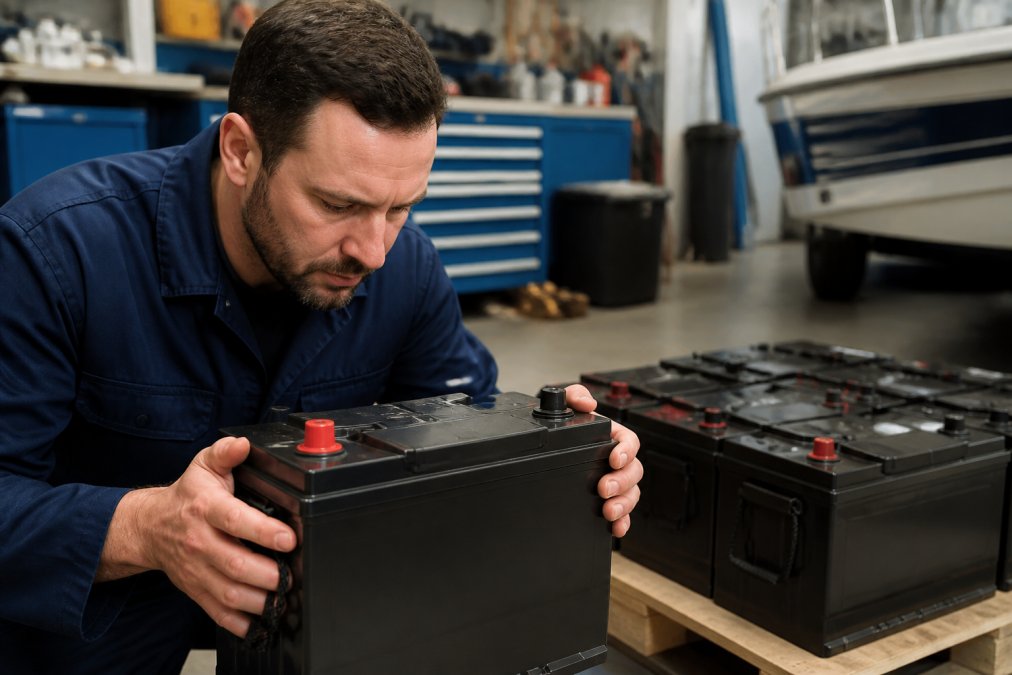
Amp hour (Ah) rating tells you how much power the battery stores. Group size tells you whether it physically fits. Get one wrong and the whole order is scrap. Match both to your vessel's battery bank before ordering, and confirm cold cranking amps if the battery also handles starting duty.
Terminal Type and Charging Profile
Terminal type (stud, post, or dual) determines your interconnect hardware. Charging profile determines compatibility with your existing inverter and shore power setup. AGM batteries require a specific float voltage and absorption phase. A mismatched charger will shorten cycle life across the entire bank.
Wholesale Marine Battery Pricing: What Moves the Number
Wholesale marine battery pricing is driven by volume, chemistry, and supply continuity, not by retail convenience. According to Leoch Lithium's 2026 marine battery sourcing guide, wholesale buyers prioritize marine-specific durability, project compliance, and long-term service support over retail-focused perks. Individual retail pricing for a 12V marine battery sits near $179.99, per Battery Wholesale's 2026 price benchmark, but bulk buyers negotiate against a different set of levers.
How Volume Tiers Actually Break
Most distributors structure AGM pricing in tiers, and the jumps between them are not linear. A common pattern looks like this:
- 1-5 units: retail or near-retail pricing, no freight allowance.
- 6-23 units (one pallet): first meaningful discount, typically the point where a supplier will quote a landed price instead of a unit price.
- 24-47 units (two pallets): tier break where per-unit freight drops because the shipment consolidates into a single LTL load.
- 48+ units (full pallet quantity or truckload): best per-unit pricing, but you now own the storage, rotation, and sulfation risk.
The Cost Stack Retail Pricing Hides
The quoted unit price is rarely the invoice price. For AGM marine batteries, the landed cost typically includes:
- Freight class. Lead-acid batteries generally ship under a higher freight class than dry goods of similar size because of density and hazmat handling.
- Hazmat fees. Non-spillable AGM batteries are often exempt from some DOT hazmat rules, but carriers still apply handling surcharges. Confirm the exemption in writing before you assume it applies.
- Core charges. If you're replacing existing batteries, core credits can offset 5-15% of the invoice, but only if you return the cores on the same shipment.
- Payment terms. Net-30 or Net-60 terms are effectively a financing cost baked into the unit price. A supplier quoting 3% lower for prepayment is not necessarily cheaper once you price the float.
Total Cost of Ownership: AGM vs. LiFePO4 at Fleet Scale
Unit price is the wrong comparison for a commercial fleet. The right one is cost per usable cycle over the service life of the bank. AGM batteries typically deliver a few hundred to roughly a thousand cycles at moderate depth of discharge, while LiFePO4 banks commonly deliver several thousand. That gap narrows or widens depending on how you actually run the boat:
- Seasonal operations (under ~200 cycles/year): AGM usually wins on TCO because the upfront savings are never recovered by the longer lithium cycle life within the ownership window.
- Daily commercial use (300+ cycles/year): lithium closes the gap fast, and in many fleet scenarios overtakes AGM on TCO within the first replacement cycle.
- Weight-sensitive vessels: the AGM weight penalty costs fuel and reduces payload, which rarely shows up in a unit-price comparison but shows up in the operating budget.
Bulk Procurement Logistics and Shipping Rules
Lead-acid batteries ship as regulated goods, and that changes your logistics. Flooded and AGM batteries fall under hazardous materials rules that govern packaging, labeling, and carrier eligibility. Your supplier must ship in compliant packaging with proper UN classification.
Freight, Palletizing, and Carrier Eligibility
AGM batteries are generally classified as non-spillable under common carrier rules when they meet the vibration and pressure-differential test criteria, but that exemption is not automatic, it depends on the specific battery and the carrier's interpretation. Practical implications for a bulk order:
- Palletizing. Batteries ship upright, strapped, and shrink-wrapped on a standard 48x40 pallet. Ask for the pallet quantity per SKU before you quote freight; a Group 24 pallet and a Group 8D pallet are not the same load.
- LTL vs. FTL. Less-than-truckload is fine for one or two pallets. Once you cross roughly 6-10 pallets depending on weight, full truckload often prices lower per unit and avoids terminal handling damage.
- Liftgate and residential delivery. Marine shops and yards are usually commercial addresses, but if you're receiving at a residential or marina address without a dock, liftgate service adds cost and lead time.
- Damage claims. Photograph every pallet on arrival before signing the bill of lading. Concealed damage claims on battery shipments are difficult to win after the fact.
Bulk Storage Requirements
Storing a pallet of AGM batteries is not the same as storing a pallet of parts. Key requirements:
- Temperature. Cool, dry, and stable. High heat accelerates self-discharge and shortens calendar life even on unused stock.
- Charge state. Store at full charge and top off periodically. A battery left at partial state of charge for months will sulfate, and sulfation is permanent.
- Ventilation. AGM batteries are sealed and recombinant, but a bulk storage room still needs airflow in case of a vented failure.
- Rotation. First-in, first-out. Label every pallet with its arrival date and rotate stock so the oldest batteries ship first.
Stagger your bulk orders across two delivery windows. One large shipment creates a storage and cash-flow problem; two smaller ones keep inventory fresh and reduce sulfation risk on stock sitting too long.
Installation and Compliance at Fleet Scale
Bulk purchasing only pays off if the batteries are installed correctly across the whole fleet. The American Boat and Yacht Council (ABYC) publishes the standards most surveyors, insurers, and yards reference for marine battery installation, including requirements for overcurrent protection within a specified distance of the battery, secure mounting that resists vibration and vessel motion, and ventilation and terminal protection.
- Standardize the bank. If every vessel in the fleet uses the same group size, terminal type, and charging profile, your spares inventory, maintenance schedule, and training all simplify. Mixed banks across a fleet multiply the failure modes.
- Match the charger to the bank. AGM batteries require a specific float voltage and absorption phase. A charger set up for flooded lead-acid will undercharge or overcharge an AGM bank and shorten its life across every vessel it touches.
AGM Battery Storage Best Practices for Bulk Inventory
AGM battery storage best practices come down to three variables: temperature, charge state, and time. Store batteries in a cool, dry space and top off the charge every few months. A battery left at partial charge for months will sulfate, and sulfation is permanent.
Marine Battery Maintenance Guide for Fleet and Shop Use
A marine battery maintenance guide for fleet operations is simpler than most mechanics expect. AGM batteries are maintenance-free in the sense that you never add water, but they still need periodic attention:
- Check terminal torque and clean corrosion quarterly
- Verify float voltage on the whole bank monthly
- Test reserve capacity before each season
- Replace weak cells before they drag down the bank
The real difference between a battery bank that lasts three seasons and one that lasts seven is rarely the battery itself. It's whether anyone checked the charging profile after installation.
Conclusion
Bulk buying AGM marine batteries rewards operators who plan for total cost of ownership, not just unit price. The buyers who get burned are the ones who skip the landed-cost math, ignore group size, or let inventory sit uncharged through the off-season. Bigtime Battery stocks a wide selection of replacement batteries for marine, medical, and specialty applications, all at competitive prices.
Frequently Asked Questions
What are the primary advantages of buying AGM marine batteries in bulk?
Bulk buying cuts your per-unit cost and locks in supply continuity, which matters when a fleet or shop cannot wait on backorders. AGM batteries are spill-proof and maintenance-free, so storing a pallet is simpler than flooded lead-acid. You also standardize group size, terminal type, and charging profile across vessels, which reduces wiring mistakes and simplifies replacement. Commercial buyers increasingly weigh five-year ownership costs rather than upfront price alone.
How do I determine the right capacity for bulk marine battery orders?
Start with the amp hour rating your vessels actually draw. Add up continuous loads (electronics, refrigeration, lighting), estimate daily runtime, then size the battery bank so depth of discharge stays near 50% for AGM. Check group size and terminal type fit the existing trays and cables. If you run a mixed fleet, order the two or three most common ratings rather than one compromise size. Bigtime Battery's team can help match amp hour ratings and group sizes to your specific boats before you commit to a volume order.
What is the expected shelf life of AGM batteries when stored in bulk?
AGM batteries self-discharge roughly 2% to 3% per month at room temperature, so they need a top-up charge every two to three months to avoid sulfation. Kept cool, dry, and fully charged, a stored AGM battery holds its capacity for 6 to 12 months before performance starts to slip. Rotate stock first-in, first-out, and never stack batteries directly on a concrete floor without a barrier.
Are there specific shipping regulations for bulk marine battery orders?
Yes. AGM batteries are non-spillable lead-acid, so they ship under a different classification than flooded batteries, but carriers still require proper terminal protection, upright orientation, and DOT-compliant labeling. Bulk orders usually move by freight rather than parcel, which means you need a loading dock or liftgate service arranged in advance. Confirm the carrier handles hazardous materials and ask for the shipping papers before dispatch. Bigtime Battery coordinates freight for commercial accounts and will confirm the paperwork your order needs before it leaves the warehouse.