 ultimate-guide
Why Sump Pump Batteries Fail During Outages
Table of Contents
- Why Sump Pump Batteries Fail During Outages
- How Battery Backup Systems Function
- The Role of Power Outages in Sump Pump Failure
- Common Causes of Sump Pump Battery Failure
- How to Test Sump Pump Backup Battery Health
- Sump Pump Battery Lifespan and Replacement Cycles
- Signs of a Failing Sump Pump Battery
- Maintenance Strategies to Prevent Battery Failure
- Frequently Asked Questions
Last Updated: September 4, 2026
Why Sump Pump Batteries Fail During Outages
Power outages are the number one cause of primary sump pump failure in residential settings, according to PumpAlarm's analysis of basement flooding causes. That statistic explains why sump pump batteries fail during outages so frequently: the moment the grid drops, an aging or poorly maintained backup battery becomes the last line of defense between your basement and severe water damage. In this guide from Bigtime Battery, we break down the mechanical, electrical, and environmental reasons these batteries let homeowners down, and how to prevent it. Below, we'll show you exactly how to test, maintain, and replace your backup system before the next storm hits.
Most backup batteries are never tested until needed, and by then it is too late. A battery that has sat idle for years will almost certainly fail under the sudden load of an active sump pump.
How Battery Backup Systems Function
A battery backup sump pump system is a secondary pumping unit powered by a deep cycle battery that activates automatically when the primary pump loses power. A float switch detects rising water and triggers the backup unit to pump.
The critical limitation is battery capacity. A deep cycle battery stores a finite amount of energy, and the discharge rate depends entirely on how hard the pump has to work. If water enters the sump pit slowly, a fully charged battery might run the pump for hours. If the inflow is rapid, the battery can deplete its charge quickly, failing to keep up with the volume compared to a grid-powered or generator-backed system, as noted in Bogleheads forum discussions on backup system limitations.
Battery Chemistry and Environmental Factors
Battery chemistry and basement conditions are critical variables often overlooked. The two most common types, flooded lead-acid and sealed AGM (Absorbent Glass Mat) batteries, perform very differently in typical basement environments.
Flooded lead-acid batteries are affordable but temperature-sensitive. For every 15°F drop below 77°F, capacity drops approximately 50 percent. A 55°F basement delivers only half the runtime of room temperature. They require periodic water top-offs and are prone to sulfation, corrosion, and plate degradation in cold, damp conditions.
AGM batteries (sealed, maintenance-free) are less temperature-sensitive and resist sulfation better, but cost 30-50 percent more and have lower tolerance for overcharging. They can fail prematurely from internal corrosion if the charger is miscalibrated or left unmonitored for years.
A flooded lead-acid battery in a cold, humid basement may deliver only 60-70 percent of rated capacity, while an AGM battery maintains 85-95 percent. Choosing the wrong chemistry is a common reason backup systems fail.
The Role of Power Outages in Sump Pump Failure
Most residential sump pumps rely exclusively on the home's electrical system. When the grid goes down, the backup battery must bridge the gap, but its effectiveness depends on factors homeowners often overlook.
Power outages rarely occur in isolation. Severe storms that knock out electricity also bring heavy rain, causing the sump pit to fill faster than usual. This combination of no power and high water inflow puts maximum strain on the backup system.
Common Causes of Sump Pump Battery Failure
The typical lifespan of a backup battery for a sump pump is 3-5 years, even with minimal usage, according to BatteryClerk's maintenance guidelines. Yet many batteries fail long before that window closes. The most common culprit is neglect: batteries that are never tested, never cleaned, and never replaced on schedule will fail at the worst possible moment.
Beyond simple neglect, several specific failure modes account for most dead backup batteries:
- Sulfation: When a lead-acid battery sits partially discharged for extended periods, lead sulfate crystals form on the plates, permanently reducing capacity.
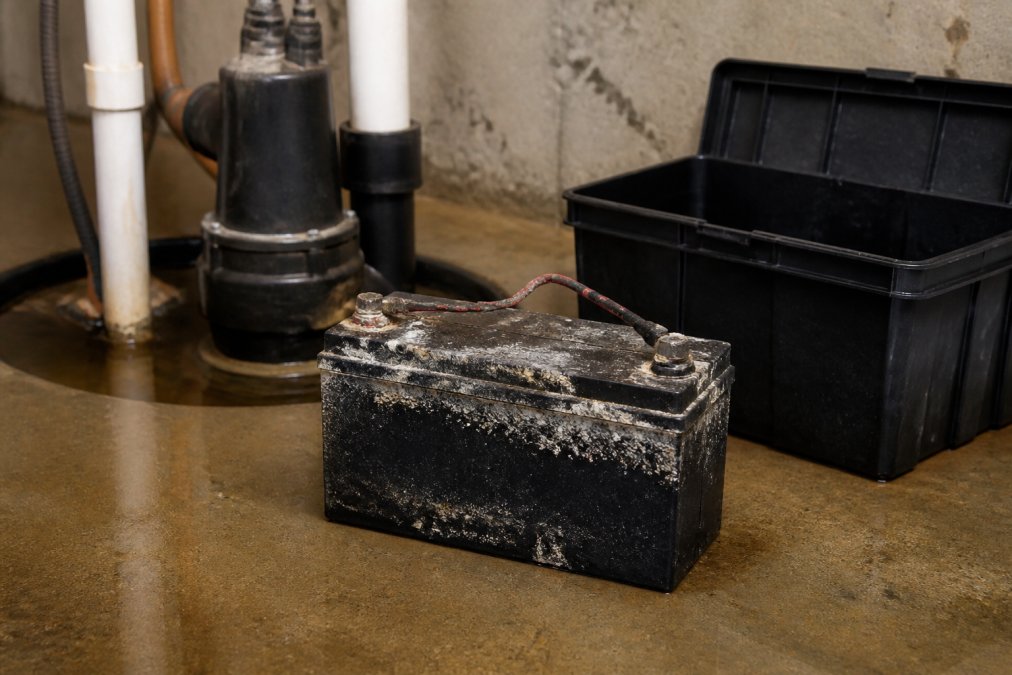
- Terminal corrosion: White or green buildup on the terminals creates resistance, causing a voltage drop that prevents the pump from receiving enough power.
- Electrolyte depletion: In flooded batteries, water loss exposes the plates, leading to damage and reduced performance.
- Undercharging: If the charger is faulty or the battery is not connected properly, it never reaches full capacity.
- Mechanical failure of the pump: A stuck float switch, burned-out motor, or clogged impeller can drain the battery even when the pump should not be running.
Sump pumps themselves are mechanical devices with a finite operational lifespan of 7-10 years, and failures during outages are frequently attributed to a combination of power loss and mechanical issues such as stuck float switches, burned-out motors, or clogged impellers, per HomeScore's 2026 install cost guide.
How to Test Sump Pump Backup Battery Health
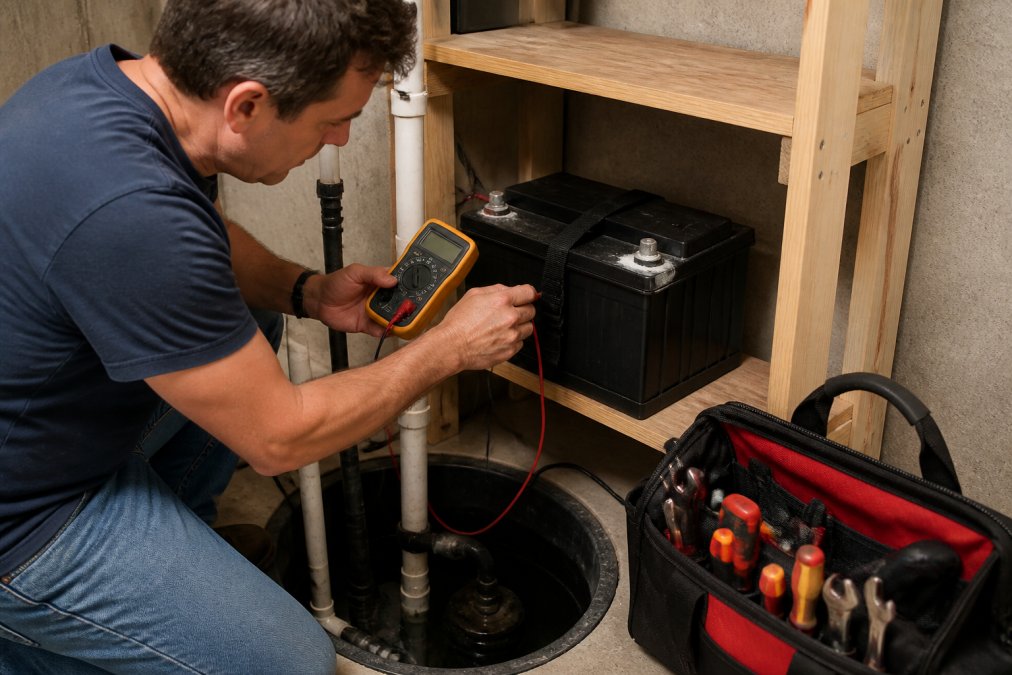
Testing your backup battery monthly is the single most effective way to prevent failure during an outage. The process takes about ten minutes and requires only a digital voltmeter. A fully charged 12-volt deep cycle battery should read between 12.6 and 12.8 volts at rest. Anything below 12.4 volts indicates a charge level under 75 percent, and below 12.0 volts means the battery is severely depleted and may be damaged.
Step-by-Step Load Testing Procedure
Here is a simple load testing procedure to verify the battery can actually do its job:
- Visual inspection: Check for corrosion on terminals, cracks in the case, and bulging sides.
- Voltage check: Measure the resting voltage with the pump off. Record the reading.
- Load test: Activate the backup pump manually by lifting the float switch. Let it run for 5-10 minutes while monitoring voltage.
- Monitor voltage drop: A healthy battery should maintain voltage above 12.0 volts under load. A rapid drop below 11.5 volts indicates a weak battery nearing the end of its life.
- Check the charger: Verify the charger is plugged in and the indicator light shows a full charge state.
Diagnostic Troubleshooting Flowchart
If your backup system is showing signs of failure, use this flowchart to pinpoint the problem:
Problem: Alarm beeping continuously or at random intervals
- Check resting voltage (charger disconnected, battery at rest for 30 minutes). If below 12.4V → Battery is undercharged. Verify charger is plugged in and functional. If charger light is off or red, charger may be faulty; replace it.
- If voltage is normal (12.6-12.8V) but alarm still beeps → Perform load test. If voltage drops below 11.5V within 2 minutes of pump running → Battery is weak; replace it. If voltage holds steady above 12.0V → Alarm sensor may be faulty; consult pump manual or manufacturer.
Problem: Pump runs very slowly or weakly when activated
- Check resting voltage. If below 12.0V → Battery is severely discharged. Charge for 24 hours and retest. If still below 12.0V after full charge cycle → Battery has internal damage; replace it.
- If voltage is normal but pump is slow → Check for terminal corrosion. Clean terminals with a baking soda and water paste, dry thoroughly, and retest. If corrosion returns within days → Battery is off-gassing excessively; replace it.
- If terminals are clean and voltage is normal → Float switch may be stuck or pump impeller may be clogged; inspect pump mechanically.
Problem: Pump makes rapid clicking sounds but does not run
- Check resting voltage. If below 11.5V → Battery is too weak to start the pump. Charge fully and retest. If voltage is normal but clicking persists → Pump motor may be burned out or stuck; the battery is fine but the pump requires replacement.
Problem: Battery case is swollen or bulging
- Do not attempt to test or use this battery. Swelling indicates internal failure, overcharging, or excessive heat exposure. Replace immediately. Check that the charger is not set to an excessive voltage (should be 13.2-13.8V for lead-acid, 14.1-14.4V for AGM).
Problem: Rotten egg smell near battery
- This indicates hydrogen sulfide gas from internal failure. Do not attempt to charge or use the battery. Ventilate the area and replace the battery immediately.
Industry guidance now emphasizes monthly voltmeter testing and terminal maintenance to prevent failure during emergency events, a shift toward proactive monitoring of battery health, according to Blackhawk Electric's battery maintenance recommendations.
Sump Pump Battery Lifespan and Replacement Cycles
The typical lifespan for a sump pump backup battery is 3-5 years, even with minimal use. A battery that sits idle for months, constantly trickle-charged, experiences gradual degradation from sulfation and plate corrosion regardless of actual pump usage.
Base replacement on battery age and test results, not on failure. At the three-year mark, test quarterly instead of monthly. Replace immediately if it fails any load test.
| Battery Age | Recommended Action | Testing Frequency |
|---|---|---|
| 0-2 years | Normal maintenance | Monthly voltage check |
| 2-3 years | Increase testing frequency | Monthly load test |
| 3-5 years | Plan for replacement | Quarterly load test |
| 5+ years | Replace immediately | Replace regardless of condition |
Signs of a Failing Sump Pump Battery
A failing sump pump battery rarely fails without warning signs, but most homeowners never look for them. The most obvious indicator is the alarm: it triggers when battery voltage drops below a safe threshold, often because the battery is old or undercharged.
Other signs include:
- Audible clicking: Pump tries to start but lacks power.
- Slow pumping: Reduced power output.
- Swollen case: Internal damage from overcharging or excessive heat.
- Corroded terminals: Severe buildup that returns quickly suggests off-gassing and internal problems.
- Rotten egg smell: Indicates hydrogen sulfide gas and internal failure.
The most common reason for backup battery failure during emergencies is that they are only tested during actual power outages. Regular testing is essential, not optional.
Maintenance Strategies to Prevent Battery Failure
Preventing sump pump battery failure requires three disciplines: regular testing, proper maintenance, and timely replacement. A battery tested monthly, kept clean, and replaced on schedule will almost never fail during an outage.
Monthly maintenance includes checking electrolyte levels in flooded batteries, cleaning terminal corrosion with baking soda and water, and verifying the charger functions. For sealed batteries, visual inspection and voltage testing are primary tasks. Keep the area clean and dry, and secure the battery.
:::tip If you are replacing your backup battery, choose a deep cycle battery specifically rated for standby power applications. A standard automotive starting battery is not designed for repeated deep discharges and will fail prematurely. Match the battery capacity to your pump's amperage draw and the typical duration of outages in your area.
For extra protection, consider a smart home monitoring system that alerts you to battery voltage drops and pump activity remotely. At Bigtime Battery, we stock deep cycle batteries suited for sump pump backup applications and can help identify the right replacement for your pump model.
Keeping your basement dry depends on a backup system that is tested, maintained, and replaced on schedule. The cost of a new deep cycle battery is small compared to water damage repair. Bigtime Battery offers reliable specialty batteries for sump pumps with low prices. Get started with Bigtime Battery and ensure your backup system is ready for the next outage.
Frequently Asked Questions
How long should a sump pump backup battery last?
A typical sump pump backup battery has a lifespan of 3 to 5 years, even with minimal use. This is shorter than many people expect because deep cycle batteries degrade naturally over time due to electrolyte evaporation and internal chemical changes. After 5 years, capacity drops significantly, making the battery unreliable during emergencies. Regular voltage testing can help you catch declining performance before failure.
How do I test my sump pump backup battery to ensure it works?
Use a digital voltmeter to check voltage monthly. A healthy deep cycle battery should read 12.6 volts or higher when fully charged. Connect the positive (red) probe to the positive terminal and the negative (black) probe to the negative terminal. If voltage drops below 12 volts, the battery needs charging or replacement. Also inspect terminals for corrosion and clean them with a wire brush if needed. Load testing under actual pump demand is the most reliable method but requires professional equipment.
What are the signs that my sump pump battery is failing?
Signs include the alarm triggering when power is still available, slow or weak pump activation, visible corrosion on terminals, a swollen or cracked battery case, or a sulfur smell near the battery. If the pump fails to activate during a power outage test, the battery has likely failed. Voltage readings below 11 volts indicate imminent failure. Any of these signs warrant immediate replacement to avoid basement flooding during the next outage.
Why do sump pump batteries fail more often during power outages?
Most backup batteries are never tested until an actual outage occurs. If the battery is old, undercharged, or suffering from terminal corrosion, it will fail when you need it most. Additionally, high water inflow rates during storms can rapidly deplete battery charge faster than the backup pump can handle the volume, causing the system to fail. Power surges that accompany outages can also damage the battery's internal cells or the inverter that converts DC power to AC power for the pump motor.