 comparison
UTV Battery Upgrade Options: A 2026 Guide
Table of Contents
- UTV Battery Upgrade Options: Which Type Is Right for You?
- AGM vs Lithium UTV Batteries: Performance and Cost Comparison
- Understanding UTV Battery CCA Requirements
- UTV Dual Battery Setup Guide
- How to Choose the Right Battery for Your UTV Model
- Signs Your UTV Battery Needs Replacement
- Installation and Maintenance Considerations
- Frequently Asked Questions
Last Updated: September 2, 2026
UTV Battery Upgrade Options: Which Type Is Right for You?
The U.S. electric UTV and ATV powertrain market was valued at USD 2.46 billion in 2022 and is projected to grow at a compound annual growth rate of 10.2% through 2030, driven by environmental concerns and technological advances (grandviewresearch.com). For UTV owners, this market expansion means more battery options than ever before. Choosing the right UTV battery upgrade means matching your vehicle, usage patterns, and budget to the right chemistry.
At Bigtime Battery, we understand that upgrading your UTV battery is a significant decision. Whether you're running a utility vehicle for work, tackling weekend trails, or powering accessories like light bars and winches, the battery you choose will directly impact performance, reliability, and total cost of ownership. This guide walks you through the major UTV battery upgrade options available in 2026, breaks down the real differences between chemistries, and helps you identify which battery type makes sense for your situation.
AGM vs Lithium UTV Batteries: Performance and Cost Comparison
The choice between Absorbent Glass Mat (AGM) and lithium iron phosphate (LiFePO4) batteries dominates the UTV battery upgrade conversation in 2026. Both are legitimate options, but they solve different problems and carry different trade-offs.
Absorbent Glass Mat (AGM) Batteries
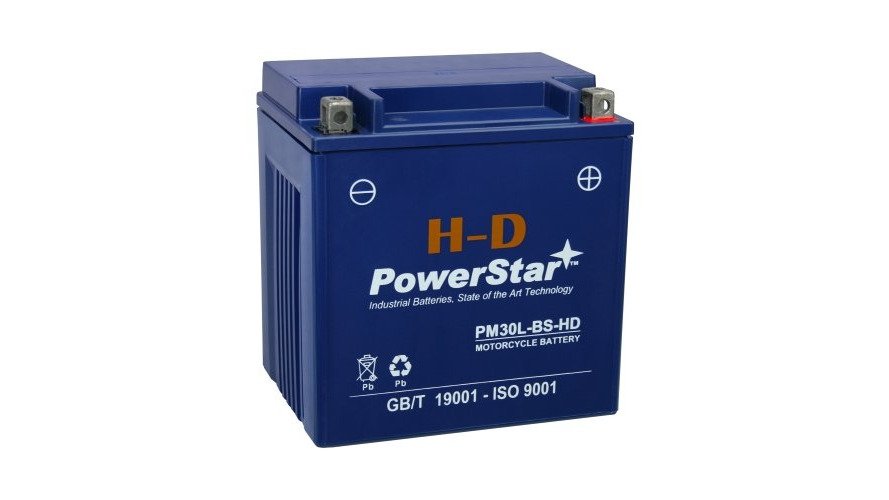
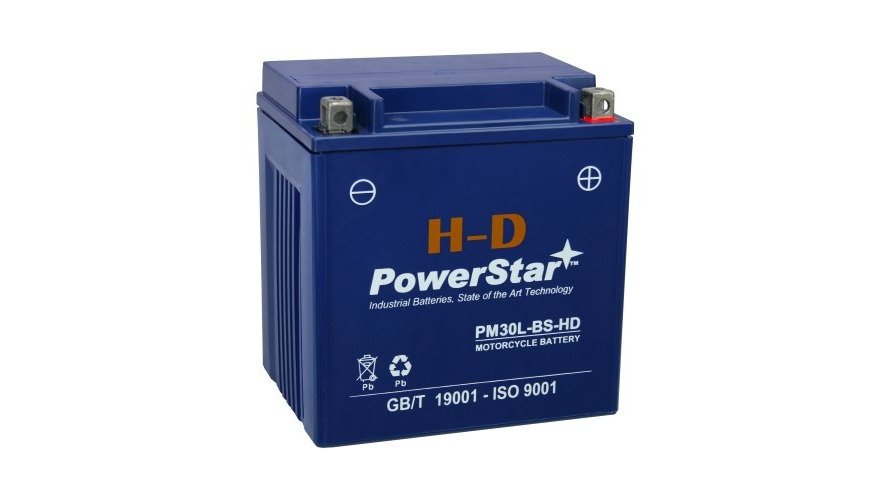
AGM batteries are maintenance-free lead-acid batteries with electrolyte absorbed in a glass mat separator. They've been the workhorse of powersports for decades.
AGM batteries deliver strong cold cranking amps (CCA) right out of the box, making them reliable for engine starting in cold conditions. The Odyssey Extreme Series uses Thin Plate Pure Lead technology and offers both high CCA and deep cycle capacity, useful if you're powering accessories alongside your engine. AGM batteries are also vibration-resistant, which matters for off-road vehicles.
The real advantage of AGM is compatibility. Your UTV's stock charging system was designed for lead-acid chemistry. An AGM battery drops in without modification, and your voltage regulator will charge it properly without special lithium-compatible chargers. AGM batteries typically cost less upfront than lithium alternatives. Pricing depends on quantity, dates, and delivery. Check Bigtime Battery's website for current prices or a quote.
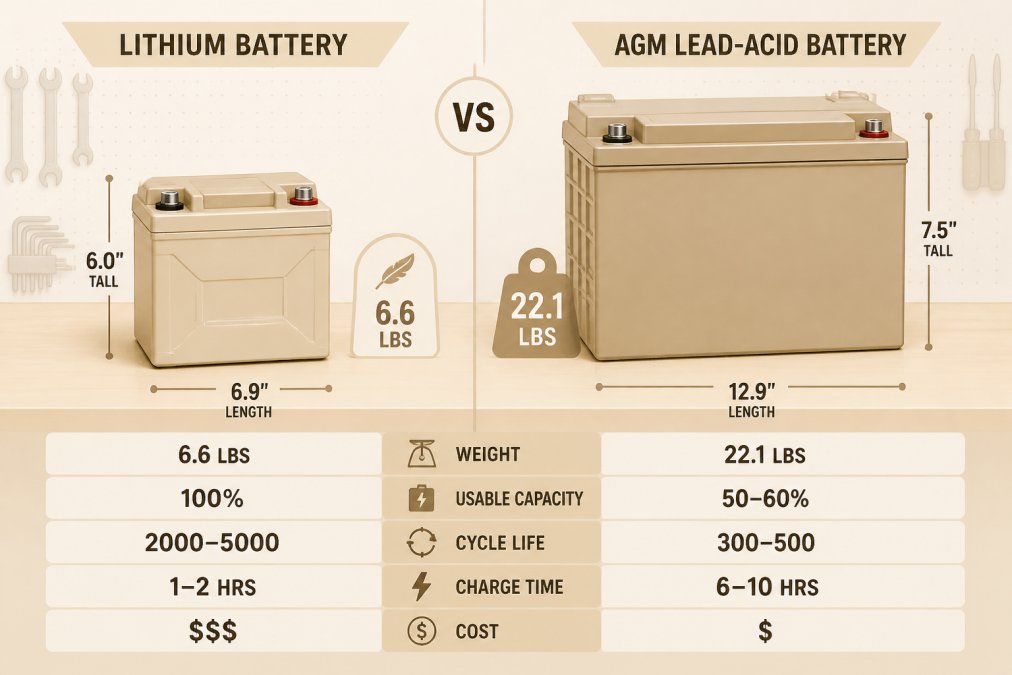
The drawbacks are significant. AGM batteries weigh considerably more than lithium, often 30-40 pounds versus 6-10 pounds for equivalent lithium units. That weight hits your UTV's suspension and handling. AGM batteries also self-discharge faster, meaning they lose charge during storage.
Lithium Iron Phosphate (LiFePO4) Batteries
Lithium iron phosphate batteries have moved from niche powersports option to mainstream choice. In 2024, lithium-ion batteries held 58.0% market share in the electric utility vehicle market, reflecting real performance advantages for UTV owners (mordorintelligence.com).
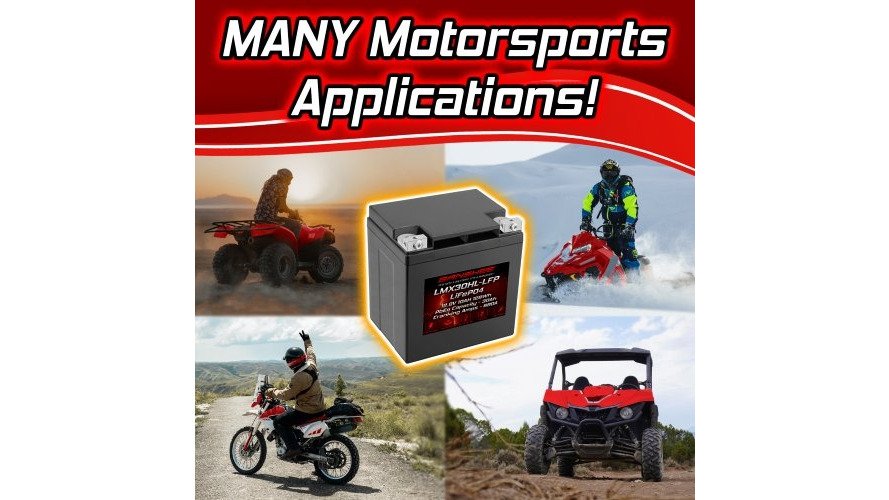
LiFePO4 batteries are dramatically lighter, a Dakota Lithium DL+ 12V 25Ah weighs just 6.4 pounds compared to 30+ pounds for equivalent AGM. That weight savings translates directly to improved suspension response, faster acceleration, and better handling.
LiFePO4 batteries also offer longer cycle life. A quality lithium battery rated for 5,000 cycles will outlast an AGM battery rated for 300-500 cycles by 10-15 years. The Dakota Lithium DL+ comes with an 11-year warranty. Lithium batteries maintain consistent voltage throughout the discharge cycle, providing full power until nearly depleted, whereas AGM voltage drops gradually as the battery drains.
The cost barrier is real. Pricing depends on quantity, dates, and delivery. Check Bigtime Battery's website for current prices or a quote.
Compatibility is the second major concern. Your UTV's charging system was designed for lead-acid batteries. Older UTVs with lower-end charging systems can deliver unstable voltage to lithium batteries, potentially triggering the battery's management system to cut off charging. Before upgrading to lithium, verify your vehicle's charging system can output stable voltage in the 14.2-14.8V range.
| Battery Type | Weight | Lifespan | Cold Weather | Upfront Cost | Charging Compatibility |
|---|---|---|---|---|---|
| AGM | 30-40 lbs | 3-5 years | Moderate | Pricing varies | Excellent with stock charger |
| LiFePO4 | 6-10 lbs | 8-10 years | Poor (unheated) | Pricing varies | Requires compatible charger |
| Heated LiFePO4 | 8-12 lbs | 8-10 years | Good | Pricing varies | Requires compatible charger |
Understanding UTV Battery CCA Requirements
Cold Cranking Amps (CCA) is the amount of current a battery can deliver for 30 seconds at 0°F while maintaining at least 7.2 volts. It's the single most important specification for engine starting in cold conditions.
Your UTV's engine has a specific CCA requirement based on displacement, compression ratio, and starter motor design. Polaris Rangers typically need 300-575 CCA. Yamaha Grizzly models often require 250-310 CCA. Kawasaki Mules generally fall in the 180-550 CCA range, depending on the model and engine type.
The mistake most owners make is assuming higher CCA is always better. It's not. A battery with excessive CCA for your application doesn't start your engine faster or more reliably. What matters is meeting or slightly exceeding your vehicle's requirement. The Dakota Lithium DL+ 12V delivers 300 CCA, which works perfectly for UTVs that originally shipped with 300-350 CCA batteries.
Check your UTV's original battery specification, stamped on the old battery case or listed in your owner's manual. Match that CCA rating or go slightly higher. Going 50-100 CCA above specification is fine and provides a safety margin.
CCA matters less for lithium batteries than for lead-acid because lithium maintains voltage consistency. An AGM battery's CCA rating can drop 30-50% in cold weather, but a quality lithium battery's performance degrades more gracefully.
UTV Dual Battery Setup Guide
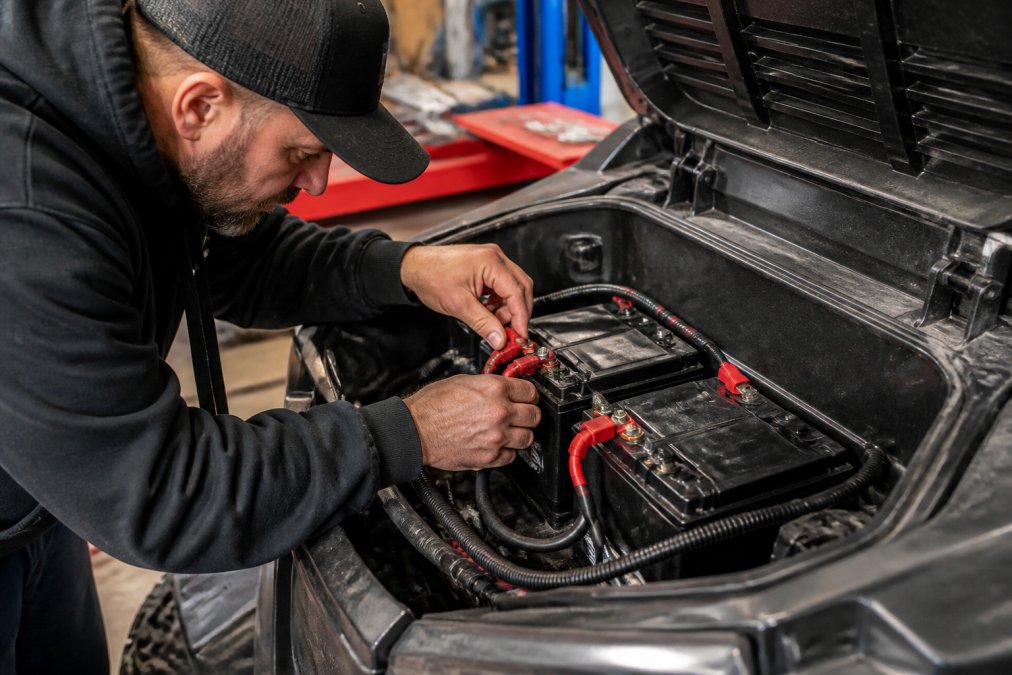
A dual battery system pairs your engine's starting battery with a secondary deep-cycle battery dedicated to accessories. This setup is ideal if you're running winches, light bars, sound systems, or other power-hungry equipment that would drain your starting battery.
Your primary battery handles engine starting and vehicle charging. Your secondary battery powers accessories and charges whenever the engine runs. A battery isolator or split charging relay prevents the secondary battery from draining the primary battery when the engine is off. lithium versus lead acid.
Installation requires a secondary battery (typically 100Ah+ deep-cycle lithium or AGM), a battery isolator (Redarc SBI12, CTEK D250SE, or equivalent), appropriately gauged wiring (typically 4-6 AWG), a secondary battery mount, and fuses and disconnects for safety. Most installations take 4-6 hours for someone with mechanical experience. Professional installation costs vary depending on complexity and location.
The isolator is the critical component. It monitors your primary battery voltage. When the engine runs and voltage exceeds a threshold (typically 13.6V), the isolator connects the secondary battery to the charging circuit. When voltage drops below threshold (engine off), it disconnects the secondary battery, preventing it from draining your starting battery.
A quality isolator like the CTEK D250SE costs around $300-$600 but ensures reliable operation. For most UTV owners, a 100Ah lithium secondary battery combined with a quality isolator provides enough accessory power for extended off-road trips.
How to Choose the Right Battery for Your UTV Model
Selecting the right battery requires matching four variables: your UTV's original battery specification, your usage patterns, your climate, and your budget.
Start with your UTV's original battery specification. Locate the battery label on your current battery or check your owner's manual. Note the voltage (typically 12V), amp-hour capacity (usually 25-35Ah for UTVs), and CCA rating. This baseline tells you what your vehicle was designed for.
Next, consider your usage pattern. If you use your UTV for light trail riding and occasional work, an AGM battery is adequate and saves money. If you're running accessories regularly, lithium's deeper discharge capability and faster recharge becomes valuable. If you operate in cold climates or plan to keep your UTV for 8+ years, lithium's longevity advantage justifies the higher cost.
Climate is critical. In temperate regions, either battery type works fine. In cold climates (below 20°F regularly), unheated lithium batteries become problematic. In hot climates (above 100°F), both battery types perform well, though lithium's lower self-discharge rate provides a slight advantage if your UTV sits between uses.
Bigtime Battery offers a wide selection of replacement batteries for UTVs and other powersports vehicles, ensuring you can find the right option for your specific needs and budget. Our team can help you identify your exact battery requirements and find the best fit for your vehicle and usage patterns.
Signs Your UTV Battery Needs Replacement
Battery degradation happens gradually, but several warning signs indicate replacement is due.
Slow engine cranking is the first clue. If your UTV's starter motor turns slowly or hesitantly, your battery isn't delivering full CCA. Dim headlights or flickering interior lights indicate low voltage. A healthy 12V battery maintains 12.6V at rest and 13.5-14.5V while charging.
Corrosion on battery terminals is a lead-acid problem. White, blue, or green crusty buildup indicates acid leakage or chemical reaction. Clean the terminals with baking soda and water, but if corrosion returns quickly, battery replacement is near.
Battery swelling or physical damage is a red flag. Lithium batteries swell when damaged internally or when the BMS detects a fault. Either way, a swollen battery should be replaced immediately.
Age is the simplest indicator. Most AGM batteries last 3-5 years with normal use. Lithium batteries typically last 8-10 years. If your battery is at the upper end of its expected lifespan, replacement is prudent even if it still starts your engine.
Installation and Maintenance Considerations
Replacing a UTV battery is straightforward for most owners, but a few details matter.
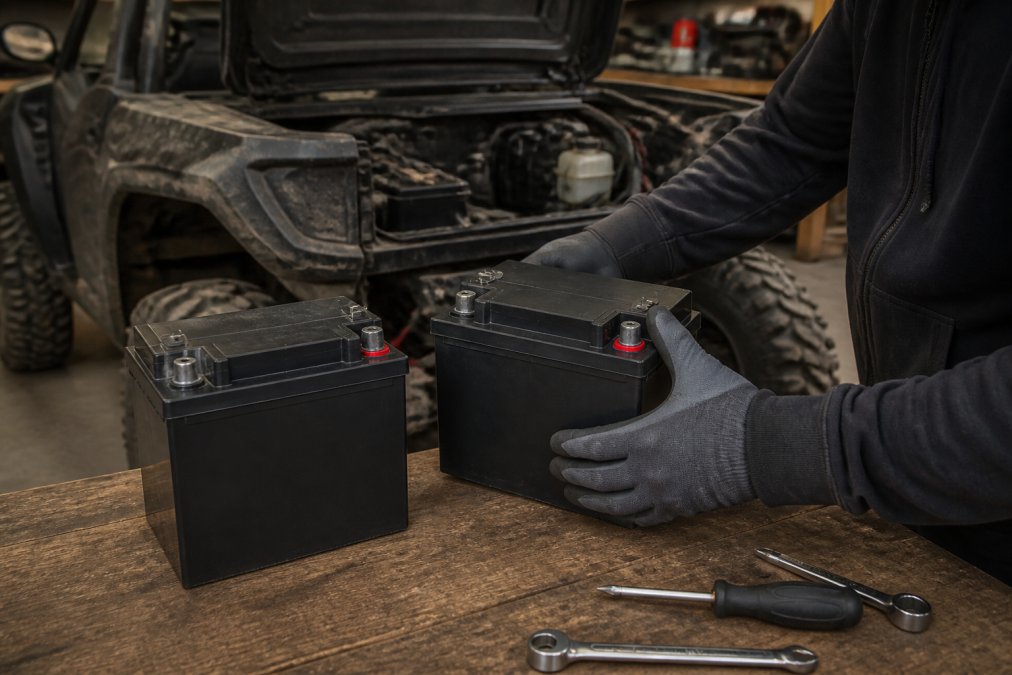
Disconnect the negative terminal first. This prevents accidental short circuits. Then disconnect the positive terminal. Remove the old battery from its mount and note its orientation and any brackets.
Install the new battery in the same orientation as the original. Terminal position matters, if your positive terminal was on the left on the old battery, it should be on the left on the new one. Connect the positive terminal first, then the negative terminal. Tighten the terminal connectors firmly, loose connections create high resistance and voltage drop.
For lithium batteries, check your vehicle's charging system voltage before connecting. Use a multimeter to verify that your alternator or stator outputs stable voltage in the 13.5-14.8V range. Older UTVs or those with aftermarket electrical modifications sometimes have charging system issues that need correction before lithium battery installation.
AGM batteries require no active maintenance, but check terminal corrosion occasionally and clean it if present. Lithium batteries require even less maintenance, just ensure the BMS isn't showing error codes and that the battery isn't swelling.
For dual battery setups, check your isolator's operation monthly. Start your engine and verify that your secondary battery is charging. After shutting off the engine, verify that the secondary battery voltage doesn't drop below your primary battery voltage over the next few minutes.
Battery storage matters if your UTV sits for extended periods. AGM batteries should be charged to full capacity before storage and checked monthly. Lithium batteries should be stored at 50% charge if possible. Bigtime Battery can help you identify the right charging solution and maintenance approach for your specific battery choice.
The UTV battery upgrade landscape in 2026 offers more options and better performance than ever before. Whether you choose the proven reliability of AGM batteries or the weight savings and longevity of lithium iron phosphate, the key is matching your choice to your vehicle, your climate, and your usage patterns. The right battery upgrade pays dividends in performance, reliability, and total cost of ownership for years to come.
At Bigtime Battery, we maintain a comprehensive selection of replacement batteries for UTVs, ATVs, and other powersports vehicles. Our team can help you identify your exact battery requirements, compare your options, and find the right fit for your specific UTV model and usage needs. Get in touch today for a quick consultation on your battery upgrade options.
=== FAQ ANSWERS (audit these too, same rules) ===
[1] Q: What is the best type of battery for a UTV battery upgrade? A: Lithium iron phosphate (LiFePO4) batteries are increasingly the preferred choice for UTV upgrades in 2026. They offer 60-75% weight reduction compared to lead-acid units, last 8-10 times longer, and provide consistent power output. However, AGM batteries remain a solid mid-range option if you want maintenance-free performance without the higher upfront cost. Your choice depends on your accessory load (winches, light bars, sound systems) and budget. Lithium-ion batteries held 74.06% market share in the electric utility vehicle market in 2026, reflecting their growing dominance among UTV owners (fortunebusinessinsights.com).
[2] Q: How many Cold Cranking Amps (CCA) do I need for my UTV battery? A: Most UTVs require 300-400 CCA for reliable engine starting in normal conditions. Check your vehicle's manual or the original battery specifications for the exact requirement. Cold Cranking Amps measure a battery's ability to deliver power at 0 degrees Fahrenheit, critical for winter operation. If you live in cold climates or operate your UTV year-round, choose a battery rated at or above your UTV's specified CCA. Undersized batteries risk slow starts or failure in freezing temperatures, while oversized batteries won't harm your vehicle but may be unnecessary for your needs.
[3] Q: Can I install a lithium battery in my older UTV with a stock charging system? A: Compatibility is a major consideration. Older and low-end UTVs have charging systems designed for lead-acid batteries, with voltage curves and stabilization logic that may not match lithium requirements. High charging voltage or unstable pulse voltage can damage a lithium battery's management system. Before upgrading, verify that your UTV's stator and voltage regulator can deliver a stable charging profile suitable for lithium. Many modern lithium batteries include a battery management system (BMS) that provides some protection, but consulting the battery manufacturer or a qualified technician is essential for older models.
[4] Q: What is the lifespan difference between lithium and traditional UTV batteries? A: Lithium iron phosphate (LiFePO4) batteries typically last 8-10 years and handle 5,000+ charge cycles, while traditional lead-acid batteries last 3-5 years with 200-300 cycles. This longer lifespan makes lithium batteries cost-effective despite higher initial investment. LiFePO4 batteries also maintain consistent voltage throughout discharge, meaning your UTV's performance stays strong until the battery is fully depleted. Lead-acid batteries experience voltage drop as they discharge, reducing power output over time. The extended cycle life and performance consistency of lithium make it the premium choice for serious UTV owners.
Frequently Asked Questions
Q: What is the best type of battery for a UTV battery upgrade?
Lithium iron phosphate (LiFePO4) batteries are increasingly the preferred choice for UTV upgrades in 2026. They offer 60-75% weight reduction compared to lead-acid units, last 8-10 times longer, and provide consistent power output. However, AGM batteries remain a solid mid-range option if you want maintenance-free performance without the higher upfront cost. Your choice depends on your accessory load (winches, light bars, sound systems) and budget. Lithium-ion batteries held 74.06% market share in the electric utility vehicle market in 2026, reflecting their growing dominance among UTV owners.
Q: How many Cold Cranking Amps (CCA) do I need for my UTV battery?
Most UTVs require 300-400 CCA for reliable engine starting in normal conditions. Check your vehicle's manual or the original battery specifications for the exact requirement. Cold Cranking Amps measure a battery's ability to deliver power at 0 degrees Fahrenheit, critical for winter operation. If you live in cold climates or operate your UTV year-round, choose a battery rated at or above your UTV's specified CCA. Undersized batteries risk slow starts or failure in freezing temperatures, while oversized batteries won't harm your vehicle but may be unnecessary for your needs.
Q: Can I install a lithium battery in my older UTV with a stock charging system?
Compatibility is a major consideration. Older and low-end UTVs have charging systems designed for lead-acid batteries, with voltage curves and stabilization logic that may not match lithium requirements. High charging voltage or unstable pulse voltage can damage a lithium battery's management system. Before upgrading, verify that your UTV's stator and voltage regulator can deliver a stable charging profile suitable for lithium. Many modern lithium batteries include a battery management system (BMS) that provides some protection, but consulting the battery manufacturer or a qualified technician is essential for older models.
Q: What is the lifespan difference between lithium and traditional UTV batteries?
Lithium iron phosphate (LiFePO4) batteries typically last 8-10 years and handle 5,000+ charge cycles, while traditional lead-acid batteries last 3-5 years with 200-300 cycles. This longer lifespan makes lithium batteries cost-effective despite higher initial investment. LiFePO4 batteries also maintain consistent voltage throughout discharge, meaning your UTV's performance stays strong until the battery is fully depleted. Lead-acid batteries experience voltage drop as they discharge, reducing power output over time. The extended cycle life and performance consistency of lithium make it the premium choice for serious UTV owners.