 ultimate-guide
Rechargeable Marine Battery Bulk Buy: 2026 Guide
Table of Contents
- Why a Marine Battery Bulk Buy Pays Off in 2026
- AGM vs Lithium Marine Battery Performance for Fleet Orders
- Deep Cycle Battery Lifespan Expectations: What Bulk Buyers Should Plan For
- Sizing a Marine Battery Bulk Buy: Amp Hours, Voltage, and Group Sizes
- Marine Battery Maintenance Best Practices That Protect a Bulk Purchase
- Bulk Procurement Logistics, Storage, and Cold Weather Performance
- Total Cost of Ownership and Environmental Impact of Bulk Marine Batteries
- Frequently Asked Questions
Last Updated: September 23, 2026
Why a Marine Battery Bulk Buy Pays Off in 2026
The marine battery market hit $893.1 million in 2026, according to Grand View Research's marine battery market report, and unit volume in the U.S. alone reached 2.05 million batteries in 2025. For fleet operators and marine businesses, that growth signals something practical: a rechargeable marine battery bulk buy is no longer just a convenience play. It is a cost-control strategy. At Bigtime Battery, we see buyers move from one-off retail purchases to planned bulk orders because the savings compound across every vessel in a fleet.
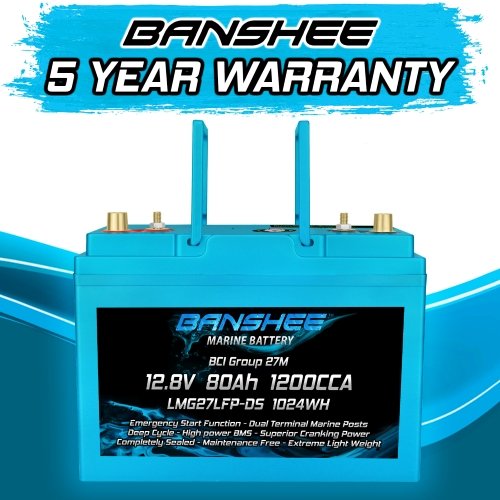
Banshee Lithium Marine Battery Group 27M
Below, we break down the technology choices, sizing math, and procurement logistics that determine whether a bulk order actually pays off.
AGM vs Lithium Marine Battery Performance for Fleet Orders
Lithium iron phosphate (LiFePO4) batteries deliver roughly three times the usable energy at about one-third the weight of lead-acid equivalents, and their cycle life runs up to eight times longer. That gap matters most when you are buying for ten boats instead of one. Absorbed glass mat (AGM) batteries remain a solid, lower-cost choice for shorter trips and lighter cycling, but they tolerate deep discharge poorly and weigh significantly more per amp hour.
- AGM: Lower upfront cost, maintenance-free, heavier, shorter cycle life
- LiFePO4: Higher upfront cost, dramatically lighter, longer cycle life, built-in battery management system (BMS)
The global lithium-ion marine segment is growing at a 15.54% CAGR through 2031, per TechSci Research's marine lithium-ion battery analysis.
Deep Cycle Battery Lifespan Expectations: What Bulk Buyers Should Plan For
Trojan Battery's deep-cycle case studies show operational longevity gains in marine and industrial projects when battery technology is matched to the duty cycle, per Trojan Battery's case study library. The lesson: plan replacements around cycle life, not calendar years.
Sizing a Marine Battery Bulk Buy: Amp Hours, Voltage, and Group Sizes
Amp hours (Ah) measure capacity, reserve capacity (RC) measures how long a battery sustains a load, and cold cranking amps (CCA) and marine cranking amps (MCA) measure starting power. Group size determines physical fit. Get these wrong and a bulk order becomes dead inventory.
Application | Voltage | Typical Ah Range | Best Chemistry |
|---|---|---|---|
Trolling motor (small) | 12V | 50-100Ah | LiFePO4 or AGM |
Trolling motor (large) | 24V-36V | 100Ah per unit | LiFePO4 |
Starting / cranking | 12V | 50-100Ah | AGM |
House bank | 12V-48V | 100Ah+ | LiFePO4 |
Marine Battery Maintenance Best Practices That Protect a Bulk Purchase
Marine battery maintenance best practices protect the entire investment, not just one unit. Store batteries at a partial state of charge, avoid deep discharges, and keep terminals clean and dry. A quality LiFePO4 battery has a low self-discharge rate and needs no watering, which simplifies storage across a fleet.
- Check state of charge every 30-60 days in storage
- Use a compatible charger matched to chemistry
- Keep terminals coated against corrosion
- Rotate stock so older units get used first
Bulk Procurement Logistics, Storage, and Cold Weather Performance
This is the section most retail-focused guides skip entirely, and it is where a bulk order is won or lost. Ordering ten to forty batteries is not the same as ordering one, because freight class, documentation, and storage conditions all change once you cross into pallet quantities.
Pallet quantities and freight class
When considering bulk orders, the physical dimensions and weight of batteries impact shipping logistics. Lithium packs are generally lighter per amp hour, which can influence freight class and per-unit freight costs.
Documentation you need before the truck rolls
For commercial quantity shipments, certain documentation is typically required:
- UN 38.3 test summary, often required for lithium cells and packs under transport rules.
- Safety Data Sheet (SDS), standard for both AGM (lead-acid) and LiFePO4.
- State of charge at shipment, lithium cells are typically shipped at a partial state of charge, not full, per common carrier and air-freight guidance.
AGM batteries are typically classified based on their design, with many marine AGM units shipping as non-spillable. It's always advisable to confirm classification with your supplier before booking freight.
Cold weather performance: what the numbers actually mean
Cold cranking amps (CCA) and marine cranking amps (MCA) are important metrics for cold weather performance. For a starting battery, a LiFePO4 starting pack needs a BMS rated for the appropriate burst current to perform effectively in cold conditions.
Storage rules for bulk inventory
- Store at 50-70°F, dry, off concrete if possible.
- Keep lithium at roughly 50% SOC for long storage; keep AGM at full charge and on a maintainer.
- Rotate stock FIFO, first in, first out, so older units cycle first.
- Never charge a frozen lithium battery; let it warm to room temperature first.
Bigtime Battery ships bulk marine orders with the documentation package included, and you can confirm pallet quantities and freight options for your fleet at bigtimebattery.com.
Total Cost of Ownership and Environmental Impact of Bulk Marine Batteries
Total cost of ownership (TCO) is where a bulk marine battery purchase proves itself, but only if you run the math on cost per usable cycle, not cost per unit. That single shift in framing is what separates a fleet buyer from a retail shopper, and it is the angle most top-ranking guides never take.
The cost-per-cycle framework
Cost per cycle = (purchase price + charging cost over life + disposal cost) ÷ total usable cycles.
Factor | AGM Deep Cycle | LiFePO4 |
|---|---|---|
Usable depth of discharge | ~50% | ~80-100% |
Typical cycle life | A few hundred cycles | Several thousand cycles |
Weight per 100Ah | Roughly 60-70 lb | Roughly 25-30 lb |
Charging efficiency | Lower (heat loss) | Higher |
Maintenance | Terminal care, no watering | Terminal care, no watering |
End-of-life | Mature lead recycling chain | Growing lithium recovery |
Replacement-year math you can run yourself
- Estimate daily cycles per vessel (a charter boat running a trolling motor four hours a day is roughly one cycle per day).
- Multiply by 250 operating days for a seasonal fleet.
- Divide your battery's rated cycle life by that annual figure to get replacement interval in years.
- Multiply replacement interval by units per vessel by fleet size to get total units needed over a 10-year horizon.
That last number is the one that decides your bulk order quantity, not the discount tier on the quote.
Charging cost and efficiency
Lithium charges at higher efficiency than AGM, which means less energy lost as heat and a smaller generator or shore-power draw to refill the same usable amp hours. Over a 10-year fleet life, that efficiency gap is a real line item, especially for boats running off solar or a genset.
Environmental impact and end-of-life handling
Lead-acid batteries generally have established recycling options. For lithium packs, recycling pathways are evolving, and it's advisable to research and plan for disposal with a suitable recycler, especially for bulk quantities.
What this means for your bulk buy
The cheapest battery per unit is rarely the cheapest per year. Run the cost-per-cycle math across your full fleet, factor in charging efficiency and disposal, and let the 10-year number drive the order. Bigtime Battery stocks the LiFePO4 marine packs that make that math work in your favor, start your fleet quote and make your purchase at bigtimebattery.com.
Frequently Asked Questions
What are the advantages of purchasing marine batteries in bulk?
Buying in volume lowers your per-unit cost, keeps spare batteries on hand for fleet downtime, and simplifies warranty tracking because every unit comes from one supplier. A marine battery bulk buy also lets you standardize on one group size, which cuts mistakes when swapping batteries across boats.
How should bulk-purchased marine batteries be stored to maintain longevity?
Store batteries in a cool, dry space between 50°F and 80°F, off concrete, and keep them at roughly 50% state of charge if they will sit for months. LiFePO4 units have a low self-discharge rate, so they hold charge far longer than sealed lead acid. Rotate stock first-in, first-out, and recharge every three to six months. Following marine battery maintenance best practices during storage protects the cycle life you paid for.
What is the difference between AGM and lithium marine batteries for bulk orders?
AGM batteries use absorbed glass mat construction, cost less upfront, and tolerate vibration well, but they deliver fewer cycles and weigh more. LiFePO4 lithium batteries cost more per unit, yet the global lithium-ion marine segment is growing at a 15.54% CAGR (TechSci Research, 2025) because they last longer and charge faster. For a marine battery bulk buy, lithium usually wins on total cost of ownership over five to ten years.
Are there specific safety regulations for shipping and storing marine batteries in bulk?
Yes. When shipping batteries in bulk, it's important to be aware of transport regulations. For lithium batteries, there are often guidelines regarding state-of-charge limits and package marking. Lead-acid and AGM units also have specific shipping classifications. It's always recommended to confirm documentation and requirements with your supplier and freight carrier before a large order ships.
Fleet power is a long-term commitment, and the wrong bulk order locks in years of hidden costs. Bigtime Battery makes it simple to buy the right batteries in volume, with a one-stop selection of marine and specialty replacements at competitive prices, backed by reliable performance for every application. Make your purchase at bigtimebattery.com and lock in dependable marine power for your whole fleet.