 ultimate-guide
Marine Battery Storage Solutions for Fleets: 2026 Guide
Table of Contents
- Why Marine Battery Storage Solutions for Fleets Are Scaling in 2026
- Battery Chemistry and System Architecture for Fleet Energy Storage
- How Marine Battery Management Systems Protect Fleet Assets
- Total Cost of Ownership: The Financial Case for Fleet Electrification
- Retrofitting vs New-Build: Integrating Storage Into Existing Vessels
- Regulatory Compliance and Marine-Grade Certification Requirements
- Marine Battery Maintenance Best Practices for Fleet Longevity
- Frequently Asked Questions
Last Updated: September 22, 2026
Why Marine Battery Storage Solutions for Fleets Are Scaling in 2026
Marine battery storage solutions for fleets have moved from pilot projects to standard procurement. According to Fortune Business Insights' marine battery market report, the global marine battery market is projected to reach $2.10 billion in 2026, with decarbonization mandates and fuel-cost volatility driving the shift. At Bigtime Battery, we've watched fleet operators move from asking whether to electrify to asking how fast they can retrofit.
Battery Chemistry and System Architecture for Fleet Energy Storage
Marine battery chemistry determines cycle life, weight, and thermal risk more than any other specification. Lithium iron phosphate (LFP) packs are estimated to account for 38.0% of chemistry demand in 2026, according to Future Market Insights' marine battery pack analysis, because fleets prioritize safety and longevity over raw energy density.
LFP vs NMC vs Lead-Acid: What Fleet Managers Should Know
| Chemistry | Cycle Life | Thermal Risk | Best For |
|---|---|---|---|
| LFP | 3,000-5,000 cycles | Low | Ferries, workboats, daily cycling |
| NMC | 1,500-2,500 cycles | Moderate | Weight-sensitive, high-range vessels |
| Lead-acid | 300-700 cycles | Low | Backup power, tight budgets |
LFP wins on total cost of ownership for most fleet duty cycles. NMC makes sense when weight and range matter more than cycle count. Lead-acid still works for auxiliary power, but it can't compete on depth of discharge or cycle life. A ScienceDirect review of marine battery systems found that chemistry selection now drives the entire system architecture, from thermal management to propulsion control.
How Marine Battery Management Systems Protect Fleet Assets
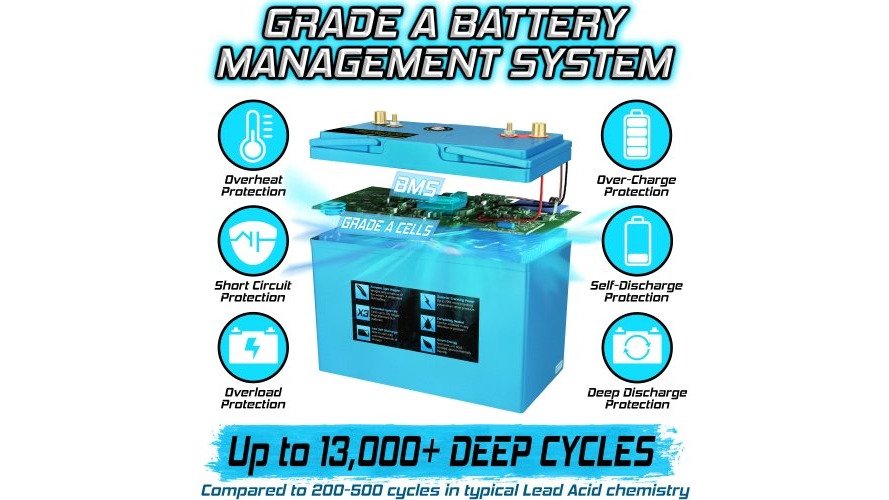
A marine battery management system (BMS) monitors cell voltage, temperature, and state of charge to prevent thermal runaway and extend pack life. Without one, a single weak cell can take down an entire bank.
Total Cost of Ownership: The Financial Case for Fleet Electrification
Total cost of ownership (TCO) is where electrification either wins or dies. Most articles stop at "batteries cost more upfront but save on fuel." Fleet managers need the actual line items, the time horizon, and the variables that flip the math. Below is the framework we use with fleet operators evaluating marine battery storage solutions for fleets.
The Five Cost Lines That Decide the Outcome
1. Pack cost (CapEx). Priced per kilowatt-hour of usable capacity, not nameplate. A pack rated at 100 kWh with a 90% depth-of-discharge limit and 85% round-trip efficiency delivers roughly 76 kWh of usable work. Modeling nameplate instead of usable capacity overstates savings by 20-25% in year one.
Diesel vs. Electric: What the Model Actually Looks Like
| Cost Line | Diesel Baseline | Battery-Electric | Direction |
|---|---|---|---|
| Propulsion energy | Fuel + delivery + storage | Electricity + demand charges | Electric wins on energy, loses on demand charges if unmanaged |
| Maintenance | Engine, fuel, exhaust systems | BMS, thermal, capacity testing | Electric wins |
| Downtime | Unplanned haul-outs, engine failures | Fewer moving parts, scheduled service | Electric wins |
| CapEx | Lower upfront | Higher upfront | Diesel wins in year 1 |
| Residual | Engine resale | Second-life or recycling credit | Depends on planning |
The crossover point, where cumulative electric savings overtake the CapEx premium, typically lands between year 3 and year 6 for high-utilization duty cycles (daily ferries, workboats, harbor tugs) and beyond year 8 for low-utilization vessels. Utilization is the single biggest variable: a vessel running 250 days a year crosses over years earlier than one running 80.
Retrofitting vs New-Build: Integrating Storage Into Existing Vessels
Retrofitting existing vessels is usually cheaper than new-build integration, but it comes with hull-specific constraints land-based storage never faces: enclosure design, weight distribution, and available space all differ from vessel to vessel.
For fleets, the decision framework is straightforward:
- If the vessel has 5+ years of service life left, retrofit
- If weight margins are tight, evaluate NMC over LFP
- If the hull lacks cooling access, prioritize air-cooled BMS designs
- If charging infrastructure exists, retrofit cost drops sharply
- If the vessel is due for replacement within 3 years, defer to new-build
Regulatory Compliance and Marine-Grade Certification Requirements
Marine-grade certification is non-negotiable for commercial fleets. Most articles mention "classification society standards" and move on; fleet managers need the actual framework: which bodies set the rules, which standards apply, and what an inspection checks. A pack that passes a land-based test may still fail marine certification, and discovering that after installation costs weeks of lost service.
Who Sets the Rules
Three layers of authority govern battery installations on commercial vessels:
- U.S. Coast Guard, enforces federal requirements for fire suppression, ventilation, electrical isolation, and emergency shutdown on inspected vessels. For vessels carrying passengers, these requirements are enforced at the vessel level, not the component level.
- Classification societies, the American Bureau of Shipping (ABS) is the primary class society for U.S.-flagged commercial vessels, with DNV and Lloyd's Register also active in the market. Class rules govern battery system design, installation, and survey intervals.
- Standards bodies, IEEE, IEC, and NFPA publish the technical standards that class societies and the Coast Guard reference. The relevant ones for lithium-ion marine installations include IEEE 45 (marine electrical engineering), IEC 62619 (safety of industrial lithium cells and batteries), and NFPA 301 (safety to life on merchant vessels).
What Certification Actually Covers
Compliance touches every part of the system, and each element is tested separately:
- Enclosure materials, fire resistance, structural integrity under vibration, and resistance to saltwater corrosion
- Cable routing, separation from fuel systems, chafe protection, and short-circuit protection
- Gas detection, off-gas sensors for lithium-ion thermal events, with alarm and shutdown logic
- Emergency shutdown, manual and automatic disconnection accessible from outside the battery space
- Ventilation, active or passive, sized to prevent accumulation of off-gas in the event of a cell failure
- Vibration resistance, tested to class-specified frequency and amplitude profiles, which differ from automotive and land-based standards
- Corrosion protection, salt spray testing and material compatibility with marine atmospheres
The Retrofit Compliance Trap
The most common compliance failure in retrofits is treating the battery installation as a component swap rather than a system modification. Adding a lithium-ion bank to a diesel vessel changes the fire load, ventilation requirement, and emergency shutdown logic. A class surveyor looks at the whole space, not just the pack.
Documentation and Survey Intervals
Class societies require a documentation package typically including battery system drawings, cell and pack test certificates, BMS functional descriptions, thermal management calculations, and a thermal runaway propagation risk assessment. Surveys are generally annual, with detailed surveys every five years. Fleets that keep a live compliance file, updated whenever a pack is added, replaced, or re-rated, pass faster with fewer findings.
Marine Battery Maintenance Best Practices for Fleet Longevity
Marine battery maintenance best practices extend pack life by years and protect the capital investment. The routine is simple; consistency separates fleets that get 5,000 cycles from those that get 2,000.
- Keep state of charge between 20% and 80% for daily cycling
- Log cell balance and temperature weekly through the BMS
- Inspect terminals and enclosures for corrosion monthly
- Run a full capacity test quarterly
- Store packs at 50% charge during off-season layups
Frequently Asked Questions
What is the best way to store marine batteries when a vessel is not in use?
Store marine batteries in a cool, dry location away from direct sunlight and vibration. Charge lithium-ion packs to roughly 50-60% state of charge before long storage, and lead-acid batteries to a full charge. Disconnect the negative terminal to prevent parasitic drain. Recharge every two to three months to avoid deep discharge, which shortens cycle life. Bigtime Battery stocks replacement deep cycle batteries suited to seasonal storage, and you can order at bigtimebattery.com.
How do lithium-ion marine batteries compare to traditional lead-acid options for fleet use?
Lithium-ion packs, especially LFP chemistry, deliver higher energy density, longer cycle life, and deeper usable depth of discharge than lead-acid. LFP packs are estimated to account for 38.0% of chemistry demand in 2026, per Future Market Insights. For fleets, that means fewer replacements, less weight on board, and lower operational expenditure over the vessel's life. Lead-acid still costs less upfront, but the total cost of ownership often favors lithium over a multi-year horizon.
What safety standards must marine battery storage systems meet?
Marine battery installations in the United States must comply with U.S. Coast Guard regulations and standards from organizations such as the National Fire Protection Association (NFPA). These cover ventilation, overcurrent protection, thermal management, and enclosure requirements. Fleet managers should also verify marine-grade certification for vibration resistance and corrosion protection. Always confirm that a battery management system includes overcharge, over-discharge, and thermal cutoff protections before installation.
How does a battery management system improve fleet battery longevity?
A battery management system (BMS) monitors cell voltage, temperature, and current, then balances cells to prevent overcharge and over-discharge. This directly extends cycle life and reduces downtime. Industry reports note that thermal management integration is now a priority for marine BMS designs because heavy loads and fluctuating conditions stress cells. A quality BMS also logs performance data, helping fleet managers schedule maintenance before a failure strands a vessel. Bigtime Battery carries replacement batteries compatible with common BMS setups at bigtimebattery.com.