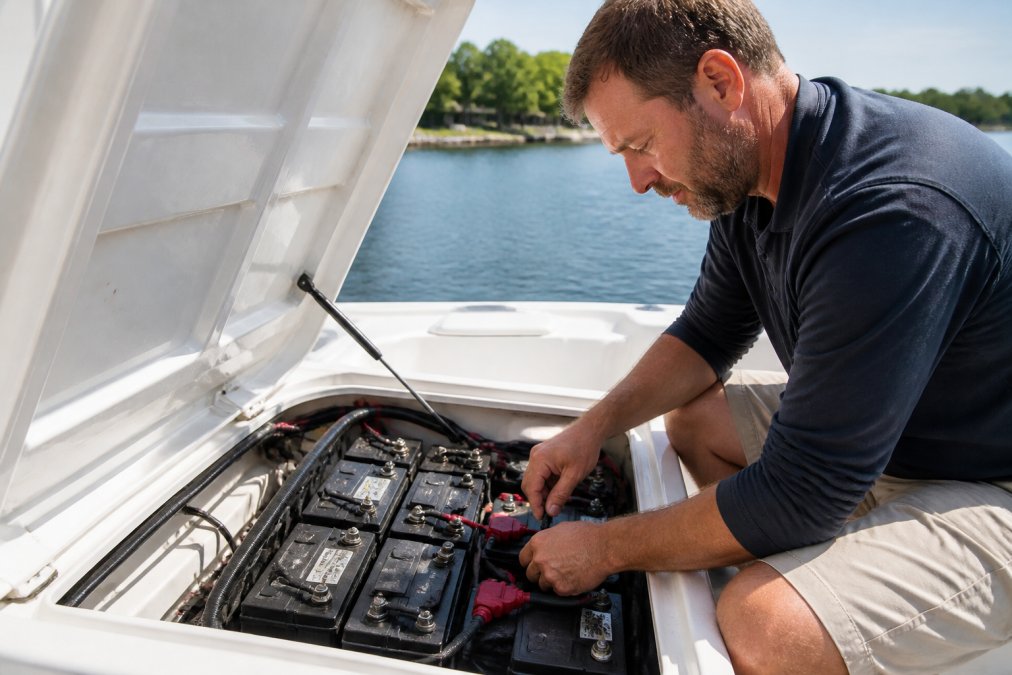
 ultimate-guide
How to Extend Marine Battery Lifespan: 7 Proven Steps
Table of Contents
- Why Marine Battery Lifespan Depends on How You Treat It
- Marine Battery Charging Best Practices That Prevent Early Failure
- Terminal Cleaning, Corrosion Prevention, and Routine Maintenance
- How to Store Marine Batteries in Winter Without Killing Them
- Signs of a Failing Marine Battery (and What to Do About It)
- Battery Monitoring Technology: Track Voltage Before Problems Start
- Frequently Asked Questions
Last Updated: September 17, 2026
Why Marine Battery Lifespan Depends on How You Treat It
Most boat owners treat batteries as disposable. Buy one, run it until it dies, buy another. That cycle costs far more than it should, because marine battery lifespan is not fixed at purchase. It is decided by how you charge, store, and maintain the battery over years of use.
Standard flooded and AGM marine batteries typically last between 2 and 5 years, according to LithiumHub's 2025 marine battery lifespan data.
Marine Battery Charging Best Practices That Prevent Early Failure
Charging is where most batteries are quietly ruined. Overcharging cooks the electrolyte and corrodes the positive grid. Undercharging leaves lead sulfate crystals on the plates, a process called sulfation that hardens over time and permanently reduces capacity. Both failures are avoidable with the right charger and the right habits.
Why Multi-Stage Smart Chargers Beat Trickle Chargers
A multi-stage smart charger moves through bulk, absorption, and float phases based on the battery's actual state of charge. A trickle charger delivers a constant low current regardless of condition, which means it can overcharge a full battery and never fully charge a deeply discharged one.
The phases do different jobs:
- Bulk: delivers full charger amperage until the battery reaches roughly 70-80% state of charge
- Absorption: holds a steady, elevated voltage while current tapers, pushing the last 20-30% in without boiling the electrolyte
- Float: drops to a lower maintenance voltage that offsets self-discharge without gassing
Depth of Discharge: The Number That Decides Your Battery's Fate
Depth of discharge (DoD) is the percentage of capacity you drain before recharging. It is the strongest single predictor of how many cycles a battery will deliver.
- Flooded lead-acid: keep DoD under 50% for maximum cycle life
- AGM: 50-60% is a reasonable target
- LiFePO4: 80-90% is safe, which is a major reason lithium banks last longer
The Charging Habits That Actually Add Years
- Recharge promptly. Leaving a lead-acid battery at partial charge for days accelerates sulfation. Get it back to full within 24 hours of a deep discharge.
- Equalize flooded banks periodically. A controlled overcharge every few months stirs the electrolyte and evens out cell voltages. Do not equalize AGM or lithium.
- Don't float lithium indefinitely. LiFePO4 prefers to sit at a partial charge, not held at 100% for months. Charge to full before a trip, then let it rest.
- Match charger amperage to bank size. A charger rated at roughly 10-20% of the bank's amp-hour capacity is a common target for lead-acid; lithium often accepts higher rates.
- Watch for the charger that never reaches float. That usually means parasitic draw or a failing charger, not a bad battery.
Battery Monitoring Technology: Track Voltage Before Problems Start
A shunt-based battery monitor or a smart shunt with Bluetooth gives you real state of charge, amp-hours consumed, and voltage trends over time. That data turns guesswork into maintenance: you see parasitic draw before it flattens the bank, and you see capacity fade before a battery fails at sea.
Terminal Cleaning, Corrosion Prevention, and Routine Maintenance
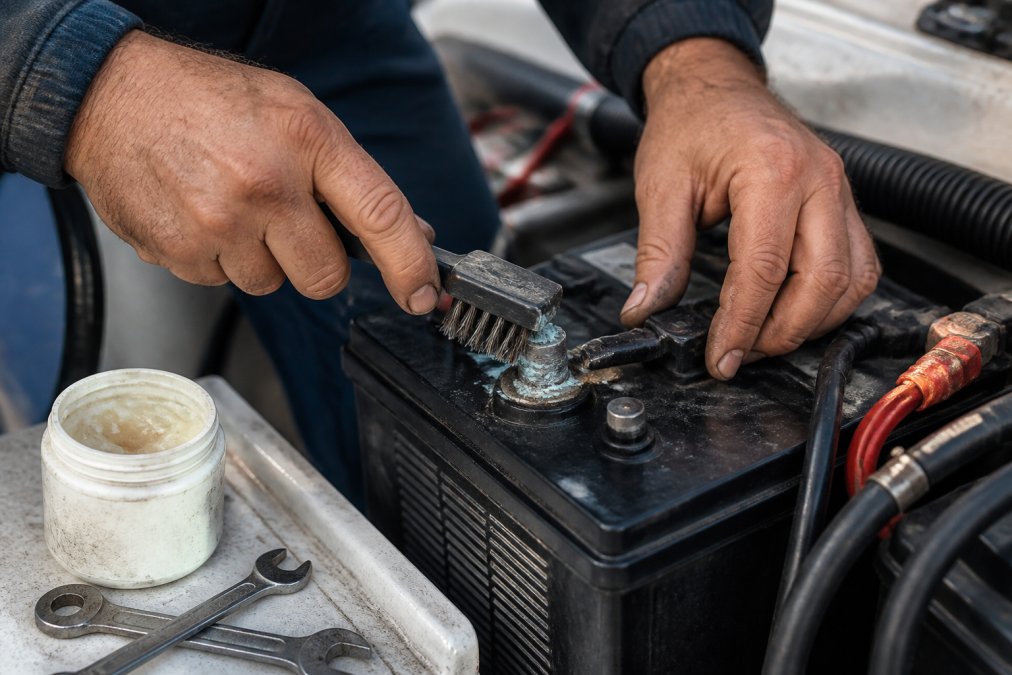
Corrosion is the most visible sign of neglect. White or blue-green crust on a terminal restricts current flow, causes voltage drop under load, and eventually prevents the battery from accepting a charge at all. Cleaning takes ten minutes and prevents the majority of connection-related failures.
Building a Maintenance Schedule That Actually Gets Followed
A schedule you ignore is worse than no schedule, because it creates false confidence. Keep it short and tie it to something you already do, like washing the boat or topping off fuel.
| Frequency | Task | Why It Matters |
|---|---|---|
| Monthly | Check voltage and terminal condition | Catches parasitic draw and corrosion early |
| Quarterly | Clean terminals, apply dielectric grease | Prevents voltage drop and connection failure |
| Seasonally | Load test and check electrolyte levels | Confirms real capacity, not surface charge |
| Annually | Full inspection of charger and wiring | Finds failing chargers before they ruin the bank |
Saltwater-Specific Maintenance for Coastal Boaters
Salt air accelerates terminal corrosion faster than freshwater exposure, and salt spray leaves conductive residue on battery tops that can create a slow drain between posts. Rinse battery tops with fresh water after every offshore trip, dry them completely, and inspect clamps for the green patina that signals active corrosion.
How to Store Marine Batteries in Winter Without Killing Them
A battery left connected and unattended through a cold season will self-discharge, sulfate, and in hard freezes can crack if state of charge drops too low. The fix is straightforward: charge it fully, disconnect it, store it cool and dry, and recharge it periodically. What most guides skip is that the right workflow depends on your climate and your chemistry.
Off-Season Storage Workflow: Step by Step
- Charge the battery to 100% using a multi-stage charger
- Disconnect the negative terminal to eliminate parasitic draw
- Clean terminals and apply dielectric grease
- Move the battery to a cool, dry, ventilated space above freezing
- Recharge every 60-90 days, or leave a smart maintainer connected
- Check voltage monthly and top up before spring launch
LiFePO4 batteries tolerate storage better than lead-acid and self-discharge more slowly, but they still benefit from a partial charge rather than a full one for long-term storage. A case study on extending LiFePO4 lifespan in off-grid applications found that consistent charging protocols were the deciding factor in multi-year reliability, and the same discipline applies to marine banks.
Winterization by Climate: What Changes Where You Boat
The six-step workflow above is the baseline. The details shift with the weather your boat sees.
Storage State of Charge by Chemistry
- Flooded lead-acid: store at 100% and top up every 60 days
- AGM: store at 100%; AGM self-discharges slower than flooded but still needs a periodic top-up
- LiFePO4: store at roughly 50-60%, not 100%, and recharge to full only when you are ready to use it
Spring Wake-Up Checklist
Before you trust the bank for the season, do a real load test rather than a voltage check. Voltage can look healthy on a sulfated battery. Confirm the charger reaches absorption and float, inspect every connection for corrosion, and check electrolyte levels on flooded batteries. If a battery needed frequent top-ups over the winter, that is a sign of internal wear, not a storage problem.
Signs of a Failing Marine Battery (and What to Do About It)
A battery rarely dies without warning. It gives you slow cranking, dim lights, a charger that finishes suspiciously fast, or a voltage reading that drops under any load. Catching these signs early is the difference between a recharge and a replacement.
Troubleshooting Common Failure Modes
- Won't hold a charge: likely sulfation or a dead cell; load test to confirm
- Voltage drops under load: high internal resistance, often from age or corrosion
- Charger never reaches float: parasitic draw or a failing charger, not the battery
- Swollen case: internal damage, especially in lithium; replace immediately
- One cell reads low with a hydrometer: failed cell, not recoverable
A desulfator can sometimes recover a lightly sulfated lead-acid battery, but it will not resurrect a battery with a shorted cell. Load testing under a real load beats a voltage reading every time.
Battery Monitoring Technology: Track Voltage Before Problems Start
A shunt-based battery monitor or a smart shunt with Bluetooth gives you real state of charge, amp-hours consumed, and voltage trends over time. That data turns guesswork into maintenance: you see parasitic draw before it flattens the bank, and you see capacity fade before a battery fails at sea.
Frequently Asked Questions
What's the average lifespan of a marine battery?
Standard lead-acid and AGM marine batteries typically last 2 to 5 years, according to LithiumHub (2025). LiFePO4 lithium batteries can reach 10 or more years, with properly maintained units often achieving 8 to 10 years (LiTime, 2025). No fixed year count applies to every boater, though. Lifespan depends heavily on depth of discharge, charging habits, and storage conditions. A battery kept above 50% state of charge and stored in cool, dry conditions will consistently outlast one that is run flat and left in the sun.
How long can you leave a marine battery on a trickle charger?
A trickle charger can stay connected for weeks or months during off-season storage, but only if it has automatic float mode. A basic trickle charger that keeps pushing current will overcharge the battery, boil off electrolyte, and cause sulfation. Smart multi-stage chargers switch to float charge once the battery hits full capacity, then maintain it safely. Check water levels monthly on flooded lead-acid batteries during extended charging. If the charger runs hot or the battery case feels swollen, disconnect immediately.
Does discharging a marine battery completely ruin it?
Deep discharges cause permanent damage, especially to lead-acid and AGM batteries. Dropping below 50% depth of discharge shortens cycle life significantly. Going to 0% can cause sulfation, where lead sulfate crystals harden on the plates and block the chemical reaction needed to hold a charge. A desulfator may recover a lightly sulfated battery, but severe cases are usually unrecoverable. Lithium iron phosphate batteries tolerate deeper discharges better, but even they last longer when kept above 20% state of charge.
What kills AGM batteries fastest?
Overcharging and heat are the two biggest killers of AGM batteries. Unlike flooded batteries, AGM units are sealed and cannot be refilled, so any electrolyte loss from overcharging is permanent. Heat accelerates grid corrosion and shortens cycle life, which is why engine compartments and direct sunlight are the worst places to mount them. Parasitic draw during storage also drains AGM batteries slowly, and repeated deep discharges below 50% cause sulfation. Using a smart charger with temperature compensation and storing in a cool, dry location prevents most of these failures.