 comparison
Are AGM Marine Batteries Good for Sailboats? (2026)
Table of Contents
- AGM Marine Batteries: What Sailors Need to Know
- AGM vs Flooded Marine Battery: Which Is Right for Your Boat?
- How Long Do AGM Marine Batteries Last?
- Deep Cycle Battery Charging Requirements for AGM
- Safety, Ventilation, and Installation on a Sailboat
- Our Top AGM Marine Battery Picks for Sailboats
- Final Verdict: Should You Switch to AGM?
- Frequently Asked Questions
Last Updated: September 6, 2026
AGM Marine Batteries: What Sailors Need to Know
Industry guidance from Sailors for the Sea Boating Resources identifies AGM marine batteries as the most versatile option for sailboats, particularly for vessels not used daily, because they hold a charge better than wet or gel cells. So, is an AGM marine battery good for sailboats? The short answer is yes for most cruisers, but the longer answer depends on how you charge it, how deep you discharge it, and whether you understand the chemistry you are buying.
AGM, or Absorbed Glass Mat, is a lead-acid battery chemistry where the electrolyte is suspended in a fiberglass mat rather than sloshing freely. That single design choice delivers a sealed, maintenance-free unit with high vibration resistance and a low self-discharge rate. For a sailboat that sits at the dock for weeks between outings, that charge retention matters more than peak power.
AGM vs Flooded Marine Battery: Which Is Right for Your Boat?
The core decision for most boat owners comes down to AGM vs flooded marine battery technology. A flooded lead-acid battery costs less upfront but requires regular electrolyte checks, vents explosive hydrogen gas, and suffers from terminal corrosion. An AGM battery eliminates those maintenance chores entirely.
The durability argument is compelling. According to SL Battery & Tire's 2026 marine analysis, AGM batteries are increasingly favored for their resistance to heat, shock, and vibration compared to flooded batteries. That ruggedness matters when your battery bank is bouncing through a chop. AGMs also accept higher charging currents than flooded types, which means your alternator or shore charger can push energy back in faster after a deep discharge.
| Feature | AGM Battery | Flooded Lead-Acid |
|---|---|---|
| Maintenance | Sealed, none required | Regular water checks |
| Vibration resistance | High | Moderate |
| Mounting positions | Any position | Upright only |
| Self-discharge rate | Low, holds charge longer | Higher, drains faster |
| Upfront cost | Higher | Lower |
| Ventilation needs | Minimal | Must be vented |
For a sailboat, the choice often comes down to whether you value the sealed, spill-proof convenience of AGM over the lower purchase price of flooded. If you are replacing batteries in a tight compartment where acid spills would damage the hull, AGM wins. If you run a minimal electrical load and want the cheapest possible bank, flooded still works.
How Long Do AGM Marine Batteries Last?
Marine battery lifespan varies wildly depending on who you ask and how the battery is treated. A well-maintained AGM in a marine application typically lasts 2 to 3 years, according to LiTime's 2026 marine battery guide, which is comparable to a well-maintained flooded battery. Some premium manufacturers claim up to 11 years of potential service life for their AGM products in marine settings, per Lifeline Batteries' technical specifications, but that figure assumes ideal conditions rarely found on a working boat.
Real-world results tell a more sobering story. One documented case study from the r/sailing community involved a sailor who installed six Victron 12-125AH AGM batteries on a new vessel. Two batteries failed after two years, and five of the six needed replacement after three years. That is a 2026 data point worth respecting before you spend on a premium bank.
The variable that decides lifespan is depth of discharge. Technical guidance from Fullriver Battery recommends discharging AGM batteries to no more than 50% capacity to avoid significant performance degradation. Treat 50% as your floor, not a target. Regularly cycling below that threshold accelerates sulfation and cuts cycle life dramatically.
Deep Cycle Battery Charging Requirements for AGM
Deep cycle battery charging requirements for AGM differ from flooded batteries in one critical way: AGMs need a specific charging profile with a controlled absorption phase and a lower float voltage. Most modern marine chargers have an AGM setting, but older vessels with original alternators often do not.
The problem emerges when your alternator output lacks a proper voltage regulator calibrated for AGM chemistry. Flooded batteries tolerate a wider charging window. AGMs do not. Overcharging an AGM forces the internal pressure relief valves open, venting gas and permanently losing electrolyte you cannot replace. Undercharging leaves the battery in a partial state of charge, which drives sulfation and kills capacity.
If your boat was built before the mid-2000s and still runs its factory alternator, budget for a smart regulator or an external charge controller before you switch to AGM. West Marine notes that AGM batteries can accept higher charging currents than flooded types, making them rugged for marine storage, but that fast-charge capability only works when the charging source follows the correct bulk and absorption phases.
Safety, Ventilation, and Installation on a Sailboat
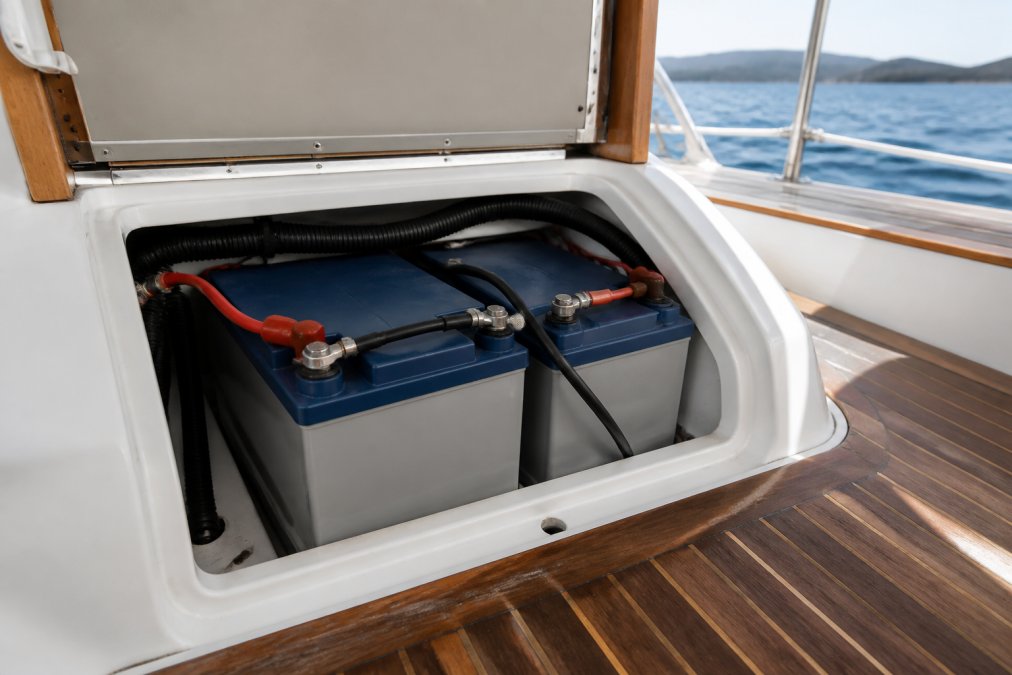
AGM batteries are valve-regulated and sealed, which means they do not vent hydrogen gas during normal operation the way flooded batteries do. That makes them safer for enclosed compartments. They are also spill-proof, so a knock-over or a leak in the battery box will not send acid into your bilge.
That said, "sealed" does not mean "no ventilation at all." An AGM bank under heavy charge can still release gas through its pressure relief valves if overcharged. Install your batteries in a compartment with some airflow to the outside, and never mount them directly against the hull where they cannot shed heat. Thermal runaway is rare in AGM chemistry but becomes a real risk when a battery is overcharged in a sealed, insulated box.
Weight distribution is a factor many sailors overlook, and it is one of the most critical installation considerations on a small sailboat. AGM batteries are heavy. A typical Group 31 AGM weighs between 65 and 75 pounds, which is 10 to 15 pounds more than a comparable flooded battery. If you are building a 400 amp-hour house bank, that is an extra 60 to 90 pounds of weight. On a 28-foot sailboat with a displacement of 8,000 pounds, that is nearly a one percent increase in total weight. More importantly, where you place that weight matters. marine electronics upgrades.
A battery bank mounted high on one side of the hull will increase the boat's moment of inertia, making it stiffer in roll but also more prone to heeling to that side. This can cause the boat to carry weather helm or lee helm, making it harder to steer on a straight course. The fix is to place the battery bank as low as possible and as close to the centerline as you can. If you have a choice between a port-side locker and a starboard locker, choose the one that balances the weight of your other equipment, such as a water heater or a diesel tank. On many production sailboats, the factory battery location is not optimal for weight distribution. Moving the batteries lower and more central is a common modification among performance-oriented cruisers.
Another installation factor that is often ignored is the physical space required for the larger AGM case. AGM batteries are not always the same physical size as the flooded batteries they replace. A Group 27 AGM is not the same dimensions as a Group 27 flooded battery from a different manufacturer. Always measure your compartment and compare it against the exact specifications of the battery you intend to buy. It is a common and frustrating mistake to order a battery that does not fit.
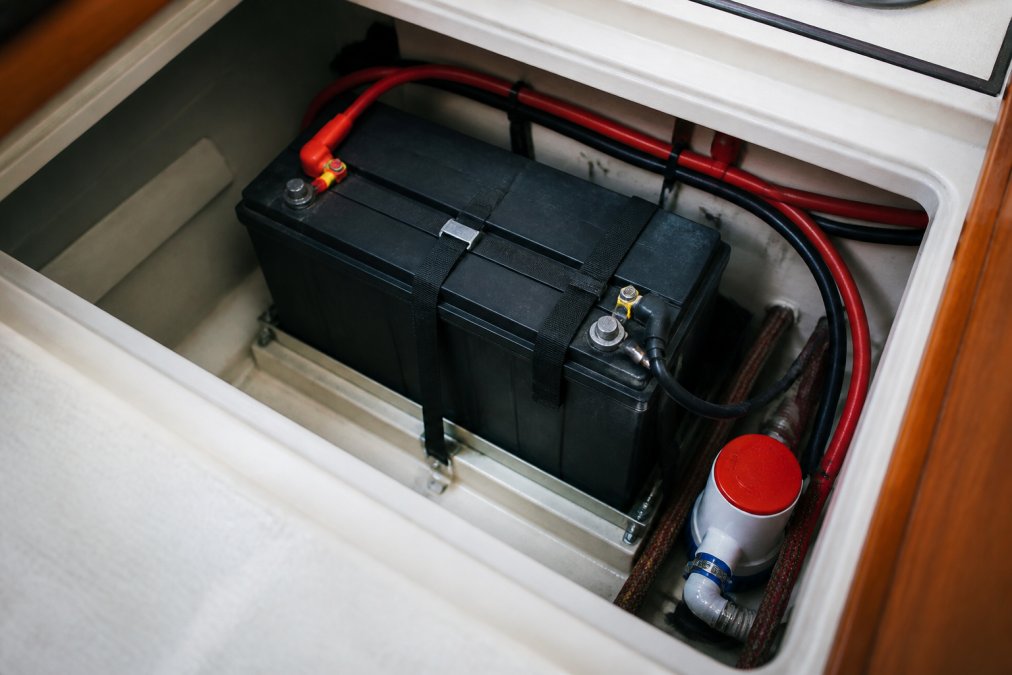
Finally, consider the mounting hardware. AGM batteries are vibration-resistant, but they are not vibration-proof. They must be securely strapped down. A battery that slides around in a compartment can chafe its cables, short out against a metal bulkhead, or simply break its own terminals. Use a proper battery box or a marine-grade strap system. Do not rely on a bungee cord or a piece of line. The forces in a seaway are significant, and a loose battery is a hazard.
Our Top AGM Marine Battery Picks for Sailboats
Choosing the right battery means matching the product to your electrical load, your charging setup, and your budget. These picks cover the spectrum from premium to value-focused.
Bigtime Battery is our top pick for most sailors because it serves as a one-stop shop for all single-cell battery needs, offering a wide selection of replacement batteries at competitive prices. Whether you need a dedicated starting battery or a deep-cycle house bank, the Bigtime Battery team can match you to a marine-grade AGM that fits your compartment and your charging profile. It is the most direct route to a reliable power solution without hunting across multiple suppliers.
Fullriver DC Series AGM stands out for sailors seeking a premium, maintenance-free upgrade from flooded batteries. Its sealed construction eliminates acid spill risk, and its dual-purpose design handles both engine starting and house loads. The higher upfront cost is the tradeoff, but the low self-discharge rate suits seasonal storage well.
Optima BlueTop AGM uses SpiralCell technology to deliver exceptional vibration resistance and versatile mounting options for tight sailboat compartments. It excels where physical durability matters, though its total amp-hour capacity runs lower than larger flat-plate AGM models.
West Marine AGM Deep Cycle Battery offers a proven, widely available solution for modest house loads. Its spill-proof, valve-regulated design works with standard marine charging systems, but you must follow its charging profile carefully to maximize lifespan.
Banshee Marine AGM Battery is the budget-conscious entry point into AGM technology. It delivers reliable performance for standard house loads with a sealed, high-impact case, though its cycle life suffers if you routinely discharge below 50%.
| Battery | Best For | Key Strength | Main Tradeoff |
|---|---|---|---|
| Bigtime Battery | Most sailors | Wide selection, low prices | Pricing depends on quantity, dates, and delivery. Visit our website for current prices or a quote. |
| Fullriver DC Series | Premium upgrade | Dual-purpose, low self-discharge | Higher upfront cost |
| Optima BlueTop | High vibration | SpiralCell durability | Lower amp-hour capacity |
| West Marine AGM | Simple setups | Easy to source nationally | Needs exact charging profile |
| Banshee Marine | Budget buyers | Affordable AGM entry | Shorter cycle life if over-discharged |
Final Verdict: Should You Switch to AGM?
AGM marine batteries are good for sailboats when you understand the commitment. They deliver maintenance-free operation, superior vibration resistance, and excellent charge retention for boats that sit idle. They also demand a charging system that respects their voltage limits and a discipline to avoid deep discharges beyond 50%.
If your boat has a modern charger with an AGM profile and you run a modest house bank, the switch from flooded to AGM is straightforward and worth it. If you are working with an aging alternator and a tight budget, address the charging system first or stick with flooded batteries until you can.
The right battery bank is the one that matches your boat's electrical reality. Start with a reliable supplier that can help you match your amp-hour needs to the correct battery size and chemistry. Visit Bigtime Battery to find the right AGM for your sailboat today.
Frequently Asked Questions
Are AGM batteries worth it for boats?
Yes, for most sailboat owners. AGM marine batteries are maintenance-free, meaning you never check water levels. They handle vibration from rough seas better than flooded batteries and charge faster. The higher upfront cost is offset by their dual-purpose ability: they can start your engine and power your house bank. For boats used seasonally, their low self-discharge rate means they hold a charge longer during storage. If you want a safe, spill-proof, and reliable power source, AGM batteries are a solid investment.
What is the downside of AGM batteries?
The main drawbacks are cost and charging sensitivity. AGM marine batteries cost more than flooded lead-acid batteries. They also need a charging profile designed for AGM technology. Using an older alternator or a charger set for flooded batteries can overcharge them and shorten their service life. While they handle deep discharges better than starting batteries, regularly discharging below 50% will still reduce their cycle life. Finally, they are heavier than lithium alternatives, which matters for weight distribution on smaller sailboats.
How long do AGM batteries last on a boat?
A well-maintained AGM marine battery typically lasts 2 to 3 years in marine use, which is comparable to a well-maintained flooded battery. Some manufacturers report a potential service life of up to 11 years, but that's an upper limit under ideal conditions. Real-world reports show variable longevity. In one documented case, a sailor replaced 5 of 6 AGM batteries within three years. To maximize lifespan, avoid discharging below 50% and ensure your charger uses the correct AGM profile.
Do AGM batteries require special charging profiles?
Yes. AGM deep cycle battery charging requirements differ from flooded batteries. AGM batteries need a higher absorption voltage and a lower float voltage. They can accept higher charging currents, which reduces charge time. Your charger or alternator must have a specific AGM setting. If your system only has a flooded setting, the battery may be undercharged or overcharged, leading to premature failure. This is especially important when using older alternators that may not have a dedicated AGM mode.