 how-to
Choose the Right Amp Hour Rating for Sump Pumps
Table of Contents
- Understanding Amp Hour Ratings and Sump Pump Backup Systems
- Key Factors That Determine Your Amp Hour Needs
- How to Calculate Sump Pump Battery Runtime
- Sump Pump Duty Cycle and Battery Life
- Sump Pump Backup Battery Capacity: Rated vs. Usable
- How to Test Sump Pump Backup Battery Performance
- Sizing Examples for Common Basement Scenarios
- Choosing Battery Chemistry and Compatibility
- Frequently Asked Questions
Last Updated: October 13, 2026
Understanding Amp Hour Ratings and Sump Pump Backup Systems
An amp hour rating measures how much electrical charge a battery can store and deliver over time. Understanding the amp hour rating sump pumps need determines how long your battery can power your pump during a power outage.
Think of amp hours like a fuel tank. A bigger tank holds more fuel. A higher amp hour rating holds more electrical energy.
At Bigtime Battery, we help homeowners and contractors understand which amp hour capacity works best for their specific setup.
Most people focus only on the battery's amp hour number. They miss the real factors that determine whether a battery will actually protect their home. We'll walk you through exactly how to calculate what you need.
Key Factors That Determine Your Amp Hour Needs
Your amp hour requirements depend on three critical factors: your pump's electrical draw, the voltage of your system, and how often your pump actually runs.
Pump horsepower and amperage draw
Residential sump pumps typically range from 1/4 to 1/3 horsepower, while larger installations may need 1/2 horsepower or more. Horsepower directly affects how much electrical current your pump draws.
The amperage draw is what matters for your battery selection. A smaller 1/4 horsepower pump might draw 5-8 amps when running. A larger 1/2 horsepower pump could draw 15-20 amps. This current draw is the single most important number you need.
To find your pump's amperage:
- Check the pump's nameplate or manual
- Look for "running amps" or "rated current"
- Call the pump manufacturer if the label is worn off
Write down this number. You'll use it to calculate everything else.
Voltage and power consumption
Most residential sump pump backup systems run on 12 volts. Some commercial installations use 24 volts. The voltage determines how your battery connects to an inverter or pump controller.
Power consumption is measured in watts. Watts equal volts multiplied by amps. A 12-volt pump drawing 10 amps consumes 120 watts while running.
Higher voltage systems can deliver the same power with lower current draw. This affects how quickly your battery drains. Always verify your system's voltage before selecting a battery.
Water flow and pump capacity
Your pump's flow rate matters because it determines how often the pump needs to run. Flow rate is measured in gallons per hour (GPH) or gallons per minute (GPM).
A pump with higher flow rate empties the sump pit faster. It runs for shorter periods but handles water inflow more quickly. A lower flow rate pump runs longer but moves less water per cycle.
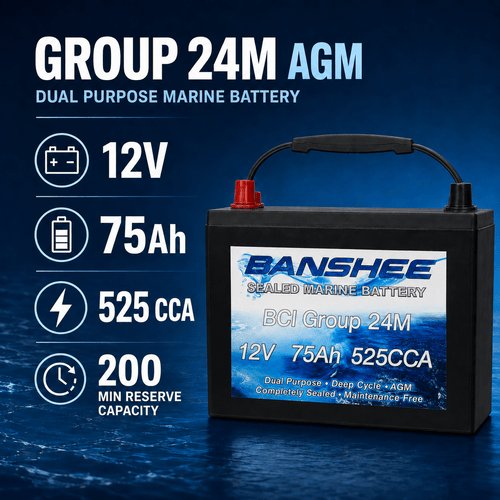
For example, one manufacturer reports that a system can deliver up to 10,000 gallons on a single charge with a 75 amp hour battery, based on a flow rate of 1,680 gallons per hour at 10 feet of lift. This tells you the battery can support extended operation under typical residential conditions.
How to Calculate Sump Pump Battery Runtime
Runtime is how long your battery powers your pump. Calculating it requires three pieces of information: amp hour capacity, amperage draw, and system voltage.
Here's the basic formula:
Estimated Runtime (hours) = (Battery Amp Hours × 0.8) ÷ Pump Amperage
We multiply by 0.8 because you can't safely use 100% of a battery's rated capacity. This accounts for battery chemistry and ensures you don't damage the battery through complete discharge.
Example calculation:
12V 80AH Group 24 Size Battery for Sump Pump by PowerStar - 3 YR WARRANTY →
- Battery: 80 amp hours
- Pump draw: 10 amps
- (80 × 0.8) ÷ 10 = 6.4 hours
This means your 80 amp hour battery could theoretically power a 10-amp pump for about 6.5 hours.
But this assumes the pump runs continuously. Real sump pumps cycle on and off based on water level. Your actual runtime will be longer because the pump doesn't run all the time.
Sump Pump Duty Cycle and Battery Life
Your pump's duty cycle determines how often it actually runs. Duty cycle is the percentage of time the pump is actively pumping versus sitting idle.
A basement with slow water inflow might have a 10% duty cycle. The pump runs 6 minutes per hour and sits idle 54 minutes.
Higher duty cycles drain your battery faster. They also stress the battery more with repeated charging and discharging cycles.
Consider your specific situation:
- New construction in wet soil: expect 30-50% duty cycle
- Established home with adequate drainage: expect 10-20% duty cycle
- Finished basement with a large sump pit: expect 5-15% duty cycle
To estimate real runtime with duty cycle, multiply your calculated runtime by the duty cycle percentage. A 6-hour runtime at 25% duty cycle gives you 24 hours of actual protection because the pump isn't running constantly.
Battery life also depends on duty cycle. Frequent cycling shortens battery lifespan. Deep-cycle batteries handle this better than starting batteries, which is why backup sump pump systems use specialized deep-cycle designs.
Sump Pump Backup Battery Capacity: Rated vs. Usable
Battery manufacturers rate capacity in ideal conditions. Real-world conditions reduce what you can actually use.
Rated capacity is the amp hour number on the battery label. A 75 amp hour battery is rated at 75 Ah.
Usable capacity is what you can safely extract without damaging the battery. For most deep-cycle batteries, usable capacity is about 80% of rated capacity.
Temperature affects usable capacity. Cold basements reduce available power. A battery rated for 75 Ah in 70-degree conditions might deliver only 65 Ah in a 40-degree basement.
Discharge rate also matters. Pulling high current (fast discharge) reduces usable capacity. Pulling low current (slow discharge) lets you extract more total energy.
This is why oversizing your battery provides insurance.
How to Test Sump Pump Backup Battery Performance
Testing your backup battery ensures it will actually work when you need it. You should test at least twice per year, or after any power outage.
Basic load test:
- Locate your battery and inverter system
- Disconnect the pump from its normal power source
- Switch to backup battery mode
- Let the pump run on battery power for 5-10 minutes
- Check that the pump operates normally
- Return to normal power and recharge the battery fully
Voltage test:
- Use a multimeter to check battery voltage
- A fully charged 12-volt battery reads 12.6-12.8 volts
- Below 12.4 volts indicates the battery needs charging
- Below 12 volts means the battery is significantly discharged
Load test with monitoring:
- Run the pump on battery for 15-30 minutes
- Note the time and watch for voltage drop
- Voltage should drop slowly and steadily
- A sharp voltage drop indicates battery problems
- Stop the test if voltage drops below 11 volts
Most backup systems include a battery monitor that displays voltage and charge status. Check this display monthly. It should show green or "good" status. Yellow or red warnings mean the battery needs attention.
Sizing Examples for Common Basement Scenarios
Let's work through real examples to show how amp hour requirements change based on your situation.
12V 80AH Group 24 Size Battery for Sump Pump by PowerStar - 3 YR WARRANTY →
Scenario 1: New construction, clay soil, 25% duty cycle
- Pump: 1/3 HP, 12 amps
- Water inflow: moderate to high
- Desired runtime: 8 hours of protection
- Calculation: (8 hours ÷ 0.25 duty cycle) × 12 amps = 384 amp hours needed
Wait, that seems high. But remember: at 25% duty cycle, the pump runs 2 hours per 8 hours of total time. So you need 2 hours × 12 amps = 24 Ah minimum. A 75 Ah battery gives you plenty of cushion.
Scenario 2: Established home, good drainage, 10% duty cycle
- Pump: 1/4 HP, 8 amps
- Water inflow: low to moderate
- Desired runtime: 12 hours of protection
- Calculation: (12 × 0.10) × 8 amps = 9.6 Ah needed
A 75 Ah battery is massive overkill here. A 20-30 Ah battery would work fine. But many homeowners choose larger batteries for extra insurance and longer battery lifespan.
Scenario 3: Finished basement, sump pit below floor level, 40% duty cycle
- Pump: 1/2 HP, 15 amps
- Water inflow: high
- Desired runtime: 6 hours of protection
- Calculation: (6 × 0.40) × 15 amps = 36 Ah needed
A 75 Ah battery gives you solid protection with room to spare. This is a realistic application for the "sweet spot" capacity that industry sources commonly recommend.
| Scenario | Pump Size | Duty Cycle | Actual Amp Hours Needed | Recommended Battery |
|---|---|---|---|---|
| New construction, wet soil | 1/3 HP (12A) | 25% | 24 Ah | 75 Ah |
| Established home, dry soil | 1/4 HP (8A) | 10% | 9.6 Ah | 30-50 Ah |
| High water inflow, large pit | 1/2 HP (15A) | 40% | 36 Ah | 75-100 Ah |
Choosing Battery Chemistry and Compatibility
Battery chemistry determines how the battery performs and how long it lasts.
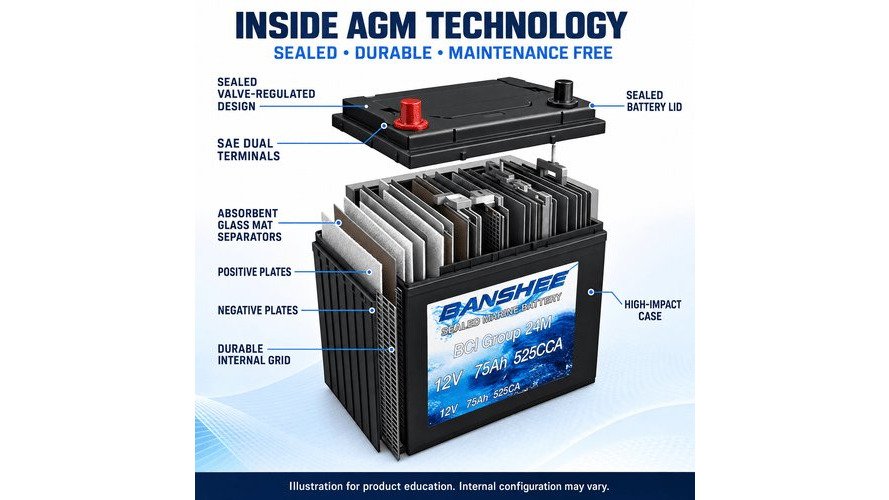
AGM batteries are sealed and maintenance-free. They handle vibration and shock better than flooded batteries.
Flooded lead-acid batteries are cheaper but require periodic water top-offs. They're heavier and need more space.
For most homeowners, AGM is the better choice.
Compatibility matters too. Your battery must match your inverter or pump controller's voltage and terminal type. Most residential systems use 12-volt batteries with standard terminals.
Bigtime Battery carries high-quality backup batteries designed specifically for sump pump systems. Our 12V 80AH Group 24 Size Battery for Sump Pump by PowerStar is rated at $223.26 and includes a 3-year warranty. For smaller applications or as a secondary backup, our PowerStar 12V 9AH Sealed Lead Acid Deep Cycle Battery AGM at $40.80 provides compact, affordable protection.
Both batteries are fully rechargeable deep-cycle designs built to handle the repeated charge-discharge cycles that sump pump systems demand.
Selecting the correct amp hour rating sump pumps require protects your home from water damage during power outages.
Don't guess at battery capacity. Use the formulas and examples in this guide to size your system accurately.
Frequently Asked Questions
What amp-hour battery do I need for a sump pump?
The amp-hour rating you need depends on three things: your pump's running amperage, how often it cycles, and your desired runtime. Most residential sump pumps draw 5-15 amps. A 75 Ah battery is considered a common choice for backup systems and is described as a 'sweet spot' for most residential applications. However, always check your pump's nameplate for its exact amp draw and multiply that by your target runtime in hours to find the minimum amp-hour capacity needed.
How do I calculate sump pump battery runtime?
To estimate runtime, divide the battery's usable amp-hours by your pump's running amperage. For example, if you have a 75 Ah battery and your pump draws 10 amps, you can expect roughly 7.5 hours of runtime (75 ÷ 10 = 7.5). Remember that usable capacity is typically 80-90% of the rated capacity, so a 75 Ah battery might provide only 60-67 usable amp-hours in practice. Also factor in duty cycle: if your pump runs intermittently rather than continuously, actual protection time will be longer.
How does frequent sump pump cycling affect battery capacity?
Frequent cycling, where your pump starts and stops repeatedly, affects battery life through the duty cycle. Continuous operation drains a battery faster than intermittent cycling at the same amperage. If your basement has high water inflow, your pump may cycle every 30 seconds or more, which stresses the battery and reduces its effective lifespan. A deep-cycle battery is designed to handle this repeated charging and discharging, but excessive cycling will still shorten its usable life. This is why matching your amp-hour rating to your actual water inflow and pump capacity matters.
What battery type is compatible with my sump pump backup system?
Most sump pump backup systems use 12-volt sealed lead-acid (SLA) or AGM (Absorbed Glass Mat) batteries because they are maintenance-free, spill-proof, and designed for deep-cycle use. Check your backup system's specifications for voltage and terminal type before purchasing. Bigtime Battery offers PowerStar 12V deep-cycle batteries in multiple amp-hour ratings, including an 80 Ah option ideal for residential sump pump systems, all sealed and maintenance-free. Verify the dimensions and terminal type match your inverter or backup system before ordering at bigtimebattery.com.