 comparison
AGM Powersports Battery vs Gel: Which Lasts Longer?
Table of Contents
- AGM vs Gel: Quick Comparison Table
- What Is an AGM Powersports Battery?
- What Is a Gel Battery and How Does It Differ?
- AGM vs Gel: Cycle Life, Cold Cranking Amps, and Cost
- Powersports Battery Charging Best Practices
- When a 12v Deep Cycle Battery Beats a Starting Battery
- Frequently Asked Questions
Last Updated: September 10, 2026
AGM vs Gel: Quick Comparison Table
The AGM powersports battery vs gel debate comes down to one question: are you starting an engine or running accessories for hours? According to VARTA Automotive's battery technology comparison, AGM batteries withstand three times as many charging cycles as conventional starter batteries, while gel designs trade burst power for deeper discharge endurance.
Here's the short version before we get into the details.
| Feature | AGM | Gel |
|---|---|---|
| Best For | Engine starting, cold weather | Deep cycle, long storage |
| Cold Cranking Amps | Higher burst power | Lower, reacts slower |
| Cycle Life (deep discharge) | Good | Better |
| Vibration Resistance | Excellent | Good |
| Charging Sensitivity | Tolerant of standard profiles | Requires precise voltage regulation |
| Self-Discharge | Faster | 6-12 months usable charge |
| Cost | Lower upfront | Higher |
This guide breaks down where each chemistry wins, where it fails, and which one actually belongs in your machine.
What Is an AGM Powersports Battery?
An AGM powersports battery is a sealed lead acid battery that holds its electrolyte in an absorbed glass mat separator rather than free-flowing liquid. That construction makes it spill-proof, maintenance-free, and highly resistant to the vibration that shakes apart conventional batteries on ATVs, motorcycles, and jet skis.
Most modern motorcycles now ship with AGM batteries by default, according to rider discussions on r/motorcycles, largely because of that vibration resistance and faster charging capability. The lead-calcium plates also cut water loss, so you never top off cells.
The tradeoff: AGM self-discharges faster than gel when sitting idle. If your machine hibernates for months, plan on a trickle charger.
What Is a Gel Battery and How Does It Differ?
A gel battery is a valve-regulated lead acid battery that uses a silica gel electrolyte instead of a liquid or mat-held one. The gelled electrolyte reacts more slowly, and that slower reaction produces longer cycle life under repeated deep discharge.
Tiandong Battery's comparison of VRLA technologies notes that gel batteries can hold a usable charge for 6 to 12 months or longer without maintenance charging, which makes them a strong fit for seasonal equipment.
Where gel falls short is starting power. ThrottleX Batteries' cold-weather analysis found that gel batteries lose power faster than AGM below 32°F. And gel is more sensitive to overcharging, so a mismatched charger can permanently damage the cells.
AGM vs Gel: Cycle Life, Cold Cranking Amps, and Cost
The AGM powersports battery vs gel decision splits cleanly along cycle life, CCA, and cost. AGM wins on starting power and price. Gel wins on deep discharge endurance. The numbers behind that split are what actually matter when you're standing in a shop aisle.
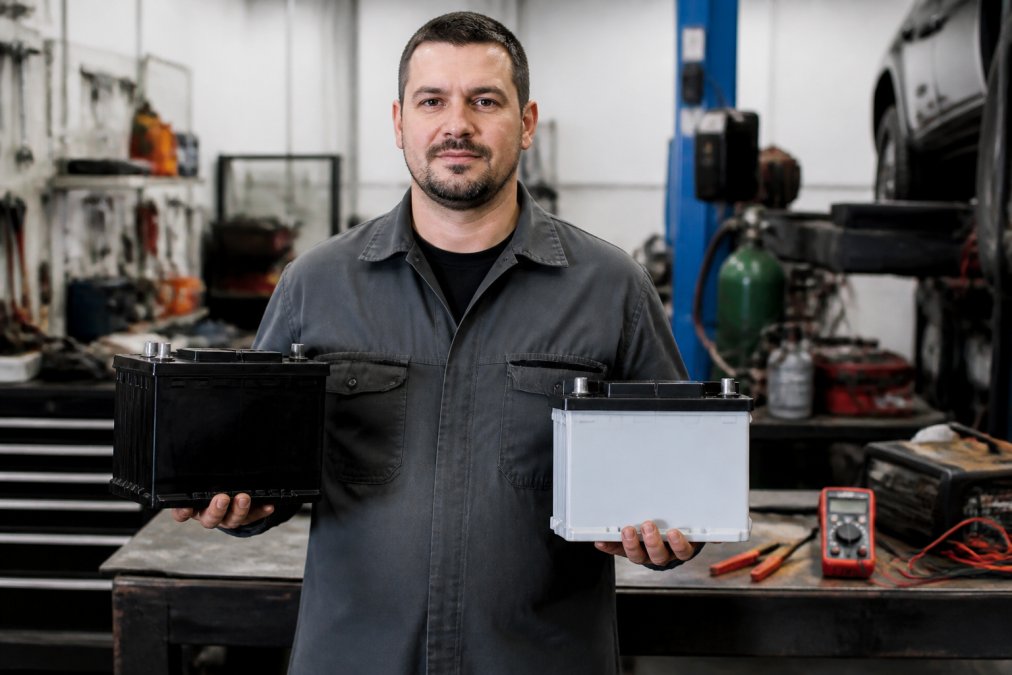
Cold cranking amps (CCA) measure a battery's ability to deliver 30 seconds of current at 0°F while staying above 7.2 volts. AGM wins here because its absorbed glass mat holds electrolyte in tight contact with the plates, which lowers internal resistance and lets current flow faster on the first crank. A typical powersports AGM in a group size like YTX20 delivers roughly 270 CCA; a gel battery in the same footprint often lands 10-20% lower because the gelled electrolyte conducts more slowly.
Reserve capacity (RC) measures how many minutes a battery can run a 25-amp load before dropping below 10.5 volts. This is the metric gel was built for. A gel battery of equivalent physical size usually posts a higher RC than an AGM, which is why gel shows up in trolling motors, sump pumps, and accessory banks that run for hours without the alternator.
Cycle life is where the trade-off gets expensive. AGM handles repeated deep discharges reasonably well, but gel's thicker plates and slower electrolyte reaction let it survive more full discharge cycles before capacity fades. If you routinely run a battery to 50% or below, gel usually outlasts AGM. If you mostly start an engine and let the alternator recharge it, that cycle-life advantage never gets used.
Cost tracks the same split. AGM starts lower because the manufacturing process is simpler and the plates are thinner. Gel runs higher because of thicker plates, more complex silica handling, and tighter quality control on the electrolyte mix. Expect to pay a meaningful premium for gel in the same group size.
Weight is the data point most comparisons skip. For the same CCA rating, an AGM battery is generally lighter than a gel battery of equivalent capacity, because gel requires more lead and a heavier case to hold the gelled electrolyte. On a motorcycle or ATV, that difference shows up as unsprung weight and affects handling more than most riders expect. If you're chasing every pound, AGM is usually the lighter pick.
Installation orientation is another practical difference. AGM batteries are valve-regulated and spill-proof, so most can be mounted on their side or even inverted without leaking, as long as the terminals stay accessible and the vent isn't blocked. Gel batteries are also sealed, but manufacturers typically specify upright mounting because the gelled electrolyte can shift and create voids against the plates if the battery is stored or run at an angle. Check the label before you mount either one sideways.
Powersports Battery Charging Best Practices
Powersports battery charging best practices start with voltage regulation, because both chemistries fail fast under the wrong profile. Use a charger with a gel/AGM selector switch, and never fast-charge either type above the manufacturer's rated amperage.
- Store at a 50-75% state of charge, never fully depleted
- Use a trickle charger for anything sitting more than 30 days
- Check terminal corrosion every few months and clean with a baking soda solution
- Avoid float charge above 13.6V for gel, which risks thermal runaway
- Equalize AGM occasionally; skip equalization on gel entirely
Sulfation is the real killer. A battery left at low charge builds lead sulfate crystals on the plates, and those crystals don't reverse. Gel resists this longer during storage; AGM needs more attentive top-offs.
When a 12v Deep Cycle Battery Beats a Starting Battery
A 12v deep cycle battery beats a starting battery whenever your load runs long and steady rather than in short bursts. Trolling motors, sump pumps, GPS units, and emergency lighting all draw continuous power, and that's the profile gel chemistry handles best.
Practical Sailor's deep cycle battery testing found that gelled electrolyte batteries deliver longer cycle life when the bank is frequently and deeply discharged. A separate comparison from Ace of Carts' battery performance data showed a gel battery outlasting an AGM even when discharged to 90% versus the AGM's 50%.
Why gel wins the deep cycle comes down to plate thickness and electrolyte behavior. Gel batteries use thicker lead plates and a silica-gel electrolyte that reacts more slowly, which spreads the discharge stress across more plate material and slows the sulfation that kills a battery over time. AGM's thinner plates and faster reaction are great for burst current but wear faster under repeated deep discharge.
Charging profile compatibility is the gap most comparisons miss. A standard motorcycle trickle charger is usually set for AGM or flooded lead acid and floats around 13.6-13.8V with an absorption stage near 14.4-14.8V. That's fine for AGM. On a gel battery, the same charger can overcharge the cells, dry out the gel, and permanently reduce capacity. Gel wants a lower absorption voltage, typically around 14.1V, and a float closer to 13.4-13.6V. If your charger doesn't have a gel selector switch, don't use it on gel. This is the single most common way riders kill a gel battery in the first year.
Weight and orientation matter here too. For the same reserve capacity, a gel deep cycle battery is generally heavier than an AGM because of the thicker plates and extra lead. If you're mounting a battery in a tight space or on a vehicle where every pound counts, that weight penalty is real. On orientation, AGM can usually be mounted on its side or inverted without leaking, while gel manufacturers typically call for upright mounting to keep the gelled electrolyte in contact with the plates. If your install requires a sideways mount, AGM is the safer choice.
CCA vs. reserve capacity is the trade-off to weigh. A deep cycle gel battery will have lower CCA than an AGM of the same size, so it's a poor choice for cold-weather starting. But it will run accessories longer without the alternator. If your machine needs both starting power and long accessory runtime, the honest answer is that no single battery does both well, and a dual-battery setup is often the better solution.
For starting an engine, though, AGM remains the better pick. Higher power density, better cold-weather cranking, and broad charger compatibility. Bigtime Battery offers a wide selection of replacement batteries across marine, powersports, and specialty applications, so you can match the battery to the actual load instead of guessing.
Frequently Asked Questions
What is the main difference between AGM and gel batteries?
AGM batteries hold electrolyte in a fiberglass mat, while gel batteries use a silica-thickened electrolyte. AGM delivers higher cold cranking amps for engine starting, and gel resists deep discharges better. Both are sealed, spill-proof, and maintenance-free, but they need different charging voltages. AGM suits motorcycles and ATVs that start engines regularly; gel suits trolling motors and accessories that drain batteries deeply.
Can I use a gel battery in my motorcycle or ATV?
Yes, but check your charging system first. Gel batteries are more sensitive to overcharging than AGM. Most modern powersports vehicles ship with AGM batteries and charging profiles tuned for them. If your regulator puts out more than 14.4 volts, a gel battery can fail early. Match the battery to your vehicle's charging voltage, or choose AGM, which handles a wider range of charging profiles.
Are AGM batteries better than gel for cold weather starting?
AGM wins for cold-weather starting. Below 32°F, gel batteries lose power faster than AGM, according to ThrottleX Batteries. AGM's lower internal resistance lets it deliver more cranking amps in cold conditions, which is why most modern motorcycles come with AGM batteries from the factory. If you ride or drive in freezing temperatures, AGM is the safer choice.
Do AGM and gel batteries require different charging profiles?
Yes. Gel batteries need a lower float charge, typically around 13.6 to 13.8 volts, and can be damaged by the higher voltages AGM batteries tolerate. AGM batteries charge at roughly 14.4 volts and handle standard chargers. Using the wrong profile shortens battery life. If you own both types, use a charger with selectable AGM and gel modes, or label each battery and charge separately.
The hardest part of the AGM powersports battery vs gel decision isn't the chemistry, it's finding the right replacement without ordering the wrong size twice. Bigtime Battery carries a wide selection of replacement batteries for marine, powersports, and specialty devices, backed by low prices and a one-stop shop for single-cell battery needs. Get started with Bigtime Battery and get reliable power for every application.