 how-to
Powersports Battery Maintenance for Beginners
Table of Contents
- What You'll Need Before You Start
- Know Your Powersports Battery Type
- Picking the Right Powersports Battery Charger
- Signs of a Failing Powersports Battery
- Powersports Battery Storage Tips for the Off-Season
- Common Mistakes to Avoid
- Conclusion
- Frequently Asked Questions
Last Updated: September 15, 2026
What You'll Need Before You Start
Powersports battery maintenance for beginners starts with a short list of tools, and the good news is that most of it costs less than a tank of fuel. A quality powersports battery typically lasts 3 to 5 years with optimal upkeep, according to BatteryStuff's motorcycle battery buyers guide, so the hour you spend now protects a multi-season investment. This guide from Bigtime Battery walks through battery types, charging, storage, and the mistakes that quietly kill batteries early.
Gather these before you touch the terminals:
- Safety glasses and nitrile gloves
- A soft-bristled brush and a baking soda solution for cleaning
- A battery charger rated for your battery's chemistry
- A multimeter for voltage checks
- Dielectric grease and terminal protectors
- A wrench set sized to your terminal bolts
The market keeps growing because riders keep riding. The global motorcycle battery market is estimated at USD 8.489 billion in 2026, with projections to reach USD 9.679 billion by 2035, per Business Research Insights' motorcycle battery market report. That expansion is being driven by a shift toward absorbed glass mat and lithium-ion designs, which changes how you should maintain them.
Know Your Powersports Battery Type
Your maintenance routine depends entirely on which chemistry sits in your machine, and the three you'll encounter are flooded lead-acid, absorbed glass mat (AGM), and lithium-ion. Flooded batteries need regular water checks. AGM batteries are sealed and maintenance-free, which is why Motorcycle Powersports News coverage of battery technology trends notes their high vibration resistance and lower upkeep demands.
Lithium-ion is the newest option and the lightest by a wide margin. It can also outlast the standard 3-5 year window of lead-acid, according to BatteryClerk's ATV and UTV replacement battery guide, though it costs more up front and demands a chemistry-specific charger.
| Battery Type | Maintenance Level | Typical Lifespan | Best For |
|---|---|---|---|
| Flooded lead-acid | High (water checks) | 3-5 years | Budget replacements |
| AGM | Low (sealed) | 3-5 years | Vibration-heavy use |
| Lithium-ion | Low (sealed) | Often 3-5+ years | Weight savings |
Picking the Right Powersports Battery Charger
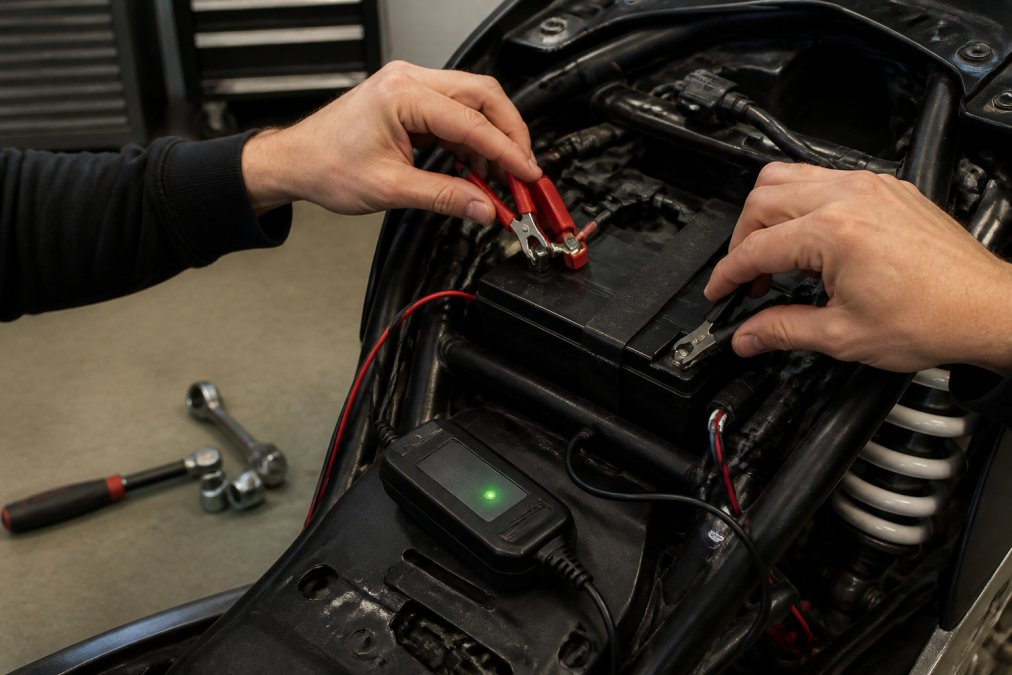
The right charger matches your battery's chemistry and delivers a controlled, tapering charge rather than a constant blast. Modern guidance emphasizes that lead-acid and lithium-ion batteries require distinct charging profiles to stay ready year-round, per Battery Tender's 2026 charger guide. Buying a charger with selectable modes solves this if you own both types.
Trickle Charger vs. Battery Tender: What's the Difference?
A trickle charger delivers a low, constant current and never shuts off, which is fine for a few hours but can overcharge a battery left connected for weeks. A battery tender is a smart maintainer: it charges to full, then monitors voltage and only tops up when the reading drops. For a battery you're storing for months, the tender is the correct tool. For a quick overnight top-up before a ride, either works.
Signs of a Failing Powersports Battery
The clearest signs of a failing powersports battery are slow cranking, dim lights at idle, a swollen or cracked case, and a resting voltage below 12.4 volts on a lead-acid unit. If your machine needs a jump every time it sits overnight, the battery is telling you something.
Watch for these specific indicators:
- Slow engine turnover, especially on cold mornings
- A clicking sound instead of a crank when you hit the starter
- Sulfation, a white crusty buildup on the terminals or plates
- Physical distortion, including a bulging case or leaking fluid
- A rapid voltage drop when you apply a load
Year-to-date motorcycle sales reached nearly 170,000 units as of April 2026, up almost 2% over the same period in 2025, so more riders are dealing with these exact symptoms right now. A multimeter test takes two minutes and saves you from guessing.
Powersports Battery Storage Tips for the Off-Season
Proper powersports battery storage tips come down to three things: charge it fully, keep it cool, and maintain it. Longevity depends heavily on avoiding deep discharges, preventing undercharging, and protecting the battery from excessive heat. Leaving a battery to sit at half charge for a winter is the fastest way to shorten its life. Consistent voltage monitoring prevents the gradual capacity loss that often complicates efforts to test battery range during the transition to warmer riding seasons.
For a typical off-season:
- Remove the battery if the machine sits somewhere that freezes.
- Clean the terminals with a baking soda solution and dry them completely.
- Charge to full before storage, never store it depleted.
- Connect a maintainer and leave it on for the duration.
- Store it off the ground in a cool, dry spot.
The old rule about never setting a battery on concrete is mostly a legacy concern. Modern cases are sealed and insulated enough that the surface itself rarely causes discharge, as Industry Today's analysis points out. The bigger risk is temperature, not the floor.
Common Mistakes to Avoid
Most beginner battery failures trace back to a handful of avoidable errors. The most damaging is using the wrong charger for the chemistry, which can cook a lithium pack or undercharge an AGM unit. A common mistake is assuming one charger fits every battery in the garage.
The rest of the list looks like this:
- Storing a battery at partial charge. Sulfation sets in fast and permanently.
- Ignoring the terminals. Corrosion adds resistance and mimics a dying battery.
- Overcharging with a trickle unit. Constant current with no cutoff damages cells.
- Jumping a battery repeatedly. This masks the real problem instead of fixing it.
- Skipping voltage checks. You can't catch a slow decline you never measure.
What most guides miss is that heat does more long-term damage than cold. A battery stored near a furnace or in a sun-baked shed will age faster than one kept in a cool garage, regardless of how carefully you charge it.
Conclusion
Battery care rewards consistency more than effort, and the riders who get five seasons out of a battery are the ones who check voltage, match their charger to the chemistry, and never store a unit depleted. When a battery finally does give out, replacing it with the right match matters as much as the maintenance did.
That's where Bigtime Battery comes in. We're a one-stop shop for single-cell battery needs, with a wide selection of replacement batteries for marine, powersports, and specialty applications at competitive prices. Whether you're restocking a boat fleet or replacing a single motorcycle battery, our team helps you identify the correct unit and get reliable power back in place fast. Get started with Bigtime Battery and keep your equipment running on the right battery.
Frequently Asked Questions
How often should I charge my powersports battery?
If you ride regularly, the vehicle's charging system keeps the battery topped off. During storage or off-season months, connect a battery tender to maintain a full charge. Industry guidance for 2026 recommends checking voltage monthly and recharging when it drops below 12.4 volts for lead-acid or roughly 13.2 volts for lithium-ion. Avoid letting any powersports battery sit deeply discharged, since that shortens its lifespan significantly.
Can I use a standard car charger on a powersports battery?
Not safely. A full-size car charger pushes too many amps for the small cells in a powersports battery and can overheat or damage it. Use a charger rated for your battery's chemistry and amp-hour capacity instead. Current 2026 recommendations stress that lead-acid and lithium-ion batteries need distinct charging profiles, so match the charger to the battery type. A 1 to 2 amp charger works well for most motorcycle and ATV batteries.
How do I know if my powersports battery is dead or just discharged?
A discharged battery reads low voltage but recovers after charging. A dead battery won't hold a charge even after a full cycle. Test with a multimeter: 12.6 volts means charged, 12.0 volts means about half-discharged, and below 11.8 volts suggests a problem. If the battery drops below 12.4 volts within a day or two of charging, it's likely failing and due for replacement.
What is the best way to store a powersports battery during the off-season?
Remove the battery, clean the terminals, and store it in a cool, dry place above freezing. Connect a battery tender to keep it topped off, or recharge every few weeks. Quality powersports batteries last 3 to 5 years with good maintenance, and proper storage is a big part of that. Modern sealed cases mean you don't need to worry about storing on concrete, a legacy concern that no longer applies to most batteries.