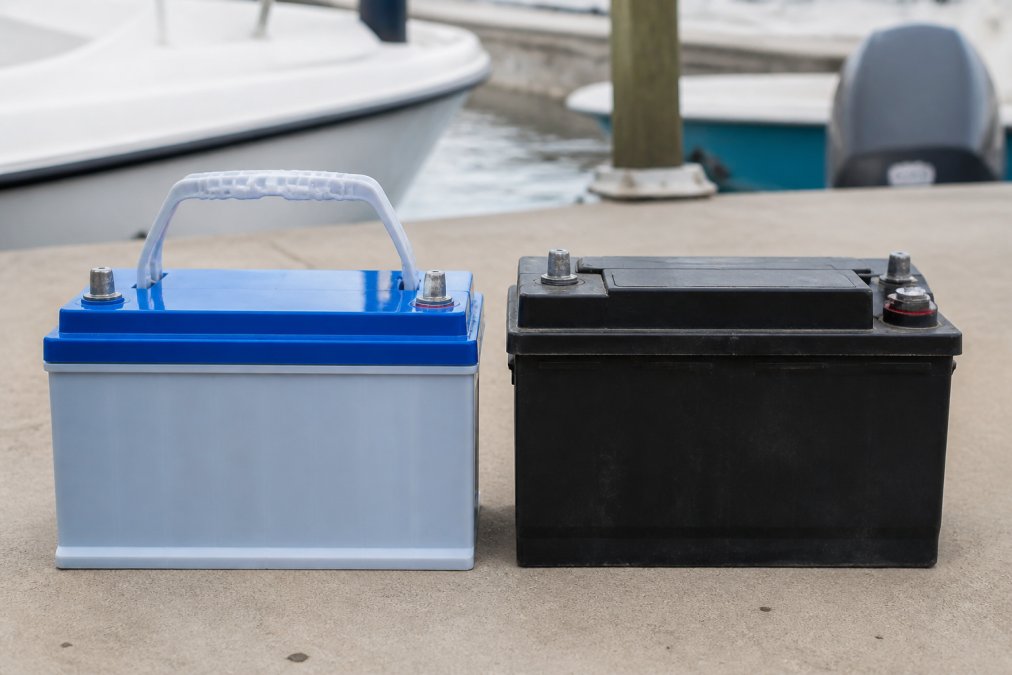
 comparison
Marine Battery Cost vs Car Battery: 2026 Price Guide
Table of Contents
- Marine Battery Cost vs Car Battery: Key Differences at a Glance
- Marine Starting vs Deep Cycle Battery: What's the Difference?
- 12V Deep Cycle Battery: Costs and Use Cases
- Battery Lifespan Comparison: How Long Do They Last?
- Can You Use a Marine Battery in a Car?
- Can You Use a Car Battery in a Boat?
- Cost per Cycle: The Real Long-Term Value
- Frequently Asked Questions
Last Updated: September 14, 2026
Marine Battery Cost vs Car Battery: Key Differences at a Glance
Marine battery cost vs car battery pricing comes down to one thing: marine batteries are built for repeated deep discharging, and that construction costs more. According to Mordor Intelligence's marine battery market analysis, the global marine battery market was valued at USD 0.97 billion in 2026 and is projected to grow at 8.29% annually through 2031. At Bigtime Battery, we understand that boat owners and mechanics often wonder why a marine battery costs more than a car battery. The short answer: different chemistry, thicker plates, and vibration engineering that automotive batteries simply don't need. Below, we break down the actual cost drivers, lifespan math, and when each battery type makes sense.
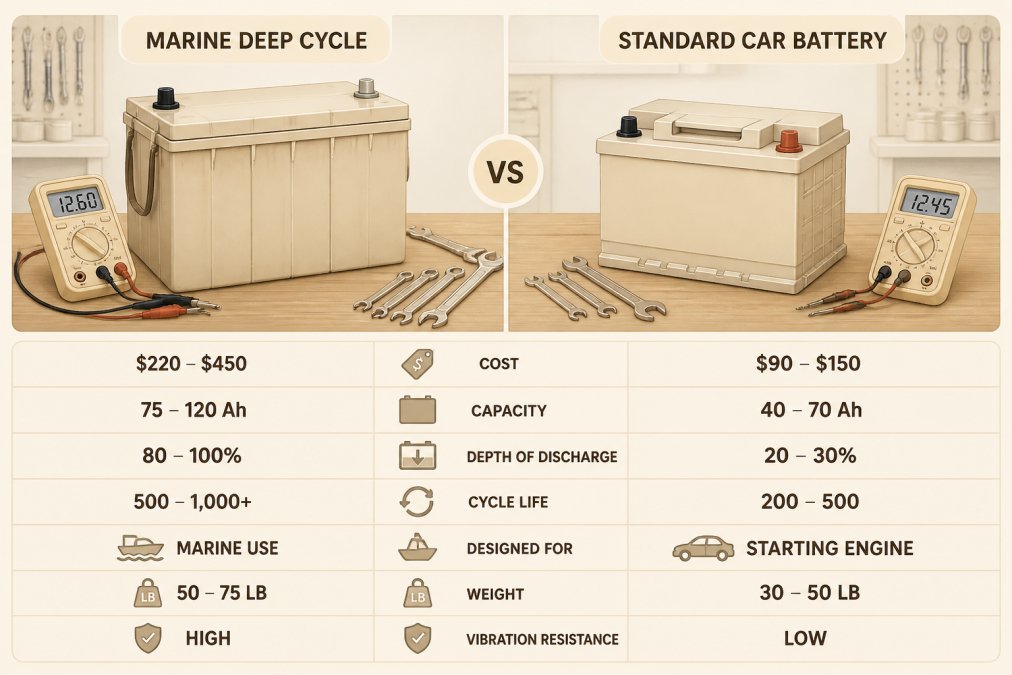
Quick Comparison Table
| Factor | Marine Battery | Car Battery |
|---|---|---|
| Primary design | Deep cycle, sustained discharge | Starting power, short bursts |
| Typical construction | Thicker plates, vibration-resistant | Thinner plates, lighter casing |
| Cycle life | 300-1,000+ cycles | 30-50 deep discharges |
| Weight | Heavier (lead-acid) or lighter (LiFePO4) | Lighter |
| Cost driver | Plate thickness, marine-grade casing | Cranking amps, group size |
| Best for | Trolling motors, house banks, accessories | Engine ignition only |
Why the Price Gap Exists
A marine battery costs more because it contains more lead, thicker plate grids, and reinforced internal construction. Those thicker plates resist the physical stress of repeated discharge cycles, which is exactly what kills a car battery in a marine application.
Vibration resistance is another cost factor. Marine batteries are engineered to be up to 28 times more vibration-resistant than traditional designs to withstand wave impacts, according to Batteries Plus technical comparison. That reinforcement adds material and manufacturing cost.
What most buyers miss is that the price gap isn't arbitrary. You're paying for cycle life, not just cranking power.
Marine Starting vs Deep Cycle Battery: What's the Difference?
A marine starting battery delivers high cranking amps for engine ignition, while a deep cycle battery provides steady power over long periods for trolling motors, electronics, and house loads. They are not interchangeable for their intended roles.
Marine cranking amp ratings matter for starting batteries, just like cold cranking amps in automotive applications. Deep cycle batteries, by contrast, are rated in amp hours and reserve capacity.
Dual-purpose marine batteries attempt to bridge both roles. They work for boats with modest electrical demands, but they compromise on both ends: less cranking power than a dedicated starting battery, shorter cycle life than a pure deep cycle unit.
12V Deep Cycle Battery: Costs and Use Cases
A 12V deep cycle battery costs more than a comparable car battery because of its plate construction, but the exact price depends on chemistry, capacity, and brand. Lithium iron phosphate (LiFePO4) options sit at the higher end, while flooded lead-acid remains the budget choice.
What actually moves the price is amp-hour capacity and plate thickness, not brand markup. A group 24 flooded deep cycle in the 75-85 amp-hour range is the entry point most boaters start with. Step up to a group 27 or group 31 and you are paying for more lead and more plate surface area, which is why the same chemistry can span a wide price band. AGM sits above flooded because the absorbed glass mat construction costs more to manufacture and tolerates faster charging. LiFePO4 sits at the top because of the battery management system, the cells themselves, and the fact that a single unit can replace two or three lead-acid batteries over its life.
A useful way to think about it: you are buying amp-hours and cycle life, not cranking amps. Two batteries with the same footprint can differ by hundreds of dollars because one is rated for 500 cycles and the other for 4,000.
The 12V deep cycle battery serves applications where sustained power matters:
- Trolling motors running for hours at low draw
- Boat house banks powering lights, pumps, and electronics
- Off-grid solar storage
- Sump pump backup systems
- Golf cart and RV auxiliary power
Lithium iron phosphate batteries are increasingly replacing lead-acid house batteries in marine environments because of faster charging and significant weight reduction, a trend noted by marine technicians in MechanicAdvice community discussions. Some modern marine batteries are 50% lighter than comparable lead-acid units when using specific technologies, per Batteries Plus marine battery guide.
For current pricing on 12V deep cycle options, check Bigtime Battery's catalog directly, since costs vary by capacity and chemistry.
Battery Lifespan Comparison: How Long Do They Last?
Battery lifespan comparison favors marine deep cycle units by a wide margin in cycling applications. A well-maintained deep cycle battery delivers 300 to 1,000 cycles depending on chemistry, while a car battery typically survives only 30 to 50 deep discharges before sulfation degrades its capacity.
Sulfation is the killer. When a lead-acid battery sits in a partial state of charge, lead sulfate crystals harden on the plates and reduce capacity permanently. Car batteries are especially vulnerable because they're designed to stay near full charge, topped off constantly by the alternator. Every deep discharge pushes a car battery closer to permanent capacity loss.
Depth of discharge matters as much as chemistry. A lead-acid deep cycle rated for 500 cycles at 50% depth of discharge may only deliver 200-300 cycles at 80% depth of discharge. That is why the same battery can last three seasons or seven depending on how hard you run it. Most manufacturers publish cycle life at a specific depth of discharge, and comparing two batteries without checking that number is a common mistake.
Lithium iron phosphate batteries handle deep discharge far better. LiTime's marine LiFePO4 units, for example, are rated for 4,000+ cycles at 100% depth of discharge. That's roughly 10 times the cycle life of a quality AGM battery.
The trade-off is upfront cost. Lithium costs more today, but the cost-per-cycle math often favors it over a 10-year ownership window.
Here is how that plays out over a 10-year ownership window for a weekend boater running a trolling motor:
| Battery Type | Cycles per Unit | Units Needed (10 yrs) | Relative Total Cost |
|---|---|---|---|
| Flooded lead-acid deep cycle | 300-500 | 4-6 | Highest |
| AGM deep cycle | 500-800 | 3-4 | Moderate |
| LiFePO4 deep cycle | 3,000-5,000 | 1 | Lowest |
The pattern holds across most marine applications. Lithium's higher upfront price gets absorbed by year three or four, and the remaining years are pure savings. Add in the weight reduction, faster charging, and stable voltage throughout discharge, and the case gets stronger.
One caveat: cycle life ratings assume proper charging and storage. A lithium battery left at 100% charge in a hot garage, or a lead-acid battery left discharged over winter, will not hit its rated cycle count. The chemistry is only half the story; the maintenance habits are the other half.
Can You Use a Marine Battery in a Car?
You can use a marine battery in a car, but it's usually unnecessary and often more expensive than the correct automotive battery. Marine batteries are not inherently better than car batteries; they serve different functional purposes.
Car batteries are optimized for high-amperage starting power. Marine batteries are designed for different discharge cycles and structural durability, as noted by LiTime's battery comparison guide. Using a marine battery in a standard vehicle means paying for deep cycle capability you'll never use.
There are edge cases. If your vehicle has heavy parasitic loads, like a work truck running accessories with the engine off, a dual-purpose marine battery can make sense. For a standard commuter car, it's overkill.
Can You Use a Car Battery in a Boat?
A car battery in a boat works for engine starting, but it will fail quickly if you use it to run trolling motors, electronics, or any deep discharge load. The thin plates that make car batteries good at cranking amps make them terrible at sustained discharge.
Here's what happens in practice: you run your trolling motor off a car battery for a weekend, discharge it below 50%, and repeat. Within a season, capacity drops noticeably. By season two, you're replacing it.
Car batteries also lack the vibration resistance marine environments demand. Wave impacts and constant hull movement stress internal components that automotive batteries weren't built to handle. Terminal configuration and casing design also differ, which can create mounting and connection issues on marine electrical systems.
The one legitimate use: a car battery as a dedicated starting battery on a small boat with minimal electronics. Even then, a marine starting battery costs only marginally more and lasts longer in that environment.
Cost per Cycle: The Real Long-Term Value
Cost-per-cycle analysis is where marine batteries win decisively, and where most buyers make their mistake. Comparing sticker prices tells you almost nothing about 10-year ownership cost.
Consider two scenarios over 10 years of weekend boating:
| Battery Type | Upfront Cost Tier | Cycles per Unit | Units Needed (10 yrs) | Relative Total Cost |
|---|---|---|---|---|
| Flooded lead-acid deep cycle | Low | 300-500 | 4-6 | Highest |
| AGM deep cycle | Mid | 500-800 | 3-4 | Moderate |
| LiFePO4 deep cycle | High | 3,000-5,000 | 1 | Lowest |
The pattern holds across most marine applications. Lithium's higher upfront price gets absorbed by year three or four, and the remaining years are pure savings. Add in the weight reduction, faster charging, and stable voltage throughout discharge, and the case gets stronger.
Emergency use scenarios tilt the math further. A boat used for search-and-rescue support, commercial fishing, or any operation where a dead house bank means a failed mission needs the reliability that deep cycle chemistry provides. A car battery in that role isn't a cost saving; it's a liability.
Environmental impact and disposal matter too. Lead-acid batteries are highly recyclable, with established take-back programs nearly everywhere. Lithium batteries require more specialized recycling, though the infrastructure is expanding. Neither is disposable in a landfill.
For a lithium-ion conversion, budget for a compatible charging profile. LiFePO4 batteries need a charger with lithium-specific voltage regulation, not the flooded lead-acid profile most older boats use. That's an added cost, but it's a one-time expense.
Marine battery cost vs car battery pricing isn't really a fair fight once you factor in cycle life. The upfront gap narrows dramatically over a 10-year window, and for anyone running trolling motors, house banks, or sustained electronics, deep cycle chemistry is the only choice that makes financial sense. Bigtime Battery stocks a full range of marine and deep cycle batteries for boats, RVs, and specialty applications, with a selection built for one-stop shopping. Browse the catalog to find the right battery for your setup and get reliable power without the guesswork.
Frequently Asked Questions
Can you use a car battery instead of a marine battery?
You can physically install a car battery in a boat, but it won't last. Car batteries are built for short bursts of high cranking amps and don't handle deep discharges. Marine batteries, especially deep cycle types, are designed to be drained and recharged repeatedly. Using a car battery for trolling motors or electronics will quickly damage it. For reliable marine power, choose a marine-specific battery from a trusted supplier like Bigtime Battery.
Is a marine battery better than a regular battery?
Not better, just different. Marine batteries are optimized for the marine environment: they resist vibration, corrosion, and deep cycling. Regular car batteries prioritize cold cranking amps for engine starting. If you need power for a boat, a marine battery is the right choice. For a car, a standard automotive battery is sufficient and more cost-effective. Always match the battery to its application.
How many years will a marine battery last?
A marine battery's lifespan depends on type and maintenance. Flooded lead-acid marine batteries typically last 3-5 years. AGM batteries can last 4-6 years. Lithium iron phosphate (LiFePO4) batteries, like those from LiTime, can deliver 4000+ cycles and last 8-10 years. Proper charging and storage significantly extend life. Bigtime Battery offers a range of marine batteries to fit your budget and longevity needs.
Why are marine batteries more expensive than car batteries?
Marine batteries cost more because they're built tougher. They use thicker plates, more robust separators, and enhanced vibration resistance (up to 28 times more than standard batteries, per Batteries Plus). They also handle deep discharges, which requires more lead or advanced chemistry. However, the longer lifespan and reliability justify the investment for boat owners.
What happens if you use a car battery in a boat?
A car battery in a boat will likely fail prematurely. It's not designed for deep discharges, so running trolling motors or electronics will drain it below safe levels, causing sulfation and reduced capacity. It also lacks vibration resistance for rough waters. You might get stranded. For safety and performance, use a marine battery. Bigtime Battery carries marine starting and deep cycle batteries for every application.