 listicle
Long Lasting ATV Battery Brands: 2026 Guide
Table of Contents
- Quick Comparison Table
- Yuasa GYZ Series: Off-Road Durability Champion
- Odyssey Extreme Series PC545: Maximum Vibration Resistance
- Shorai LFX Lithium: Lightweight Performance Leader
- Motobatt Quadflex AGM: Versatile Multi-Terminal Design
- Antigravity Batteries Re-Start Series: Emergency Protection Built In
- AGM ATV Battery Lifespan: What to Expect
- Best ATV Battery for Cold Weather Performance
- Battery Disposal and Recycling: Environmental and Legal Requirements
- Frequently Asked Questions
Last Updated: July 27, 2026
When shopping for a new ATV battery, the difference between one that dies after one season and one that lasts years comes down to chemistry, construction, and brand reputation. Long lasting ATV battery brands deliver the durability, vibration resistance, and cold-cranking power that off-road conditions demand. At Bigtime Battery, we specialize in high-quality replacement batteries and track how different technologies perform under real-world stress. Below, we'll show you how to evaluate long lasting atv battery brands and which options deliver the best value for your riding style.
Quick Comparison Table
| Brand | Battery Type | Key Strength | Best For | CCA Rating |
|---|---|---|---|---|
| Yuasa GYZ Series | AGM | Extreme vibration resistance | Off-road warriors | 270-420 |
| Odyssey Extreme PC545 | AGM (TPPL) | Longest service life | Demanding use, cold weather | 310-540 |
| Shorai LFX | Lithium-Ion | Lightweight, low self-discharge | Performance riders | 300-480 |
| Motobatt Quadflex | AGM | Versatile terminals, extra capacity | Multi-accessory setups | 180-280 |
| Antigravity Re-Start | Lithium-Ion | Built-in jump-start technology | Adventure riders | 350-500 |
| Chrome Battery Pro iGel | AGM | Integrated voltage display | Budget-conscious users | 200-300 |
Yuasa GYZ Series: Off-Road Durability Champion
Yuasa dominates the powersports battery market, and the GYZ Series represents their commitment to extreme durability. These AGM batteries use factory-activated, maintenance-free design with heavy-duty flush terminals that resist corrosion and vibration. The internal plate design maximizes surface area for consistent power across hundreds of charge cycles, and the absorbed glass mat construction prevents sulfation, a common failure mode in lead-acid batteries. Many ATV owners report getting 3-4 years of service from a single Yuasa GYZ battery.
The trade-off: Yuasa GYZ batteries cost more upfront than conventional lead-acid options. For casual riders using their ATV a few times per month, this premium may not pay off. But for professionals and expedition riders, the durability record justifies the investment.
Odyssey Extreme Series PC545: Maximum Vibration Resistance
The Odyssey Extreme Series uses Thin Plate Pure Lead (TPPL) technology, delivering up to three times longer service life compared to conventional batteries. Pure lead plates absorb vibration without cracking, critical for ATVs bouncing across rocky terrain. The PC545 model delivers 310-540 CCA with non-spillable AGM design that allows mounting in any position except inverted.
Odyssey's deep-cycle reserve power balances cold-cranking amps for engine starts with the ability to run accessories for extended periods, making it ideal for riders using their ATV as a working vehicle with winches or lights. Odyssey batteries cost 20-40% more than standard AGM options, but the 3-10 year service life justifies the premium for long-term ownership.
Shorai LFX Lithium: Lightweight Performance Leader
Lithium Iron Phosphate (LiFePO4) chemistry represents the future of powersports batteries. The LFX Series weighs one-fifth as much as equivalent lead-acid batteries, a 15-pound battery becomes 3 pounds, directly improving handling, acceleration, and fuel economy. Shorai's low self-discharge rate means the battery holds charge for months without use, and service life reaches twice that of lead-acid under normal use.
Shorai LFX batteries run $98.95 to $304.96 depending on size, requiring a lithium-compatible charger ($50-150) as an additional purchase.
Motobatt Quadflex AGM: Versatile Multi-Terminal Design
The Motobatt Quadflex uses a patented four-terminal configuration adapting to multiple ATV models without adapter cables. The AGM construction delivers maintenance-free operation with 20% more amp-hour capacity compared to standard designs. Pricing ranges from $77.97 to $145.99, making it one of the most affordable long lasting atv battery brands.
Riders consistently report 2-3 years of reliable service, representing solid value. The limitation: Motobatt batteries don't offer extreme vibration resistance of Odyssey or weight savings of lithium, occupying the practical middle ground.
Antigravity Batteries Re-Start Series: Emergency Protection Built In
Antigravity's breakthrough is Re-Start Technology, a built-in jump-start capability preventing being stranded with a dead battery. The system stores reserve power specifically for emergency starts, separate from main battery capacity. The lithium-ion construction delivers 350-500 CCA with extreme lightweight design and a battery management system including over-discharge protection, over-charge protection, thermal management, and cell balancing.
Pricing starts at $179.99 and reaches $449.99 for larger models. The Re-Start feature justifies the premium for adventure riders prioritizing reliability.
AGM ATV Battery Lifespan: What to Expect
AGM (Absorbent Glass Mat) batteries dominate the ATV market because they balance cost, durability, and performance. A properly maintained AGM battery typically delivers 3-5 years of service in moderate use. Extreme conditions, constant racing, heat exposure, and poor charging practices shorten lifespan to 2-3 years.
The Hidden Killer: Charger Incompatibility
The single most common cause of premature AGM battery failure is using the wrong charger during storage, costing riders 1-2 years of potential lifespan.
AGM batteries require a charger delivering constant voltage float charge, typically 13.5-13.8 volts for maintenance. Standard automotive chargers designed for conventional lead-acid often deliver 14.4-14.8 volts, overcharging AGM cells and causing internal plate degradation. The solution is a dedicated battery tender rated for AGM chemistry that automatically switches to low-current float mode once the battery reaches full charge.
Critical compatibility note: Lithium batteries require chargers specifically rated for LiFePO4 chemistry. Using an AGM charger on lithium can damage the battery management system. Always verify the charger label before connecting.
Key Factors Affecting Lifespan
Three factors dominate AGM lifespan:
-
Charging consistency: A battery charged every 2-4 weeks during storage lives 30-50% longer than one left to self-discharge. Sulfation, where lead sulfate crystals accumulate on plates, is the primary failure mode.
-
Temperature extremes: Heat accelerates chemical degradation. An AGM battery stored in a 90°F garage ages faster than one in a 60°F climate-controlled space.
-
Vibration exposure: Secure mounting with vibration-dampening brackets extends lifespan by 10-20%.
Lithium Lifespan Comparison
Lithium batteries (LiFePO4 chemistry) deliver 5-10 years of service life under the same conditions as AGM. The extended lifespan results from chemistry stability and integrated battery management systems (BMS) that prevent overcharge, over-discharge, and thermal stress automatically.
Best ATV Battery for Cold Weather Performance
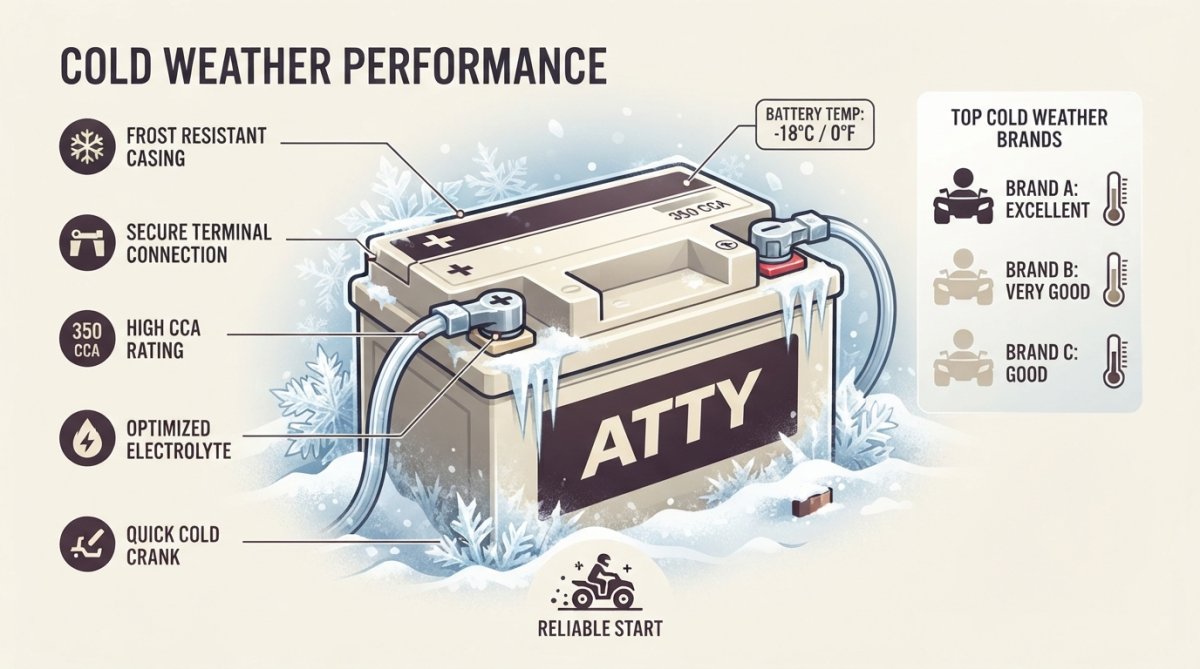
Cold weather is where battery chemistry truly matters. CCA (Cold Cranking Amps) measures how many amps a battery can deliver at 0°F for 30 seconds while maintaining minimum voltage. A battery rated at 400 CCA reliably starts your engine in sub-zero conditions; one rated at 200 CCA may struggle.
AGM batteries generally outperform lithium in extreme cold because chemical reactions remain stable below freezing. However, Shorai LFX and Antigravity Re-Start batteries include integrated heaters in premium models, warming cells for reliable cold starts.
Practical advice: If you ride in temperatures below 10°F regularly, verify any battery has CCA ratings of at least 300-350. Store your ATV in an insulated garage if possible; even a few degrees of warmth dramatically improves cold-start performance. Use a battery tender year-round to maintain optimal charge levels.
Battery Disposal and Recycling: Environmental and Legal Requirements
When your ATV battery reaches end-of-life, proper disposal is a legal requirement in all 50 U.S. states. Both lead-acid and lithium batteries contain hazardous materials that contaminate soil and groundwater if disposed of in landfills.
Lead-Acid Battery Disposal (AGM and Conventional)
Lead-acid batteries are classified as hazardous waste under the Resource Conservation and Recovery Act (RCRA), enforced by the U.S. Environmental Protection Agency (EPA).
Your disposal options:
-
Retailer take-back programs (Recommended): Most retailers selling batteries are legally required to accept old batteries for recycling when you purchase a replacement. Many retailers offer a "core charge" credit ($5-$15) when you return the old battery.
-
Manufacturer take-back: Yuasa, Odyssey, and other major manufacturers operate mail-back or drop-off programs.
-
Local hazardous waste facilities: Most U.S. counties operate hazardous waste collection events or permanent drop-off centers. Visit Earth911.com to find facilities near you.
-
Scrap metal recyclers: Licensed scrap metal recyclers accept lead-acid batteries and pay based on current lead commodity prices.
Why this matters: Lead-acid batteries contain approximately 18 pounds of lead and 7 pounds of sulfuric acid per battery. Recycling recovers 99% of the lead and plastic for reuse.
Lithium Battery Disposal (LiFePO4 and Lithium-Ion)
Lithium batteries are increasingly regulated as hazardous waste in many states due to fire risk and toxic electrolyte content.
Your disposal options:
-
Manufacturer take-back (Preferred): Shorai, Antigravity, and other lithium battery manufacturers operate take-back programs.
-
Specialized lithium recyclers: Check the Battery Recycling Coalition directory at batteryrecyclingcoalition.org.
-
Hazardous waste facilities: Some county hazardous waste programs accept lithium batteries. Call ahead to confirm.
Critical safety note: Never throw lithium batteries in the trash or curbside recycling. Lithium batteries can spontaneously ignite in landfills or recycling trucks if damaged.
Storage Before Disposal
If you cannot dispose of your battery immediately:
- Lead-acid batteries: Store upright in a cool, dry location away from children and pets. Cover terminals with electrical tape to prevent accidental short circuits.
- Lithium batteries: Store in a cool location (below 80°F) with terminals covered. Do not store in extreme heat or sealed plastic bags.
Frequently Asked Questions
What type of ATV battery lasts the longest?
Lithium Iron Phosphate (LiFePO4) batteries generally last the longest, offering service life up to twice that of traditional lead-acid batteries. AGM (Absorbent Glass Mat) batteries are the next best option, providing 3-10 years of durability with excellent vibration resistance. The actual lifespan depends on maintenance, charging cycles, and operating conditions. Brands like Shorai, Antigravity, and Odyssey are known for extended longevity in long lasting ATV battery brands.
Which long lasting ATV battery brand is most reliable for cold weather?
Yuasa GYZ Series and Odyssey Extreme Series excel in cold weather due to high Cold Cranking Amps (CCA) ratings, ensuring reliable starts in freezing temperatures. Yuasa batteries offer factory-activated AGM design with exceptional cold-weather starting power. Odyssey's Thin Plate Pure Lead (TPPL) technology maintains performance even when temperatures drop significantly. Battery Tender lithium options also perform well in cold climates with consistent cranking power.
Are lithium ATV batteries worth the higher cost?
Lithium batteries offer significant advantages: up to 80% weight reduction, 4-5x longer lifespan than lead-acid, and minimal self-discharge. However, they require a lithium-compatible charger and have higher upfront costs. For performance riders, racers, or those with multiple accessories, the investment pays off through extended runtime and improved vehicle performance. For casual riders, AGM batteries may provide better value. Shorai and Antigravity are premium long lasting ATV battery brands offering advanced lithium technology.
How can I make my ATV battery last longer?
Maintain proper charging cycles using a Battery Tender or charger compatible with your battery type. Keep terminals clean and corrosion-free, store your ATV in a climate-controlled space, and avoid deep discharges during off-season storage. For lithium batteries, use only lithium-compatible chargers to prevent sulfation and cell damage. Regular voltage checks help identify issues early. AGM batteries benefit from avoiding overcharging, while all battery types last longer when protected from extreme vibration and temperature fluctuations.
What is the difference between AGM and lithium ATV batteries?
AGM (Absorbent Glass Mat) batteries use absorbed glass mat technology for vibration resistance and maintenance-free operation, lasting 3-10 years. Lithium batteries are significantly lighter, last 2-3x longer, and have lower self-discharge rates but require specialized chargers. AGM batteries are more affordable and work with standard chargers, making them ideal for budget-conscious riders. Lithium suits performance enthusiasts prioritizing weight reduction and longevity. Both outperform traditional lead-acid batteries in durability and reliability for long lasting ATV battery brands.