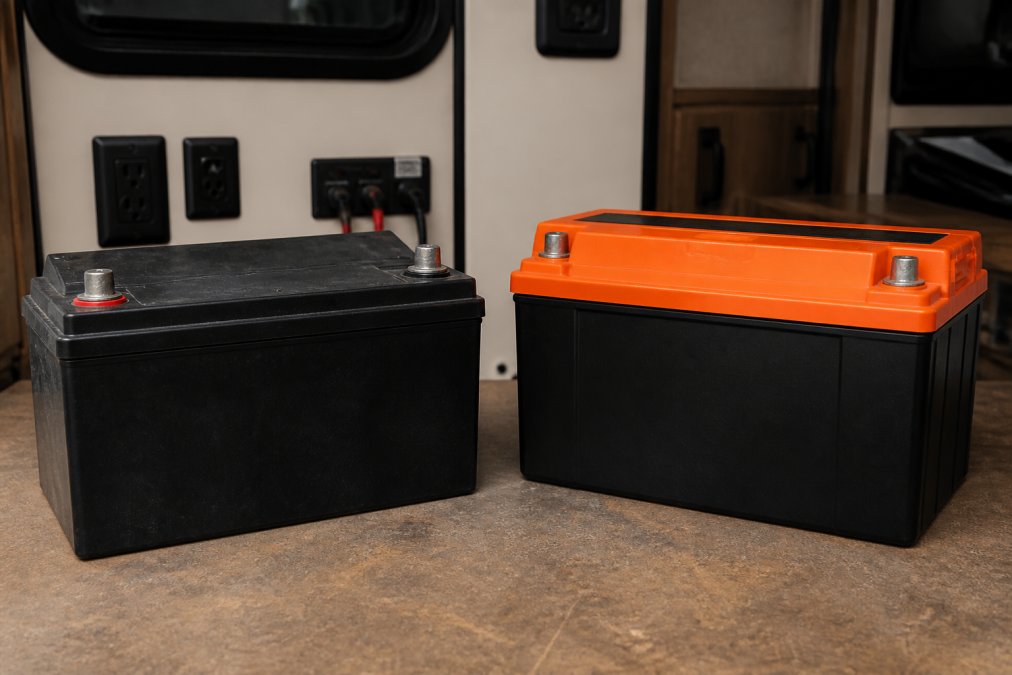
 comparison
Lead Acid vs Lithium RV Batteries: Key Differences
Table of Contents
- Lead Acid vs Lithium RV Batteries: Quick Comparison Table
- Weight, Usable Capacity, and Depth of Discharge
- Cycle Life and Long-Term Durability
- RV Battery Charging Requirements and Compatibility
- LiFePO4 Battery Benefits for RV Owners
- Cost of Lithium vs Lead Acid Batteries: Upfront and Long-Term
- Cold Weather, Maintenance, and Safety Considerations
- Frequently Asked Questions
Last Updated: September 16, 2026
Lead Acid vs Lithium RV Batteries: Quick Comparison Table
The difference between lead acid and lithium RV batteries comes down to four numbers: cycle life, usable capacity, weight, and upfront cost. Lithium (specifically LiFePO4) delivers 4,000+ cycles and 80-100% depth of discharge, while lead-acid manages roughly 400 cycles at 50% DoD. That gap changes everything about how you size, charge, and budget for a battery bank. This guide from Bigtime Battery breaks down each difference so you can pick the right chemistry for your rig.
| Spec | Lead-Acid (FLA/AGM/Gel) | Lithium (LiFePO4) |
|---|---|---|
| Cycle life | ~400 cycles | 4,000+ cycles |
| Usable capacity | ~50% of rated Ah | 80-100% of rated Ah |
| Weight (100Ah) | 60-70 lbs | 25-30 lbs |
| Maintenance | Watering, equalizing | None |
| Upfront cost | Lower | Higher |
According to RELiON Battery's lifespan comparison, lithium batteries last 10 times longer than lead-acid equivalents. That single data point reframes the entire cost conversation.
Weight, Usable Capacity, and Depth of Discharge
Lithium wins on weight and usable capacity by a wide margin. A 100Ah LiFePO4 bank weighs 50-70% less than its lead-acid counterpart, according to A1 Solar Store's motorhome battery guide. That matters for towing and payload.
Usable capacity is the more consequential difference. Lead-acid batteries should not be drained below 50% state of charge without shortening their life. Lithium can safely discharge to 0-20%, delivering 2-3 times the usable amp-hours from the same nominal rating.
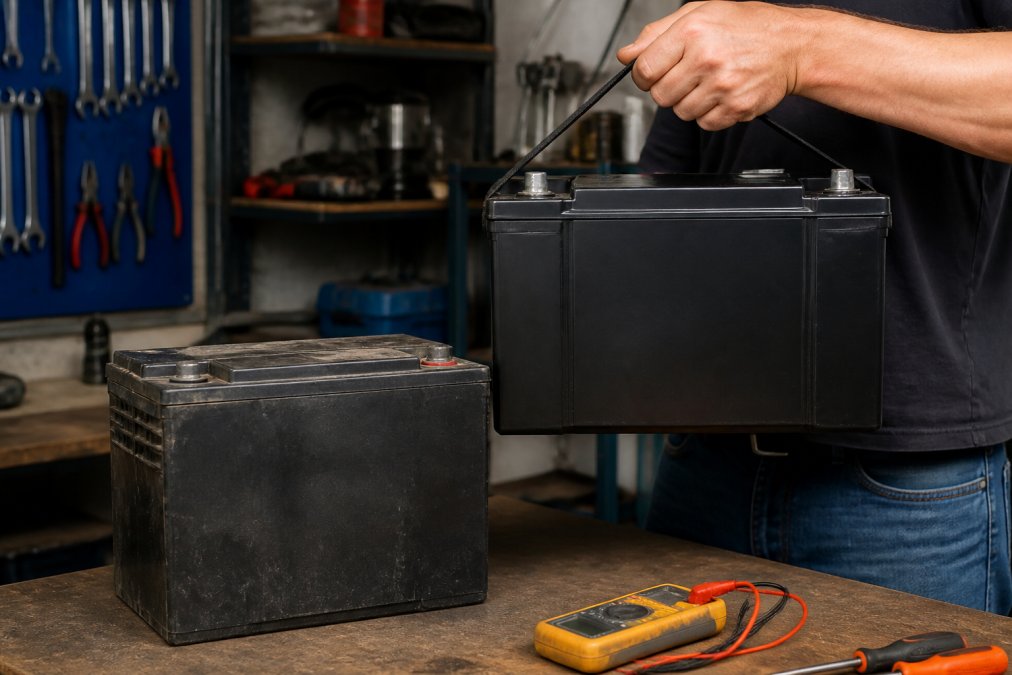
Practically, a 100Ah lithium bank gives you roughly 80-100Ah of usable power. The same rated lead-acid bank gives you 50Ah. If you boondock for three days, that difference decides whether you run the furnace on night two.
Cycle Life and Long-Term Durability
Lithium batteries cycle 4,000 times or more, while lead-acid typically manages around 400 cycles, according to Power Sonic's cycle life comparison. That is a 10x durability gap, and it is the strongest argument for lithium over a decade of ownership.
What most guides miss is how cycle depth accelerates lead-acid degradation. Every discharge below 50% State of Charge (SoC) shaves cycles off a flooded or AGM battery. Lithium tolerates deep discharge without the same penalty.
The iRV2 community's voltage testing found that lithium holds a higher static voltage (13.3V) and a flatter discharge curve than lead-acid (12.6V), so your inverter sees more consistent input across the whole cycle.
RV Battery Charging Requirements and Compatibility
RV battery charging requirements differ sharply between the two chemistries, and this is where most lithium upgrades stall. Lithium (LiFePO4) accepts high current almost to 100% state of charge. Lead-acid charge acceptance drops off steeply above 80%, which is why flooded batteries need long absorption phases and why a lead-acid charger will chronically undercharge a lithium bank.
The voltage setpoints tell the story. A typical LiFePO4 charge profile runs 14.2-14.6V bulk/absorption and 13.4-13.6V float. A flooded lead-acid profile runs 14.6-14.8V bulk, 13.2-13.4V float, and adds a periodic equalize cycle at 15.5V or higher. That equalize step is the killer: it will trip a lithium BMS into over-voltage protection and can void the battery warranty.
Before you swap in lithium, audit four components:
- Converter/charger, must have a dedicated lithium profile (typically 14.2-14.6V bulk, no equalize). Older units with only lead-acid, AGM, and gel modes will undercharge. Many 2015-and-earlier RVs ship with a single-stage or three-stage lead-acid-only converter that needs replacement, not reprogramming.
- Solar charge controller, needs a LiFePO4 setting and adjustable absorption voltage. PWM controllers often lack a lithium mode entirely; MPPT controllers from Victron, Renogy, and similar brands usually include one.
- Inverter/charger combo, verify it can be reprogrammed for lithium, or plan to replace it. Many combo units lock the charge profile to the inverter's firmware.
- Alternator charging (DC-DC), a lithium bank can pull more current than a stock alternator safely delivers, overheating it. A DC-DC charger (often 20-60A) regulates this. This is the step most guides skip entirely.
The Battery Management System (BMS) inside a lithium battery handles cell balancing, over-voltage cutoff, low-temperature cutoff, and over-current protection. It is not a replacement for a compatible charger, it is the last line of defense, not the first.
A practical upgrade order: replace the converter/charger first, add a DC-DC charger for alternator charging second, confirm the solar controller has a lithium profile third, and only then install the battery. Doing it in reverse, battery first, is the most common DIY mistake and the reason many owners report "my lithium never gets to 100%."
LiFePO4 Battery Benefits for RV Owners
LiFePO4 battery benefits extend beyond cycle count. The chemistry is thermally stable, does not off-gas, and requires no watering, making it safe to mount inside a living space. That opens up installation locations flooded lead-acid cannot use.
- Maintenance-free operation, no equalizing, no watering, no terminal corrosion scrubbing
- Faster charging, accepts high current to near-full, cutting generator runtime
- Flat discharge curve, consistent voltage from 100% down to 20% SoC
- Low self-discharge, holds charge through winter storage
For a boondocker running a 2,000W inverter, that flat curve means the inverter does not trip on low-voltage sag near the end of a cycle. Lead-acid voltage sags noticeably under load, which is a common cause of nuisance shutdowns.
Cost of Lithium vs Lead Acid Batteries: Upfront and Long-Term
The cost of lithium vs lead acid batteries flips depending on your time horizon, and the only honest way to compare them is cost per usable kilowatt-hour per cycle, not sticker price.
Here is the framework. You need three inputs: purchase price, usable watt-hours, and rated cycle life. Usable watt-hours = rated Ah × nominal voltage × depth of discharge. For a 100Ah battery at 12.8V nominal:
- Lead-acid (flooded or AGM): 100Ah × 12V × 50% DoD = 600 Wh usable
- LiFePO4: 100Ah × 12.8V × 90% DoD = 1,152 Wh usable
So a "100Ah" lithium bank delivers roughly 1.9x the usable energy of a "100Ah" lead-acid bank. That alone changes the price comparison before you factor in cycle life.
Now layer in cycles. Using the cycle data from Power Sonic's cycle life comparison, lead-acid manages roughly 400 cycles at 50% DoD, while LiFePO4 runs 4,000+ cycles at 80-100% DoD. Divide usable watt-hours by cycles to get lifetime energy delivered:
| Factor | Lead-Acid (100Ah) | LiFePO4 (100Ah) |
|---|---|---|
| Usable Wh per cycle | ~600 Wh | ~1,152 Wh |
| Rated cycles | ~400 | 4,000+ |
| Lifetime Wh delivered | ~240,000 Wh | ~4,600,000 Wh |
| Replacements over 10 yrs | 2-3 sets | 0-1 set |
| Maintenance time | Monthly watering + equalizing | None |
That lifetime-energy column is the ROI calculator most articles never build.
One caveat: the math assumes you actually cycle the battery deeply and often. A camper who plugs into shore power 90% of nights may never hit 400 cycles on a lead-acid bank in a decade, which erases lithium's cycle-life advantage and leaves only the weight and maintenance benefits.
Cold Weather, Maintenance, and Safety Considerations
Cold weather is the one area where lead-acid holds a narrow edge in charging.
Frequently Asked Questions
Can I replace my RV lead-acid battery with lithium-ion?
Yes, but you may need to upgrade your converter or charger. Lead-acid batteries charge at lower voltages, while lithium RV batteries, such as LiFePO4, require a higher charging profile. Check your converter's compatibility; many newer models have a lithium setting. You'll also need to verify that your inverter and solar charge controller support lithium voltages. A drop-in replacement works for some setups, but a full charging system review is smart before you buy.
How much longer do lithium batteries last compared to lead-acid?
Lithium batteries typically last 10 years or more, while lead-acid batteries last 3-5 years. Cycle life tells a similar story: lithium can exceed 4,000 cycles, whereas lead-acid usually manages around 400 cycles. That means a lithium battery can outlast several lead-acid sets. For frequent RVers, the reduced replacement frequency adds up to real savings over time, even though the upfront cost is higher.
Do I need a special charger for lithium batteries in my RV?
Often, yes. Lithium batteries need a charging profile that delivers a higher voltage (around 14.4-14.6V) and then stops charging when full. Many older RV converters only support lead-acid profiles, which can leave lithium batteries undercharged or cause damage. Look for a charger with a lithium mode or an adjustable voltage setting. If you have solar, confirm your charge controller has a LiFePO4 profile. Upgrading the charger is a common part of the switch.
Are lithium batteries safer for RV use than lead-acid?
Both types are safe when used correctly, but they carry different risks. Lithium batteries with a built-in Battery Management System (BMS) protect against overcharge, short circuits, and thermal runaway. Lead-acid batteries can vent hydrogen gas and require ventilation, plus they need regular watering. Some RVers report reliability concerns with low-quality lithium brands, so choosing a reputable manufacturer matters. Overall, lithium with a quality BMS is considered very safe for RV applications.
What is the biggest disadvantage of a lithium-ion battery?
The biggest disadvantage is the higher upfront cost. A lithium RV battery can cost two to three times more than a comparable lead-acid battery. You may also need to upgrade your converter, charger, or solar controller to match lithium's charging requirements, adding to the initial investment. However, when you factor in the longer lifespan, greater usable capacity, and zero maintenance, the total cost of ownership often favors lithium for frequent RVers.