 how-to
How to Safely Store Lithium-Ion Batteries for Marine Use
Table of Contents
- What You'll Need Before Storing Marine Lithium Batteries
- Step 1: Disconnect and Inspect Your Lithium-Ion Batteries
- Step 2: Set the Right Marine Battery State of Charge for Storage
- Step 3: Choose a Safe Storage Location and Enclosure
- Step 4: Follow Lithium-Ion Battery Fire Safety Standards
- Step 5: Apply Lithium Battery Winterization Tips for Cold Climates
- Step 6: Maintain and Monitor Stored Batteries
- Long-Term vs. Short-Term Storage and Insurance Compliance
- Frequently Asked Questions
Last Updated: September 13, 2026
What You'll Need Before Storing Marine Lithium Batteries
Marine lithium battery storage means preparing, disconnecting, and housing lithium-ion batteries so they hold capacity and stay safe through weeks or months of non-use. Get it wrong and you risk permanent capacity loss or a fast-spreading fire.
The stakes are higher than most people assume. A 2024 analysis of marine transport and power applications found that risks tied to storing used lithium-ion batteries can exceed the risks of normal in-service use, which is why specific packaging and storage protocols matter (risk analysis for marine transport and power applications). The National Fire Protection Association's lithium-ion battery safety guidance sets the baseline for storage, charging, and disposal.
Gather these before you start:
- Insulated tools and terminal covers
- A multimeter for voltage checks
- Non-conductive packaging or terminal caps
- A fireproof enclosure rated for lithium batteries
- Manufacturer documentation for your battery's BMS
Step 1: Disconnect and Inspect Your Lithium-Ion Batteries
Disconnect the negative terminal first, then the positive, and inspect every cell for swelling, corrosion, or moisture. A swollen casing means the battery is failing and should not go into long-term storage.
Check these items in order:
- Voltage at rest with a multimeter
- Terminal condition for corrosion or pitting
- Casing for swelling, cracks, or electrolyte residue
- Cable insulation for chafing
- Vent caps and seals for moisture intrusion
Salt air and humidity accelerate corrosion on exposed posts, so cap every terminal and coat them with a corrosion inhibitor before storage.
Step 2: Set the Right Marine Battery State of Charge for Storage
The ideal marine battery state of charge storage range is 50% to 60% for lithium-ion chemistries. Storing at 100% accelerates cell degradation, while storing near 0% risks a deep discharge that can permanently kill the cells.
Lithium cells are most stable when neither fully charged nor drained: a full charge keeps the cell at high voltage, speeding up capacity-reducing reactions, while a near-empty charge leaves almost no buffer against parasitic drain from an active BMS.
If you have a shunt or a battery monitor, verify state of charge directly. If you only have voltage, use your battery's published voltage-to-SOC chart rather than guessing.
Using BMS Sleep Mode for Extended Storage
Most marine lithium batteries ship with a battery management system that includes a sleep or storage mode, which cuts the BMS's own draw to a trickle and prevents parasitic drain from flattening a battery over a winter.
Activate it through the manufacturer's app or the physical wake button, depending on the model. If your BMS has no sleep mode, disconnect the battery entirely so the BMS can't draw anything.
Step 3: Choose a Safe Storage Location and Enclosure
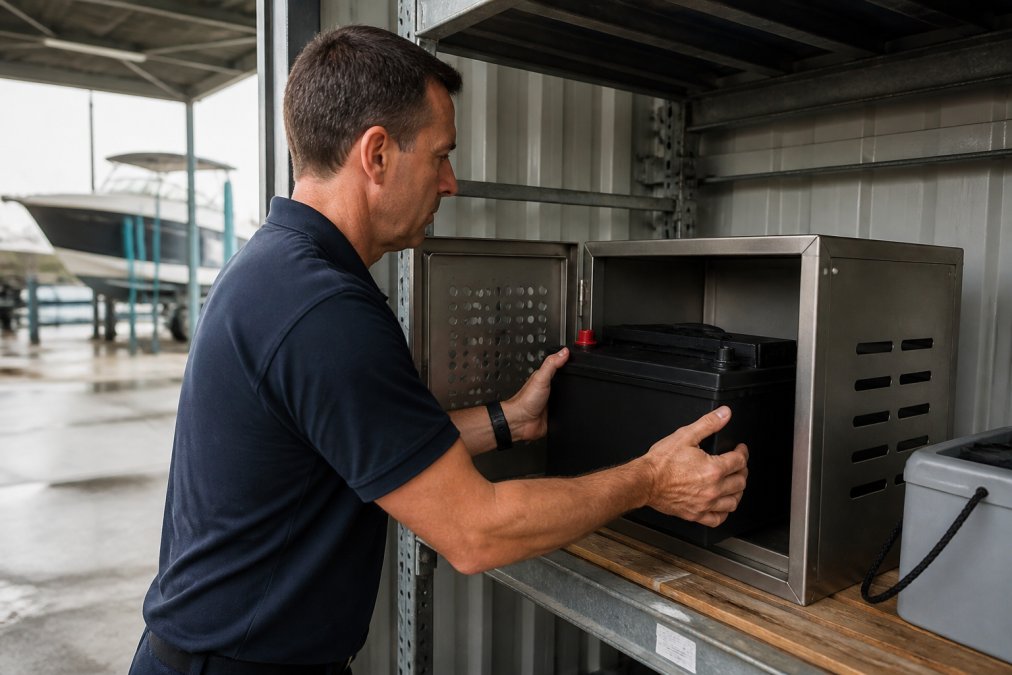
Store marine lithium batteries in a cool, dry, well-ventilated space away from combustible surfaces, ideally in a fireproof enclosure rated for lithium cells.
Good locations share a few traits:
- Ambient temperature between 15°C and 25°C (59°F to 77°F)
- Away from direct sunlight and heat sources like engines or heaters
- Off concrete floors and any combustible surface
- Ventilated so heat can dissipate if a cell fails
Avoid the sun-baked dock box and the unheated shed: heat speeds degradation, while extreme cold stresses the electrolyte and can cause plating on the next charge.
| Storage Factor | Recommended | Avoid |
|---|---|---|
| Temperature | 15-25°C (59-77°F) | Above 25°C, long freezing spells |
| State of charge | 50-60% | 100% or near 0% |
| Surface | Non-combustible, off floor | Combustible shelving, bare concrete |
| Enclosure | Fireproof, ventilated | Sealed plastic tubs, hot dock boxes |
| Terminal state | Capped and protected | Exposed posts, loose cables |
Step 4: Follow Lithium-Ion Battery Fire Safety Standards
Lithium-ion battery fire safety standards require protection against short circuits and non-conductive packaging that fully encloses each cell or battery, the same principle in transit or in your shop for the off-season.
Current shipping guidance goes further: batteries must be enclosed in non-conductive inner packaging to prevent damage during transit (2026 lithium battery shipping regulations). Apply that same logic to storage. A metal shelf with a bare positive terminal is one dropped wrench away from a short circuit.
Ventilation and fire suppression are the two levers you control. Keep the storage area ventilated so heat dissipates, and keep a lithium-rated extinguisher within reach. Standard ABC extinguishers are not designed for lithium cell fires.
What Actually Puts Out a Lithium Cell Fire
A lithium-ion fire is a self-oxidizing chemical reaction, not a fuel fire: the cell generates its own oxygen as it decomposes, so smothering agents that work on gasoline or wood do nothing.
Extinguisher selection. Look for an extinguisher labeled for lithium-ion or Class D metal fires. Dry chemical ABC units may knock down surrounding Class A material but will not arrest cell-level thermal runaway. Aqueous vermiculite dispersion (AVD) extinguishers are purpose-built for lithium cells and are what most marine safety suppliers now stock for battery compartments. Confirm the label lists lithium-ion before you buy.
Agent chemistry, briefly. AVD encapsulates the burning cell in a mineral coating that blocks oxygen and absorbs heat. Clean-agent and CO2 units cool the surrounding space but cannot penetrate a cell casing, so they buy time rather than stop the reaction. For a battery bank aboard, AVD or a dedicated lithium-rated dry powder is the realistic handheld option.
Placement. Mount the extinguisher outside the battery compartment, not inside it. If a cell vents, you do not want to open a hot compartment door to reach the extinguisher. Keep it within arm's reach of the compartment hatch and label the location so a guest or crew member can find it in the dark.
Chemical Fire Suppression for Boat Storage
Automatic chemical suppression systems are the gap most boat owners miss. A small unit mounted inside the battery compartment discharges when a heat-sensitive bulb or detection line trips, interrupting the fire at the cell level while no one is aboard, and a handheld extinguisher only works if someone is there to use it.
What to look for in a marine-grade unit:
- Agent type. Confirm the unit is rated for lithium-ion chemistry, not just general engine-room fires. Aerosol and clean-agent systems designed for fuel fires will not arrest cell runaway.
- Actuation trigger. Heat-activated bulbs and linear detection tubing are the two common triggers. Tubing gives broader coverage across a multi-battery bank; a single bulb protects a smaller compartment.
- Discharge duration. Longer discharge times matter for lithium because the reaction can reignite. A unit that dumps its agent in two seconds may not hold the cell down.
- Mounting. The unit must be secured so it does not become a projectile in rough water, and positioned so the agent discharges across the top of the cells where venting occurs.
- Power source. Many units are self-contained with no wiring, which is an advantage on a boat that sits on a mooring with the main switch off.
These systems cost more than a handheld extinguisher but work when the boat is empty. If you store batteries aboard through the season, an automatic unit is worth the spend.
Ventilation and Compartment Design
Ventilation keeps ambient temperature down and gives vented gas somewhere to go if a cell fails. A battery compartment should have low and high vents so air moves across the bank by convection, not a single opening that traps heat. Avoid routing ventilation into a living space or near ignition sources; if the compartment shares a wall with a cabin, seal penetrations and vent to the exterior.
For a stored battery bank, the same rules apply on a smaller scale: a fireproof enclosure with ventilation gaps, off a combustible surface, gives heat a path out and keeps a failing cell from igniting whatever is next to it.
Step 5: Apply Lithium Battery Winterization Tips for Cold Climates
Lithium battery winterization tips for cold climates start with one rule: don't leave the battery in prolonged extreme cold. Manufacturer guidance consistently advises room-temperature storage over cold storage, even though cold slows self-discharge.
Cold doesn't destroy a lithium battery the way it damages a lead-acid one, but it stresses the electrolyte and makes charging dangerous below freezing, because charging a frozen cell can cause lithium plating. Never charge a cold-soaked battery until it warms to room temperature.
For winterization:
- Bring the battery indoors to a space that stays above freezing
- Set state of charge to 50-60%
- Activate BMS sleep mode or disconnect completely
- Cap terminals and store in a fireproof enclosure
- Check voltage once a month
Step 6: Maintain and Monitor Stored Batteries
Check stored batteries monthly and top up the charge if it drops below 40%. This simple cycle catches parasitic drain and cell degradation before they become permanent.
Log each check: date, voltage, ambient temperature, and any visible change. A slow voltage drop across months is normal. A sharp drop in a week points to a failing cell or a BMS that isn't sleeping.
Long-Term vs. Short-Term Storage and Insurance Compliance
Most guides blur weekend storage and winter layup into one protocol. They are not the same job, treating them the same either wastes effort on a two-week break or leaves a battery exposed through a full off-season.
| Factor | Short-Term (under 1 month) | Long-Term (off-season or 1+ months) |
|---|---|---|
| State of charge | 50-60% | 50-60%, verified with a shunt if available |
| BMS | Leave active, or sleep mode if easy to toggle | Sleep mode or full disconnect |
| Location | Cool, dry, ventilated, off the floor | Indoors above freezing, fireproof enclosure |
| Terminal protection | Caps and corrosion inhibitor | Caps, inhibitor, and non-conductive packaging |
| Monitoring | Visual check before each use | Monthly voltage and temperature log |
| Charging | Top up if below 40% | Do not charge below freezing; warm first |
| Insurance | Policy rarely triggered | Policy language often applies, check before layup |
Short-Term Storage: What You Can Skip
For a two-week break, the full winterization protocol is overkill, no need to pull the battery or keep a monthly log. Don't skip the state of charge: 100% for three weeks is unnecessary stress, and 10% can drift into deep discharge if the BMS keeps drawing current. Set it to the middle, cap the terminals, and leave it in a cool spot.
Long-Term Storage: What You Cannot Skip
A full off-season is where the protocol earns its keep. The five winterization steps above are the baseline; the additions that matter for a true layup are the fireproof enclosure, the monthly log, and the insurance check below. A battery that sits five months without a voltage reading is one you're guessing about in spring.
Insurance Compliance: The Part Almost No Guide Covers
Marine insurance is where improper storage becomes a financial question. Many policies include layup or winterization conditions specifying how batteries must be left when the vessel is out of service, disconnecting the bank, removing batteries, or storing them in a manner the insurer considers fire-safe. Some policies are silent on lithium and default to lead-acid language, which may not reflect how a lithium cell fails.
What to do before you store:
- Read the policy language. Look for the layup, winterization, and unattended-vessel clauses. If the policy does not mention lithium, call your agent and ask how lithium banks are treated.
- Get it in writing. A verbal assurance that "it's fine" is not proof of care if a claim is later denied. Ask for the storage requirement in writing or by email.
- Document your compliance. Photograph the stored battery, the enclosure, the state of charge reading, and the disconnected terminals. Date the photos.
- Keep the maintenance log. A monthly log with date, voltage, and ambient temperature is your evidence that the battery was maintained, not abandoned.
- Report material changes. If you switch from lead-acid to lithium, tell your insurer. A bank that was not disclosed may not be covered.
A fire claim after a battery event can be denied if the insurer finds the storage conditions violated the policy. The maintenance log and dated photos are the cheapest defense you have, costing a few minutes a month.
Frequently Asked Questions
What is the ideal state of charge for storing marine lithium batteries?
Most marine lithium-ion batteries should be stored at a 50-60% state of charge for long-term storage. This reduces cell degradation and prevents deep discharge during months of inactivity. Check voltage levels monthly; a 12V lithium battery at 50% SOC typically reads around 13.1V. If voltage drops below 12.8V, recharge to 50-60% before returning to storage.
Can lithium-ion batteries be stored in freezing temperatures?
No. Avoid long periods of extreme cold. While some discharge is safe, charging below freezing causes permanent damage. Experts recommend room temperature storage (15-25°C / 59-77°F) for marine lithium batteries. For winterization, remove batteries from the boat and store them indoors in a climate-controlled space. If that's not possible, insulate the enclosure and monitor temperature with a remote sensor.
What are the fire safety requirements for storing lithium batteries on a boat?
Store lithium batteries in a fireproof enclosure away from combustible surfaces. Ensure ventilation to prevent heat buildup. NFPA provides standardized safety guidance for battery storage, charging, and disposal to mitigate fire risks. For boats, consider a chemical fire suppression system in the battery compartment. Inspect terminals for corrosion and protect against short circuits with non-conductive packaging.
How often should I check the voltage of stored lithium batteries?
Check voltage monthly during storage. For marine battery state of charge storage, aim to keep voltage stable at 50-60% SOC. If voltage drops significantly (e.g., below 12.8V for a 12V battery), recharge to the target SOC. Also inspect for swelling, corrosion, or damage. A battery management system (BMS) with sleep mode can help reduce parasitic drain and extend maintenance intervals, but manual checks are still recommended every 4-6 weeks.
Storing marine lithium batteries safely comes down to discipline: the right charge level, the right enclosure, and a monthly check you actually do. Bigtime Battery stocks the marine replacement batteries and terminal protection you need to get storage right, backed by our one-stop selection and low prices. Get started with Bigtime Battery and keep your batteries ready for the water.