 how-to
How to Maintain a Marine Battery in Winter: 2026 Guide
Table of Contents
- Step 1: Remove the Battery and Choose the Right Storage Spot
- Step 2: Charge to 100% Before Storage
- Step 3: Disconnect Terminals and Prevent Parasitic Drain
- Step 4: Clean Terminals and Apply Corrosion Protection
- Step 5: Use a Marine Battery Trickle Charger for Maintenance
- How to Prevent Battery Sulfation During Winter Storage
- Lithium vs Lead Acid Winter Storage: Key Differences
- Common Mistakes to Avoid When Storing a Marine Battery
- Frequently Asked Questions
Last Updated: September 16, 2026
Step 1: Remove the Battery and Choose the Right Storage Spot
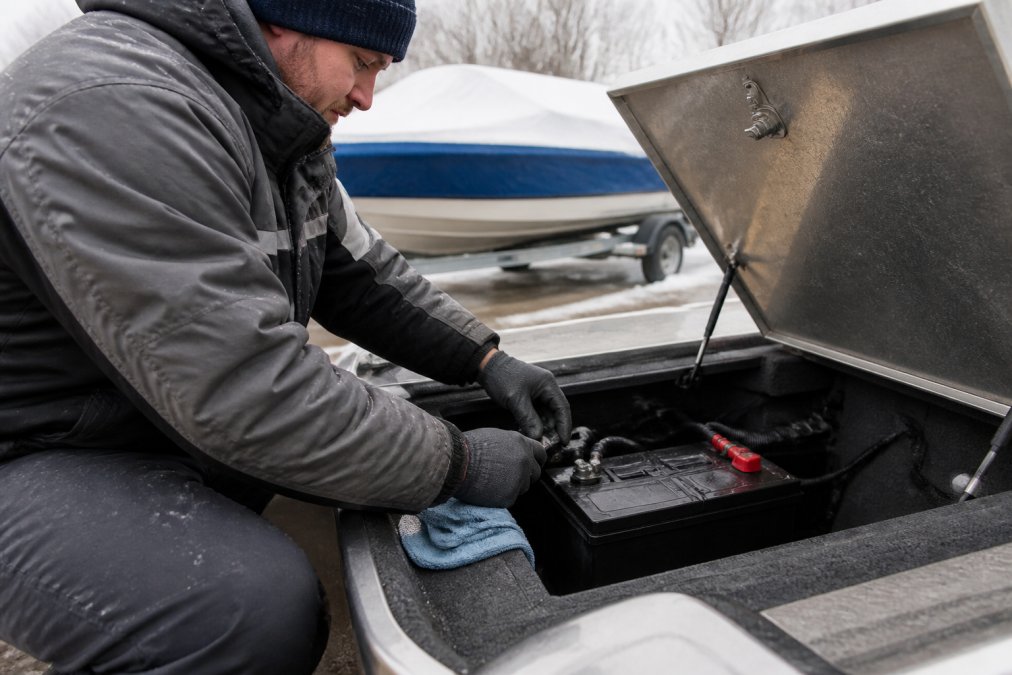
Learning how to maintain a marine battery in winter starts with a decision most boaters get wrong: where the battery actually sleeps for the off-season. Marine batteries typically last 3-5 years, according to Seattle Boat Company's battery basics guide, and how you store yours in the cold months often decides whether you get the full five or replace it early.
- Remove the battery and store it indoors in a cool, dry spot above freezing. This is the safer choice in unheated climates.
- Leave it onboard only if the boat stays accessible and you can run a maintainer. Never leave a discharged battery in a boat that will sit untouched for months.
Step 2: Charge to 100% Before Storage
A battery stored at partial charge is a battery already dying. Industry guidance for 2026 emphasizes storing marine batteries at a 100% state of charge to reduce the risks of long-term storage, per Crown Battery's winter storage guidance. A full charge lowers the concentration of lead sulfate on the plates and slows the chemical reaction that causes permanent capacity loss.
Step 3: Disconnect Terminals and Prevent Parasitic Drain
Parasitic load is the quiet killer of stored batteries. Bilge pumps, clocks, stereo memory, and onboard electronics draw small amounts of current continuously, and over a long winter that trickle becomes a deep discharge. Current 2026 recommendations for boaters leaving batteries onboard call for a battery disconnect switch to isolate the bank from parasitic loads when the vessel isn't in use, according to LiTime's guide to leaving marine batteries onboard.
Step 4: Clean Terminals and Apply Corrosion Protection
Terminal corrosion doesn't wait for spring. Maintenance protocols for 2026 continue to stress cleaning battery terminals and confirming tight connections to prevent corrosion and cable wear during the off-season, per Seattle Boat Company's battery basics guide. A crusty terminal adds resistance, which means voltage drop and slower recharge cycles.
Here's the routine that actually works:
- Mix baking soda and water into a paste.
- Scrub terminals and posts with a stiff brush.
- Rinse with clean water and dry completely.
- Apply a thin coat of dielectric grease to posts and clamps.
Step 5: Use a Marine Battery Trickle Charger for Maintenance
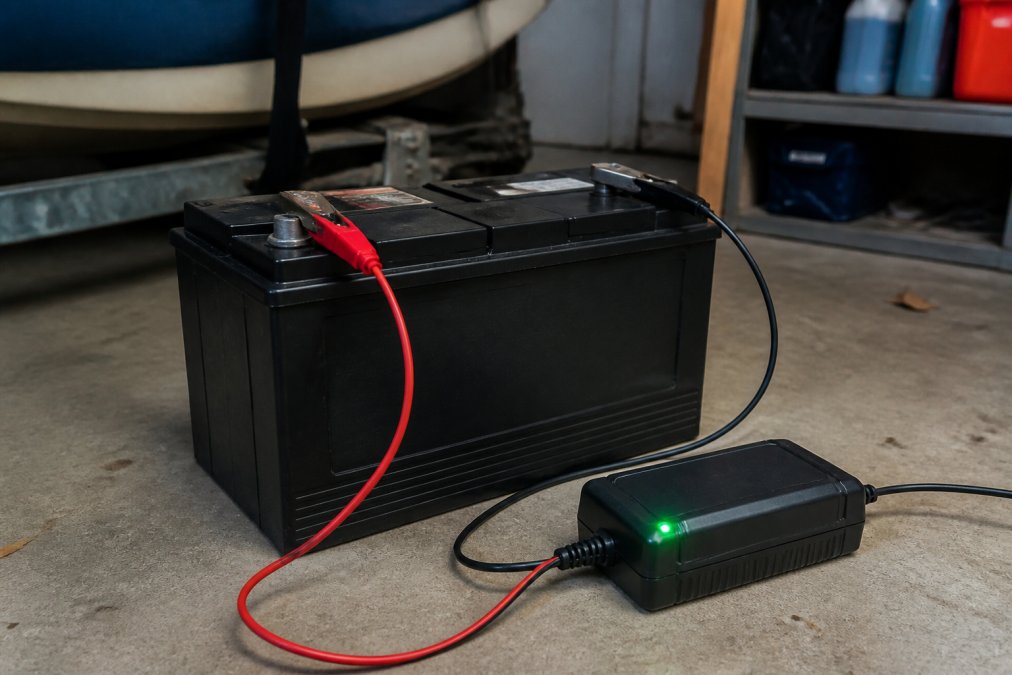
A marine battery trickle charger is the single best tool for keeping a stored battery healthy, because it replaces the energy lost to self-discharge without overcharging. Battery Tender's 2026 guide recommends four-stage marine chargers to prevent sulfation and maintain AGM, lead-acid, and lithium batteries during winter storage, per Battery Tender's WaveCharge storage guide. A maintainer holds a float charge once the battery hits full, then idles until voltage dips again.
How to Prevent Battery Sulfation During Winter Storage
Sulfation is the buildup of lead sulfate crystals on battery plates, and it's the leading cause of permanent capacity loss in stored lead-acid batteries. Keeping the battery at full charge is the primary defense, because sulfate crystals harden when a battery sits discharged for weeks. A four-stage charger or a monthly recharge cycle keeps the electrolyte active and the plates clean.
Lithium vs Lead Acid Winter Storage: Key Differences
Most winterization guides hand you one checklist and tell you to apply it to whatever battery is in the boat. That advice is wrong, and it's the fastest way to destroy a lithium bank. Flooded, AGM, and lithium iron phosphate (LiFePO4) batteries have different self-discharge rates, different cold tolerances, and different charging rules. Treating them the same is an expensive mistake.
Flooded lead-acid
Flooded batteries self-discharge the fastest of the three, roughly 4% to 8% per month at room temperature, and more in a warm garage. They tolerate cold storage well as long as they go in fully charged, because a discharged flooded battery's electrolyte can freeze and crack the case. A fully charged flooded battery's electrolyte freezes around -75°F, but a battery at 50% state of charge can freeze near -10°F, which is well within reach in an unheated northern garage.
AGM
AGM batteries self-discharge more slowly than flooded, typically 2% to 3% per month, and they're sealed, so there's no water to check and no acid to spill. They still sulfate if stored discharged, and they're more sensitive to overcharging than flooded batteries, which is why a voltage-regulated maintainer matters more than a dumb trickle charger. AGM also has a lower freeze risk than flooded at the same state of charge because the electrolyte is absorbed rather than free-flowing.
Lithium (LiFePO4)
LiFePO4 batteries self-discharge at roughly 1% to 3% per month, tolerate deep discharge far better than lead-acid, and don't sulfate. The trade-off is temperature. Charging a LiFePO4 battery below 32°F can cause lithium plating on the anode, which permanently reduces capacity and can create an internal short. Discharging below freezing is generally fine down to around -4°F for most marine LiFePO4 units, but charging is the hard line.
| Battery Type | Self-Discharge (per month) | Cold Storage | Charging Below Freezing | Freeze Risk When Full |
|---|---|---|---|---|
| Flooded lead-acid | 4%-8% | Good when full | Acceptable | Very low |
| AGM | 2%-3% | Good when full | Acceptable | Low |
| Lithium (LiFePO4) | 1%-3% | Good when full | Never | None (no liquid electrolyte) |
What this means for your winter routine
- Flooded: Full charge, distilled water top-off, maintainer set to flooded profile, store above freezing if possible.
- AGM: Full charge, no water, maintainer set to AGM profile (lower float voltage than flooded), store above freezing.
- LiFePO4: Charge to roughly 50%-60% if the manufacturer recommends partial storage, disconnect all loads, and either leave the BMS to manage itself or connect a lithium-profile maintainer. Do not charge in a freezing space without confirming the BMS allows it.
If you're not sure which chemistry you have, check the label. "Deep cycle," "marine," and "dual purpose" describe the battery's job, not its chemistry, a deep cycle battery can be flooded, AGM, or lithium, and each one needs a different winter protocol.
Common Mistakes to Avoid When Storing a Marine Battery
Most winter battery failures trace back to a handful of preventable errors. Some are well known. Others are the ones that actually cost boaters a battery every spring.
The mistakes that kill batteries
- Storing at partial charge. This is the single biggest cause of permanent capacity loss. A battery that goes into winter at 70% will sulfate over four months, and no April top-up reverses hardened crystals.
- Leaving terminals connected. Bilge pumps, stereo memory, and onboard electronics draw continuously. Over a five-month off-season, a small parasitic load can pull a battery from full to dead.
- Charging a frozen battery. Charging a frozen flooded or AGM battery can crack the case or rupture it. Let a cold battery warm to room temperature for several hours first.
- Charging a lithium battery below freezing. This causes lithium plating and permanent damage. The BMS should block it, but don't rely on that as your only defense.
- Skipping terminal cleaning. Corrosion left sitting for months etches into the posts and clamps. Clean and grease before storage, not after.
- Storing on a concrete floor. Concrete doesn't drain a modern battery, but it does expose it to temperature swings and moisture. A battery box in a cool, dry corner is better.
- Forgetting ventilation. Flooded and AGM batteries can vent hydrogen gas during charging. An enclosed closet or sealed cabinet is a bad storage spot.
- Assuming a maintainer fixes a bad battery. A maintainer holds a healthy battery healthy. It won't rescue a battery that was already sulfated before storage.
What to check before the first launch
The gap between winter storage and spring usage is where most boaters lose the plot. Before you splash the boat, run this sequence:
- Let the battery rest. Disconnect the maintainer and let the battery sit for a few hours before testing. A surface charge from a maintainer will give you a falsely high reading.
- Check resting voltage. A healthy flooded or AGM battery at rest should read 12.6 to 12.8 volts. Lithium (LiFePO4) at rest typically reads 13.2 to 13.4 volts. Anything below 12.4 volts on lead-acid means the battery lost capacity over the winter.
- Load test. A multimeter tells you voltage, not capacity. A load tester or a trip to an auto parts store for a free load test tells you whether the battery can actually deliver cold cranking amps. If CCA has dropped noticeably from the rated spec, the battery is telling you something.
- Inspect the case and terminals. Look for cracks, bulging, or white/green crust on the terminals. Bulging on a lead-acid battery usually means it froze or was overcharged.
- Reconnect in the right order. Positive first, then negative. Reverse of how you disconnected.
- Charge fully before first use. Don't ask a stored battery to crank a cold engine at partial charge.
When to recycle instead of reinstall
If the battery fails the load test, won't hold a charge above 12.4 volts after a full charge cycle, or shows physical damage like a cracked case or bulging sides, it's done. Lead-acid batteries are the most recycled consumer product in the country, and most auto parts stores, marine dealers, and municipal recycling centers accept them for free or for a small fee.
Frequently Asked Questions
Should I leave my marine battery on a charger all winter?
Yes, but only a smart trickle charger or battery maintainer. A four-stage marine charger prevents sulfation and keeps AGM, lead-acid, and lithium batteries at full charge during off-season storage. Do not use a standard automotive charger left plugged in, as it can overcharge and damage the battery. A maintainer delivers a float charge only when voltage drops, so the battery stays healthy without risk of boiling electrolyte.
Does cold weather ruin marine batteries?
Cold alone does not ruin a marine battery, but a discharged battery can freeze. A fully charged battery has a lower freezing point than a discharged one. Self-discharge rates actually decrease in cold temperatures, which is why some boaters store batteries in unheated spaces. The real risk is leaving a partially charged battery in freezing conditions, which can crack the case or damage plates. Charge to 100% before storage to protect against freeze damage.
How often should I check my marine battery charge during the off-season?
Check the state of charge once a month with a multimeter. A healthy 12V battery should read 12.6V or higher at rest. If voltage drops below 12.4V, recharge it. Boaters using a trickle charger or battery maintainer can check less often, but a monthly voltage reading confirms the charger is working and the battery is not sulfating. Log the readings so you spot capacity loss early.
Is it better to store marine batteries inside or outside during winter?
Store batteries inside a garage, basement, or climate-controlled space if possible. Indoor storage keeps temperatures more stable and protects against terminal corrosion from moisture. If you must store outside, use a marine-grade battery box, keep the battery off concrete, and ensure ventilation. Never store a lead-acid battery in a sealed space without ventilation, since charging can release hydrogen gas. A disconnect switch helps isolate the battery bank if you leave it on board.