 listicle
Best Deep Cycle Marine Battery 2026: Top Picks & Comparison
Table of Contents
- Quick Comparison Table: Battery Types & Key Specs
- Battle Born Batteries 100Ah LiFePO4: Premium Lightweight Performance
- RELiON RB100 LiFePO4: Extended Lifespan & Consistent Power
- Renogy 12V 100Ah Smart LiFePO4: Cold-Weather Charging & Bluetooth Monitoring
- OPTIMA BlueTop D34M: Compact Dual-Purpose AGM Battery
- VMAXTANKS MR137-120: High-Capacity AGM for Trolling Motors
- Trojan T-105 Plus: Budget-Friendly Flooded Lead-Acid
- Lithium Deep Cycle Marine Battery vs. Traditional Options
- AGM Deep Cycle Marine Battery: Balanced Power & Durability
- Deep Cycle Marine Battery vs Starting Battery: Key Differences
- Marine Battery Maintenance: Extending Battery Life & Performance
- Cost-Per-Cycle Analysis: Lithium vs. Lead-Acid Long-Term Value
- How to Choose the Right Deep Cycle Marine Battery for Your Boat
- Frequently Asked Questions
Best Deep Cycle Marine Battery 2026: Top Picks & Comparison
Last Updated: July 21, 2026
Finding the best deep cycle marine battery requires understanding your power needs, usage patterns, and the trade-offs between chemistry types. Whether you're powering a trolling motor, running house loads, or maintaining off-grid systems, the right battery choice determines runtime and maintenance burden. This guide delivers specific comparisons and real-world performance data.
The marine battery market offers three distinct options: Lithium iron phosphate (LiFePO4) dominates premium installations with superior cycle life and weight savings; AGM batteries provide balanced performance with zero maintenance; traditional flooded lead-acid serves budget-conscious operators who accept maintenance requirements.
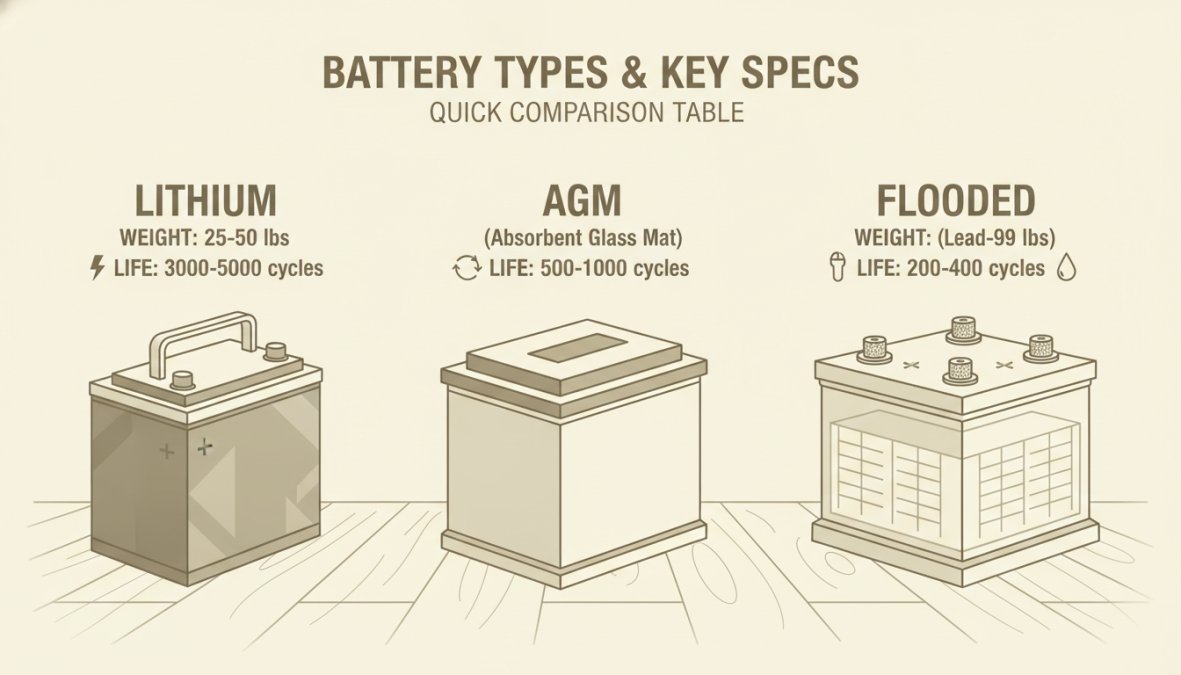
Quick Comparison Table: Battery Types & Key Specs
| Battery Type | Cycle Life | Weight (100Ah) | Maintenance | Best For | Cold Weather |
|---|---|---|---|---|---|
| LiFePO4 | 3000-5000 cycles | 31-35 lbs | None | High-use systems, weight-sensitive boats | Excellent with heater |
| AGM | 400-800 cycles | 60-75 lbs | None | Balanced starting/house power | Good |
| Flooded Lead-Acid | 200-400 cycles | 65-80 lbs | Regular watering | Budget builds, infrequent use | Fair |
Battle Born Batteries 100Ah LiFePO4: Premium Lightweight Performance
Battle Born's 100Ah 12V LiFePO4 delivers 3000-5000 cycle life with 100% depth of discharge capability, you can drain it completely without degradation. The integrated Battery Management System handles overvoltage protection, thermal management, and cell balancing automatically. At just 31 pounds, it weighs roughly half what an equivalent AGM battery weighs, improving fuel efficiency and compartment space.
The 100 Amp continuous current rating handles sustained house loads, while the 200 Amp surge capacity covers engine starting on smaller motors. You get the full 100Ah usable capacity, not the 50% depth of discharge required with lead-acid.
USA assembly ensures quality control and warranty support when far from shore. The upfront cost is higher than AGM alternatives, but the cost-per-cycle math favors it decisively over five years.
RELiON RB100 LiFePO4: Extended Lifespan & Consistent Power
RELiON's RB100 maintains 80% capacity after 2000 cycles, roughly 10 times longer than lead-acid equivalents. A boat operator cycling daily could run this battery for 5-7 years before capacity drops noticeably. The weight advantage is substantial: 50-60% lighter than comparable lead-acid batteries.
Constant power output throughout discharge is critical, lead-acid voltage sags as it discharges, dimming electronics and slowing systems. RELiON maintains stable voltage across the entire discharge curve, so navigation systems, refrigeration, and lighting perform identically whether the battery is full or half-depleted.
The 100% usable capacity means you don't need to oversize the battery to account for the 50% depth-of-discharge rule that applies to lead-acid. A 100Ah RELiON does the work of a 200Ah AGM battery in many applications.
RELiON's cold-weather variant (RB100-LT) includes internal heating for charging down to -20°C, essential for northern climates or year-round cold-water operation.
Renogy 12V 100Ah Smart LiFePO4: Cold-Weather Charging & Bluetooth Monitoring
Renogy's 100Ah Smart LiFePO4 features self-heating that enables charging in freezing temperatures down to -20°C without external intervention. The integrated BMS includes over 60 protection functions, preventing catastrophic failure if your charging system malfunctions.
Bluetooth 5.0 connectivity lets you monitor cell voltage, state of charge, and temperature from your phone. The auto-balance function works across parallel connections, keeping multiple batteries synchronized without manual intervention.
The 5000-cycle lifespan translates to 10-15 years of realistic marine use. The IP67 waterproof rating and UL94 V-0 flame-retardant casing mean this battery survives spray, humidity, and engine compartment thermal stress better than cheaper alternatives.
OPTIMA BlueTop D34M: Compact Dual-Purpose AGM Battery
The OPTIMA BlueTop D34M bridges starting power and deep-cycle capability. Its SPIRALCELL technology provides exceptional vibration resistance, critical for boats where engine vibration and wave impact stress batteries relentlessly. The 750 CCA and 55Ah capacity support engine starting and moderate house loads.
The sealed, spill-proof design eliminates watering and allows mounting in any orientation. This flexibility saves installation time on boats with cramped battery compartments.
The real limitation is cycle life: AGM batteries deliver 400-800 cycles before capacity drops noticeably. For boats that primarily use starting power with light accessory loads, the D34M delivers years of reliable service. For heavy house loads and deep-cycling, you'll replace it every 2-3 years.
The compact form factor fits spaces where larger Group 31 batteries won't fit.
VMAXTANKS MR137-120: High-Capacity AGM for Trolling Motors
VMAXTANKS MR137-120 delivers 120Ah of deep-cycle capacity with military-grade construction. The 900 Marine Cranking Amps provide reliable starting power in cold conditions. The heavy-duty plates handle repeated deep discharges that trolling motors demand.
The low self-discharge rate (1-2% per month) means the battery holds charge during winter storage better than flooded lead-acid. For boats stored seasonally in northern climates, this matters significantly.
The Group 31 size requires adequate battery box space. For boats with room, the capacity advantage justifies the footprint. Expect 400-800 cycles before capacity drops below acceptable thresholds.
Trojan T-105 Plus: Budget-Friendly Flooded Lead-Acid
The Trojan T-105 Plus is the entry point for operators prioritizing lowest initial cost. This 6V flooded battery delivers 225Ah capacity and is designed for sustained performance under repeated discharge. The Alpha Plus paste technology extends lifespan compared to commodity lead-acid batteries, but the chemistry still requires regular maintenance.
The SureVent flip-top vent cap system simplifies watering, a necessary task every 30-60 days depending on charging intensity. The HydroLink compatibility enables single-point watering across multiple batteries.
The cost-per-cycle advantage disappears after 2-3 years of regular use. Flooded batteries deliver 200-400 cycles before capacity degrades noticeably, meaning replacement every 18-36 months if deep-cycling regularly.
Lithium Deep Cycle Marine Battery vs. Traditional Options
Lithium iron phosphate technology has fundamentally changed the marine battery calculus. The comparison isn't whether lithium is "better," it's whether the cost-per-cycle advantage justifies the upfront premium for your use case.
Why LiFePO4 Dominates Modern Marine Applications
LiFePO4 batteries maintain 80% capacity after 2000-5000 cycles, compared to 200-400 cycles for AGM and 100-300 cycles for flooded lead-acid. A lithium battery costing 3-4 times more upfront delivers 10 times the cycle life. Over a decade, the cost per usable cycle favors lithium decisively.
The weight advantage compounds over time. A 100Ah LiFePO4 weighs 31 pounds versus 65-75 pounds for equivalent AGM capacity. Four 100Ah house batteries save 136-176 pounds by switching from AGM to lithium, equivalent to two additional passengers or significant fuel tank reduction.
Consistent voltage output throughout discharge means electronics perform identically whether the battery is full or half-depleted. Navigation systems don't dim, refrigeration doesn't slow, and lighting maintains brightness.
Maintenance requirement is zero: no watering, no equalization charging, no sulfation monitoring.
Real-World Cold-Weather Performance: Heating Systems That Matter
Lithium batteries with integrated heating enable charging in freezing conditions, impossible with standard lithium or traditional lead-acid. The heating element warms cells before accepting charge, adding 5-10% to charging time but preventing damage from cold-cell charging.
For northern climates or year-round cold-water operation, heating-equipped lithium models justify the premium. A boat with self-heating lithium can charge in December; the same boat with AGM or standard lithium cannot.
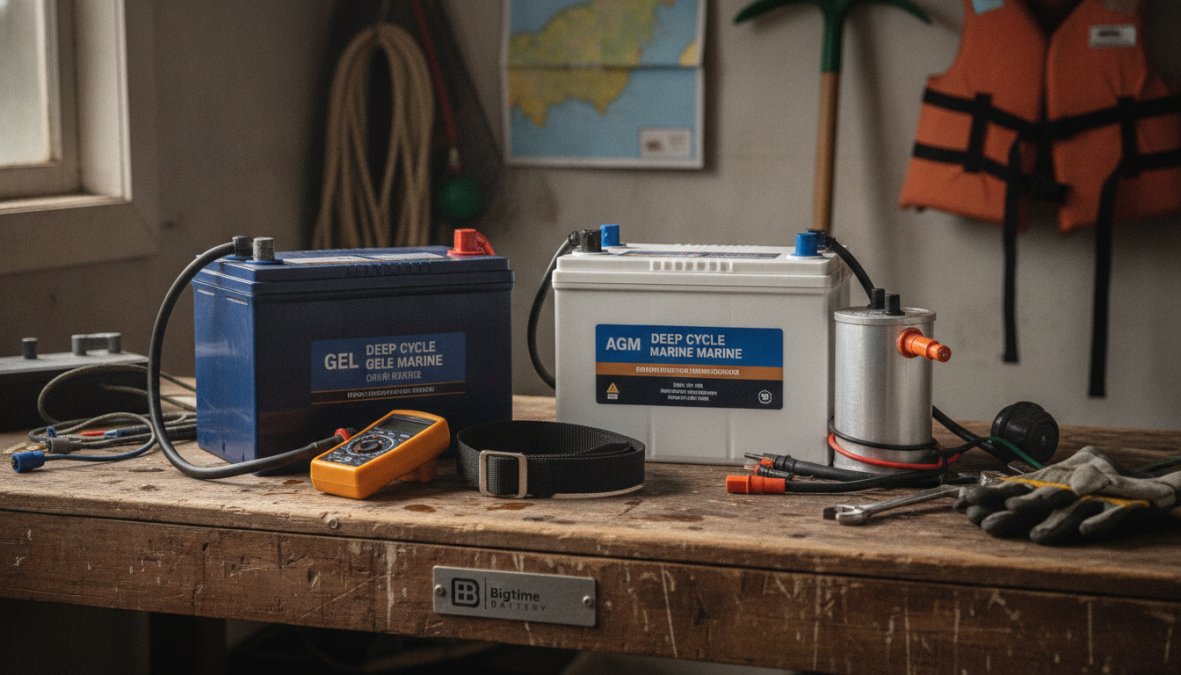
AGM Deep Cycle Marine Battery: Balanced Power & Durability
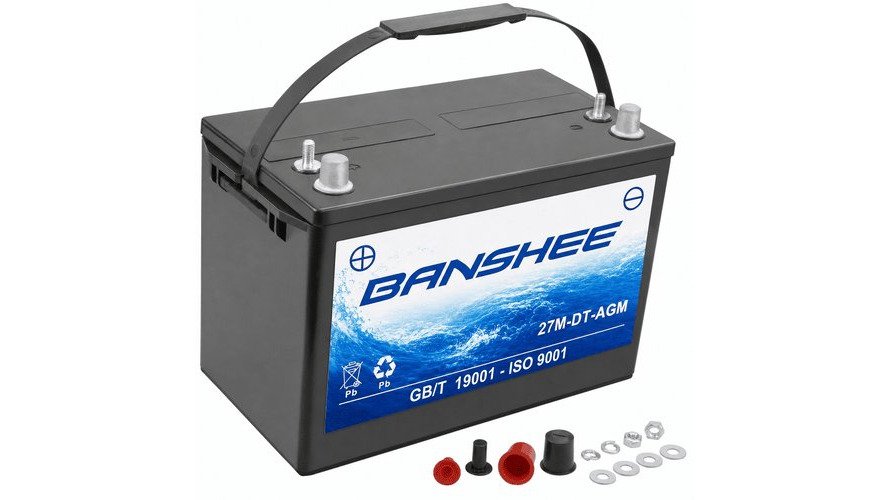
AGM (Absorbed Glass Mat) technology represents the middle ground between lead-acid simplicity and lithium performance. The electrolyte is absorbed into fiberglass matting, eliminating spillage risk and enabling mounting in any orientation.
AGM vs. Flooded: Maintenance and Vibration Resistance
AGM batteries require zero maintenance, no watering, no equalization charging, no electrolyte monitoring. Flooded lead-acid requires regular watering (typically every 30-60 days) and periodic equalization charging to prevent sulfation.
AGM vibration resistance is substantially better than flooded lead-acid. The glass mat separator holds plates more rigidly, reducing mechanical stress from engine vibration and wave impact. This translates to longer lifespan: AGM typically delivers 400-800 cycles versus 200-400 cycles for flooded lead-acid under identical conditions.
AGM batteries mount in any orientation without performance loss or spillage. Flooded lead-acid must mount upright to prevent acid escape.
Cranking Amps vs. Amp-Hour Ratings: What You Actually Need
Cold Cranking Amps (CCA) measure starting power in cold conditions, relevant for engine starting but largely irrelevant for house power calculations. Amp-Hour (Ah) ratings measure total energy capacity.
For house power systems, Ah rating is primary. If you run a 20-amp refrigerator for 8 hours daily, you need 160Ah of capacity (or 320Ah with lead-acid's 50% depth-of-discharge rule). CCA ratings are irrelevant to this calculation.
Deep Cycle Marine Battery vs Starting Battery: Key Differences
Starting batteries deliver massive current for 3-5 seconds (engine cranking) and recharge immediately. Thin, numerous internal plates optimize for high surface area and low internal resistance, enabling 500+ amps but cannot sustain moderate discharge over hours.
Deep-cycle batteries deliver repeated partial discharge and recharge cycles. Thicker, fewer plates optimize for sustained current delivery over extended periods. They deliver 5-20 amps continuously for 8-12 hours without damage but cannot deliver 500+ amps.
Depth of discharge (DOD) is the percentage of capacity you can use safely. Starting batteries should not discharge below 50%. Deep-cycle batteries tolerate 80-100% DOD depending on chemistry. Lithium accepts 100% DOD; AGM and flooded lead-acid accept 80% DOD safely.
Deep-cycling a starting battery kills it in weeks. Using deep-cycle for starting works but wastes capacity and money.
Marine Battery Maintenance: Extending Battery Life & Performance
Battery longevity depends on charging, monitoring, and storage practices. Chemistry determines the ceiling; your practices determine whether you hit it.
Monitoring State of Charge & Preventing Sulfation
State of charge (SOC) is the percentage of total capacity currently stored. Monitoring SOC prevents damage from extended low-charge states. Sulfation, accumulation of lead sulfate crystals on lead-acid plates, occurs when batteries sit discharged for weeks or months.
Store AGM batteries at 50% SOC for winter; store lithium at 20-30% SOC (the BMS prevents over-discharge). Monitor voltage regularly: lead-acid should maintain 12.6V or higher; AGM should maintain 12.8V or higher.
Bluetooth Monitoring and NMEA 2000 Integration for Modern Boats
Modern marine batteries increasingly include Bluetooth connectivity and NMEA 2000 integration, enabling real-time monitoring from your phone or boat's navigation system. Bluetooth provides state of charge, voltage, current draw, temperature, and health status. You can identify parasitic drains that kill batteries during storage, a 5-amp drain over 30 days discharges 3600Ah, enough to damage the battery.
NMEA 2000 integration connects the battery to your boat's network, displaying SOC on your chartplotter alongside fuel level and engine temperature.
Cost-Per-Cycle Analysis: Lithium vs. Lead-Acid Long-Term Value
Upfront cost comparison is misleading. A 100Ah lithium battery costs 3-4 times more than comparable AGM, but cycle life advantage makes lithium cheaper over time.
Calculating Total Cost of Ownership Over Battery Lifespan
Total cost of ownership (TCO) includes purchase price, replacement frequency, and maintenance costs over a defined period (typically 5-10 years).
A 100Ah AGM battery costs less upfront but delivers 400-800 cycles. Daily cycling means 1-2 years of service. Over 10 years, you'd replace it 5-10 times.
A 100Ah lithium battery costs 3-4 times more but delivers 3000-5000 cycles. Over 10 years of daily cycling, a single lithium battery covers the entire period.
Calculate your actual cycling frequency (cycles per week × 52 weeks × years of ownership) and match it against battery cycle ratings. If your calculation shows 2000+ cycles in your ownership period, lithium's cost-per-cycle advantage emerges. If fewer than 500 cycles, the upfront premium is harder to justify.
Environmental Impact & Disposal: What Happens After End-of-Life
Lead-acid batteries are 99% recyclable. Lead, plastic, and acid are separated and recovered through established infrastructure. Most retailers accept old lead-acid batteries for recycling when you purchase a replacement.
Lithium batteries require specialized recycling, but manufacturing environmental impact is lower for lithium over the lifespan due to cycle life advantage. A single lithium battery replaces 5-10 lead-acid batteries over 10 years, meaning 5-10 times less manufacturing waste and extraction.
How to Choose the Right Deep Cycle Marine Battery for Your Boat
The decision tree is straightforward once you calculate actual power needs and usage patterns.
Calculate Your Power Needs: Amp-Hours and Reserve Capacity
List all devices you'll power from the house battery: refrigerator, navigation systems, lighting, water pump. For each device, find current draw (in amps) and daily runtime (in hours).
Example:
- Refrigerator: 20 amps × 8 hours = 160 amp-hours
- Navigation system: 2 amps × 12 hours = 24 amp-hours
- Lighting: 5 amps × 4 hours = 20 amp-hours
- Water pump: 10 amps × 1 hour = 10 amp-hours
- Total daily consumption: 214 amp-hours
Apply the chemistry factor:
- Lithium: 214 Ah ÷ 1.0 (100% usable) = 214Ah battery needed
- AGM: 214 Ah ÷ 0.8 (80% usable) = 268Ah battery needed
- Flooded lead-acid: 214 Ah ÷ 0.5 (50% usable) = 428Ah battery needed
This reveals why lithium batteries are smaller and lighter: you don't oversize them for depth-of-discharge limits.
Weight, Size & Space Constraints: Group 24 vs. Group 31
Group 24 batteries are compact (roughly 10" × 7" × 8") and weigh 40-70 pounds. Group 31 batteries are larger (roughly 13" × 7" × 9") and weigh 60-100 pounds. Group 24 fits tight engine compartments; Group 31 offers higher capacity in a single unit.
Lithium batteries often use custom dimensions optimized for weight and space efficiency. Measure your battery box and verify it accommodates your intended battery size.
Installation, Safety & BMS Compatibility
Lithium batteries with integrated BMS require compatible charging systems. Verify your charger supports lithium charging profiles before installation, or budget for a charger upgrade ($300-500).
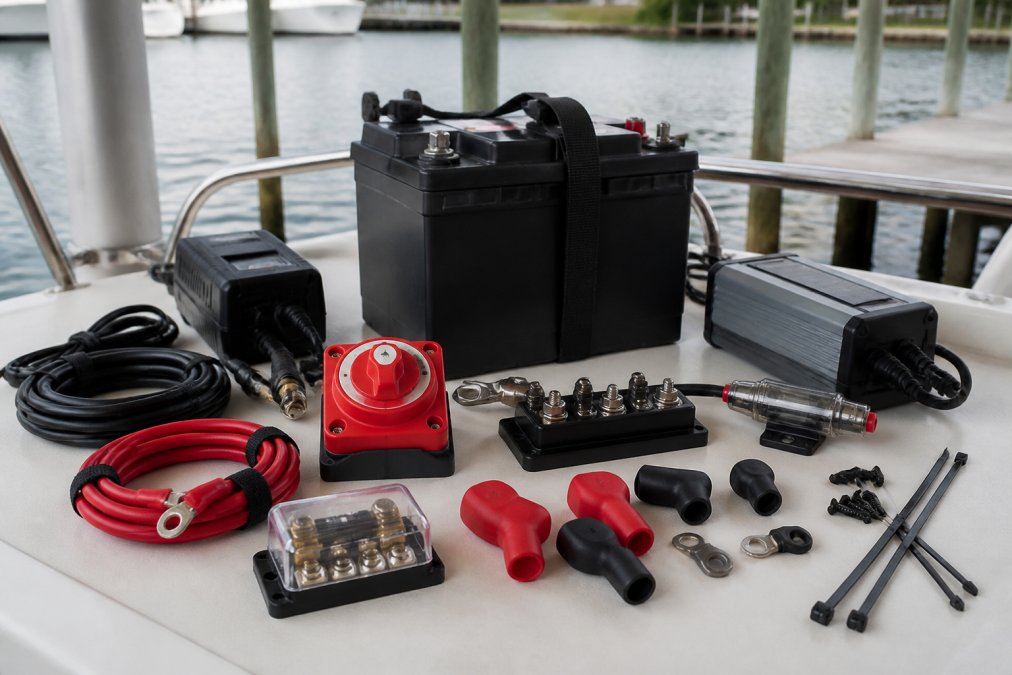
AGM and flooded lead-acid work with most marine chargers without modification. Ground installation properly using marine-grade tinned copper cable and corrosion-resistant connectors.
Ventilation is critical for flooded lead-acid, which produces hydrogen gas during charging. Lithium and AGM batteries don't produce gas but should still have ventilation to manage heat during charging.
Choosing the best deep cycle marine battery 2026 depends on your usage patterns and budget. If you cycle daily and can invest upfront, lithium delivers unmatched long-term value and eliminates maintenance. If you cycle occasionally and prioritize lower upfront cost, AGM provides reliable middle ground with zero maintenance. If you're willing to commit to regular maintenance and accept replacement every 18-36 months, flooded lead-acid remains the budget option.
At Bigtime Battery, we stock comprehensive marine batteries across all chemistries, from premium lithium systems to proven lead-acid alternatives. Our team can help you calculate actual power needs and match them to the right battery for your boat.
Frequently Asked Questions
What is the best type of deep cycle marine battery for a boat?
The best deep cycle marine battery depends on your priorities. LiFePO4 lithium batteries offer the longest cycle life (3,000-5,000 cycles), lightest weight, and 100% usable capacity, making them ideal for serious boaters with higher budgets. AGM batteries provide excellent vibration resistance and maintenance-free operation at mid-range pricing. Flooded lead-acid batteries are the most affordable option but require regular watering and maintenance. For most modern boats, lithium delivers superior performance; AGM offers the best balance of cost and reliability.
How long do lithium deep cycle marine batteries actually last?
High-quality LiFePO4 deep cycle marine batteries typically maintain 80% capacity after 2,000-5,000 cycles, depending on depth of discharge (DOD) and charging practices. At 80% DOD, most lithium batteries last 10+ years in typical marine use. In comparison, AGM batteries typically achieve 400-600 cycles, and flooded lead-acid batteries 300-500 cycles. The extended cycle life of lithium translates to significantly lower cost-per-cycle over the battery's lifespan, even accounting for higher upfront cost.
What's the difference between a deep cycle and starting marine battery?
Starting batteries deliver high cranking amps (CCA) in short bursts to start engines, then recharge immediately. Deep cycle batteries are designed for frequent, sustained discharges to power accessories like trolling motors, fish finders, and cabin systems. Starting batteries use thin plates for maximum surface area; deep cycle batteries use thicker plates for durability. Never use a starting battery for house power, it will sulfate and fail. Dual-purpose batteries attempt to do both, but compromise on performance in each role.
How do I maintain a deep cycle marine battery to maximize its lifespan?
For lithium batteries: monitor state of charge via Bluetooth apps, avoid discharging below 20% or above 100%, and keep the battery management system (BMS) functioning. For AGM batteries: keep terminals clean, check electrolyte levels monthly (if flooded), and avoid deep discharges below 50%. For all types: use a marine-grade charger matched to your battery chemistry, minimize voltage drop with proper wiring, and store in cool conditions when not in use. Lithium batteries with integrated BMS require minimal maintenance; flooded lead-acid requires the most hands-on care.
Are lithium marine batteries worth the higher upfront cost?
Yes, for most marine applications. Although LiFePO4 batteries cost 2-3× more upfront than AGM or lead-acid, they deliver 5-10× more cycles, weigh 50-60% less, and maintain consistent power output throughout discharge. Over a 10-year lifespan, the cost-per-cycle of lithium is significantly lower. Additionally, weight savings improve boat performance and fuel efficiency. If you boat frequently or run high-power accessories (trolling motors, house systems), lithium's superior cycle life and reliability justify the investment.