 listicle
Battery Mart Alternatives for Businesses
Table of Contents
- Why Businesses Switch From Battery Mart
- Wholesale Battery Suppliers for Business
- Specialized Battery Alternatives for Marine, Deep Cycle, and Industrial Use
- Bulk Battery Purchasing for Commercial Use
- How to Evaluate Battery Suppliers: Key Criteria
- What to Ignore When Comparing Battery Mart Alternatives
- Conclusion
- Frequently Asked Questions
Last Updated: August 15, 2026
Why Businesses Switch From Battery Mart
When you've been ordering from the same supplier for years, switching feels risky. But businesses are moving away from Battery Mart alternatives for businesses because their needs have outgrown what a single retailer can offer. The real issue isn't that Battery Mart is bad, it's that they're built for general consumers, not the specific demands of commercial operations.
A business ordering batteries needs more than convenience. You need wholesale pricing that scales with volume, technical support that understands your equipment, inventory reliability when downtime costs money, and supply chain transparency that lets you plan operations months ahead. Retailers optimized for one-off purchases rarely deliver on all four.
The best battery mart alternatives for businesses address this gap directly. They specialize in bulk purchasing, offer dedicated account management, provide technical specifications for industrial applications, and maintain distribution networks designed for commercial reliability. Below, we'll show you exactly what separates a business-grade supplier from a retail operation, and which alternatives actually deliver.

Wholesale Battery Suppliers for Business
Wholesale battery suppliers operate on fundamentally different economics than retail shops. They buy in massive volume, negotiate directly with manufacturers, and pass savings to businesses willing to commit to larger orders. The best wholesale battery suppliers for business also offer service level agreements, technical support, and logistics coordination that retail operations simply can't match.
Battery Sales USA, Inc.
Battery Sales USA specializes in wholesale distribution of batteries and solar products. Their strength lies in serving businesses that need reliable bulk purchasing combined with technical expertise. They maintain relationships with multiple manufacturers, which means they can source specialty batteries and manage supply chain disruptions that would leave smaller retailers scrambling.
For businesses, Battery Sales USA's real value is their account management structure. You get a dedicated contact who understands your application, can forecast your needs, and coordinates delivery schedules. This matters when you're managing fleet batteries across multiple locations or need emergency stock for critical systems. Their focus on wholesale means pricing reflects actual volume, not retail markup applied to bulk orders.
The trade-off: pricing isn't published online. You'll need to contact them for quotes, which adds friction to the buying process. But for serious volume, that conversation typically results in better terms than you'd find on any public price list.
Battery Wholesale
Battery Wholesale bridges wholesale and retail by offering transparent pricing alongside bulk capabilities. They ship from U.S. warehouses, which means faster delivery than suppliers managing single distribution hubs. Their catalog emphasizes common battery types, SLA, AGM, GEL, which covers most commercial applications.
What makes Battery Wholesale attractive for businesses is the clarity. You can see pricing before contacting anyone, which helps with budgeting and competitive evaluation. They've also built their reputation on quality testing, meaning batteries arrive ready to use rather than requiring inspection. For small to mid-sized operations that don't need custom solutions, this combination of transparency and reliability is hard to beat.
The limitation: they're strongest with standard battery types. If you need specialized deep cycle batteries for marine applications or custom lithium solutions, you'll outgrow their catalog quickly.
Bisco Industries
Bisco Industries operates as a consolidated supplier for electronic components, including batteries. Their value proposition is different from pure battery specialists, they're designed for businesses that source multiple categories of industrial components from one vendor.
If your operations require batteries plus control systems, sensors, connectors, and other industrial electronics, Bisco consolidates procurement into a single supply chain. This reduces complexity and administrative overhead. Their account structure supports larger commercial customers with dedicated support and customized pricing.
The catch: batteries are one product category among hundreds. Their technical expertise in batteries isn't as deep as specialists, and their inventory may not include niche battery types. They're best for businesses that value consolidated sourcing over specialized battery knowledge.
Specialized Battery Alternatives for Marine, Deep Cycle, and Industrial Use
Not all batteries are interchangeable. Marine applications, golf carts, renewable energy systems, and industrial equipment require batteries engineered for specific demands, high cycle life, deep discharge tolerance, or extreme temperature performance. Retail suppliers typically stock consumer batteries, not these specialized types. That's where specialized manufacturers step in.
U.S. Battery Mfg. Co.
U.S. Battery manufactures deep cycle batteries across multiple voltage configurations (6V, 8V, 12V, 24V, 48V), which means they serve golf courses, marine operators, and renewable energy installations. Their batteries are engineered for hundreds or thousands of charge cycles, not the shallow-cycle performance of consumer products.
Businesses choose U.S. Battery when reliability over time matters more than upfront cost. A golf cart fleet running on consumer batteries will replace them every two years. U.S. Battery deep cycle batteries last longer, which reduces total cost of ownership despite higher per-unit pricing. For marine applications, the same principle applies, the durability and performance justify the investment.
Their weakness is specialization. If you need standard automotive batteries or consumer electronics batteries, you'll look elsewhere. They're built for deep cycle applications specifically.
American Battery Solutions
American Battery Solutions manufactures lithium-ion battery systems for industrial and commercial applications, including electric vehicles and specialized equipment. Unlike retailers selling pre-manufactured batteries, they design custom solutions tailored to specific equipment and performance requirements.
This approach makes sense for businesses with unique power demands. A custom lithium system designed for your specific application will outperform a generic battery in every metric, efficiency, lifespan, and reliability. The engineering investment pays off when you're running critical operations or fleet vehicles.
The trade-off is complexity and cost. Custom solutions require longer lead times, technical collaboration during design, and higher per-unit pricing. This works for large operations; it doesn't work for businesses needing quick replacement stock.
Bulk Battery Purchasing for Commercial Use
Bulk purchasing isn't just about getting a discount on volume. It's about restructuring how you manage inventory, plan operations, and coordinate with suppliers. The best approaches to bulk battery purchasing for commercial use balance cost savings with operational flexibility.
When you commit to bulk orders, most suppliers offer tiered pricing that improves at higher volumes. A business ordering 100 units monthly might negotiate 15-20% better pricing than retail, while one ordering 500 units could see 30-40% savings. But those savings only materialize if you can forecast demand accurately and manage inventory without tying up capital in excess stock.
Service level agreements become critical at bulk scale. You need guaranteed delivery windows, replacement guarantees for defective units, and technical support for compatibility issues. Many wholesale suppliers build these into their standard business model; retailers typically don't. When you're managing operations across multiple locations or depending on battery stock for revenue-generating equipment, these guarantees matter.
Bigtime Battery supports bulk ordering by maintaining wide inventory across specialty and standard battery types. Their one-stop approach means you can consolidate purchasing, medical batteries, marine batteries, industrial batteries, through a single relationship, which simplifies accounting and reduces administrative overhead. For businesses scaling bulk purchases, this consolidation eliminates the complexity of managing relationships with multiple specialized suppliers.
The practical reality: bulk purchasing requires discipline. You need accurate forecasting, storage capacity, and rotation systems to prevent stock from aging. Suppliers can provide the batteries; you need to manage the logistics on your end.
How to Evaluate Battery Suppliers: Key Criteria
Not all suppliers are built the same. The criteria that matter for retail purchases, price and convenience, barely register for commercial operations. Here's what actually determines whether a supplier will support your business effectively.
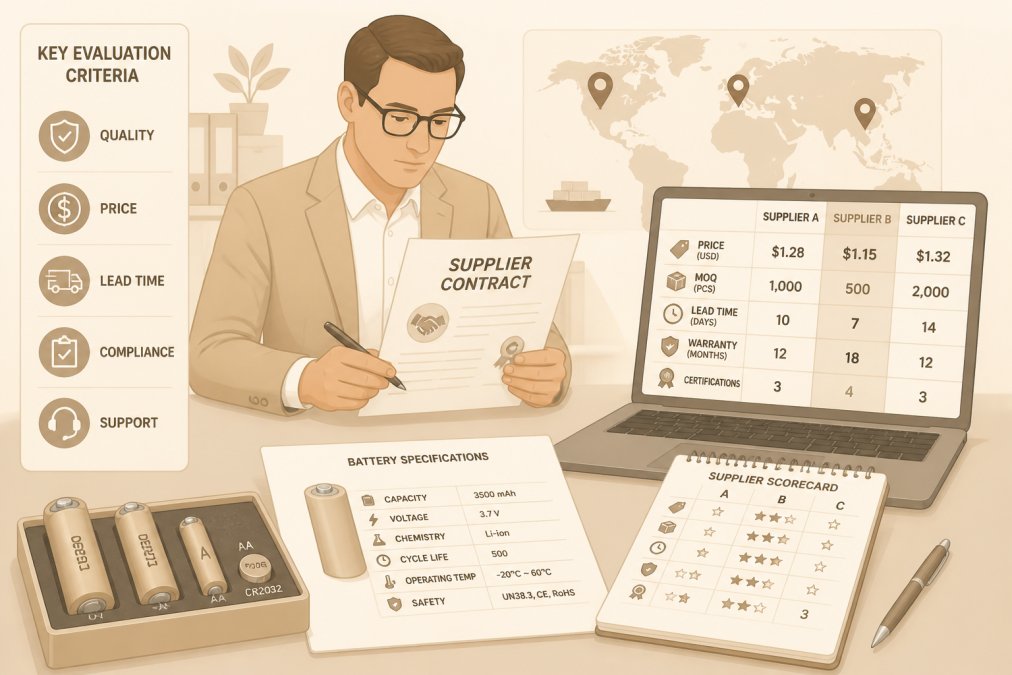
Supply chain reliability is the foundation. Can the supplier maintain inventory during demand spikes? What's their lead time under normal conditions and during shortage periods? Ask for references from businesses similar to yours, not testimonials, but actual operational data. A supplier who ships 95% of orders within 48 hours is fundamentally different from one who ships 80% within 5 days.
Technical support separates specialists from generalists. When you receive a battery that doesn't fit your equipment or a shipment with compatibility issues, does the supplier help troubleshoot, or do you handle it alone? Ask about their process for identifying correct replacements when the original specification is unclear. Many businesses have experienced receiving wrong batteries because the supplier didn't ask enough questions, that's a red flag.
Warranty and return policies matter at scale. A single defective battery in a retail purchase is an inconvenience. A batch of 50 defective batteries in a commercial order can shut down operations. Understand the supplier's policy: Do they replace defective units immediately, or require proof of failure? Do they cover shipping costs for returns? Is there a restocking fee? These details compound across orders.
Account management becomes critical above certain order volumes. Do you get a dedicated contact, or are you calling a general line each time? Can your account contact help forecast demand, coordinate delivery schedules, and escalate issues? The best wholesale suppliers assign account managers to businesses ordering regularly; retailers assign you to a queue.
Pricing transparency and flexibility matter. Can you get quotes before committing? Do prices vary based on volume, payment terms, or delivery location? Are there quantity discounts, or just flat wholesale pricing? Understanding the pricing structure helps you forecast costs and compare suppliers fairly.
| Evaluation Criteria | What to Look For | Why It Matters |
|---|---|---|
| Supply chain reliability | 95%+ on-time delivery, clear lead times | Prevents operational shutdowns |
| Technical support | Dedicated contact, compatibility help | Reduces wrong-order errors |
| Warranty and returns | Clear replacement policy, shipping coverage | Protects against batch failures |
| Account management | Dedicated account manager for regular orders | simplifies procurement and coordination |
| Pricing transparency | Published quotes, volume discounts | Enables accurate budgeting |
What to Ignore When Comparing Battery Mart Alternatives
The battery industry is full of marketing noise that doesn't correlate with actual performance. Here's what doesn't matter when evaluating suppliers.
Brand recognition alone tells you nothing. A well-known brand means they've spent money on marketing, not necessarily that their batteries perform better or their service is superior. Evaluate based on technical specifications, warranty terms, and customer operations, not advertising spend.
Lowest price almost always signals problems. Batteries are commodities, but quality varies significantly. A supplier offering prices 20-30% below market rate is either cutting corners on quality, managing inventory poorly, or won't be around in six months. The goal is value, performance relative to cost, not just the lowest headline number.
Longest warranty can be misleading. A 10-year warranty on a battery that typically lasts 5 years is marketing. A 3-year warranty on a battery that reliably delivers 5+ years is more meaningful. Read the warranty terms carefully, what's actually covered? Are there conditions that void the warranty? Does the supplier honor the warranty, or do they fight claims?
Largest inventory doesn't guarantee availability. A supplier with massive warehouse space might have slow inventory rotation, meaning older stock gets shipped to you. A smaller supplier with disciplined inventory management often delivers fresher batteries. Ask about inventory turnover and stock age, not just total warehouse size.
Most product options adds complexity without value. A supplier carrying 5,000 SKUs is harder to navigate than one carrying 500 carefully curated options. More choices don't improve your outcome, the right choice does. Specialists with focused catalogs often serve customers better than generalists trying to be everything.
Conclusion
Switching from Battery Mart to a specialized wholesale supplier isn't about finding a cheaper option, it's about aligning your battery sourcing with how commercial operations actually work. Wholesale suppliers manage bulk purchasing, offer technical support for compatibility issues, and maintain supply chains built for reliability rather than convenience.
Bigtime Battery serves businesses exactly this way. We maintain wide inventory across medical, marine, and specialty batteries, support bulk purchasing with consolidated ordering, and provide technical guidance when you need to identify the right battery for your equipment. Our one-stop approach eliminates the complexity of managing multiple suppliers while keeping you focused on operations. Get started with Bigtime Battery and simplify your commercial battery sourcing.
Frequently Asked Questions
What are the best wholesale battery suppliers for small businesses?
Battery Sales USA, Inc. and Battery Wholesale both offer wholesale battery suppliers for business with competitive bulk pricing and reliable service. Battery Sales USA focuses on volume discounts for resellers and large commercial operations, while Battery Wholesale provides transparent per-item pricing with fast U.S. warehouse shipping. Your choice depends on order volume, battery type, and whether you need quote-based or listed pricing.
How quickly can battery suppliers deliver in an emergency?
Battery Wholesale ships from U.S. warehouses with fast delivery across the continental U.S., making it suitable for urgent orders. Battery Sales USA and other wholesale distributors typically require direct contact for emergency fulfillment timelines. When evaluating bulk battery purchasing for commercial use, confirm shipping speed and inventory availability before committing to a supplier, especially for critical applications like AED units or emergency lighting.
What's the difference between Battery Mart alternatives for retail versus wholesale?
Retail suppliers like Battery Wholesale offer per-item pricing and smaller order quantities with transparent online pricing. Wholesale suppliers like Battery Sales USA, Inc. require bulk minimum orders and quote-based pricing but offer deeper discounts per unit. Bisco Industries bridges both, offering a consolidated procurement process for businesses that need multiple product types alongside batteries.
Do battery suppliers offer technical support to identify the right battery for my equipment?
Most wholesale and specialty suppliers provide customer service for equipment identification, but response times vary. Battery Wholesale has transparent online catalogs that help self-identification, while Battery Sales USA and U.S. Battery Mfg. Co. require direct contact. Before switching from Battery Mart alternatives, confirm that the supplier's technical support team can handle your specific device type, especially for medical devices, marine equipment, or industrial applications.