 ultimate-guide
Marine Battery Bulk Discount Pricing: A 2026 Guide
Table of Contents
- Understanding Marine Battery Bulk Discount Pricing
- Wholesale Marine Batteries: Sourcing Strategy
- Deep Cycle Marine Battery Bulk: Type Comparison & Costs
- Lithium Marine Battery Wholesale Options
- Finding Reliable Marine Battery Suppliers
- B2B Bulk Procurement Strategy for Marine Battery Discount Pricing
- Total Cost of Ownership and Environmental Disposal Incentives
- Technical Compatibility Checklist for Bulk Orders
- Frequently Asked Questions
Last Updated: July 24, 2026
Understanding Marine Battery Bulk Discount Pricing
Marine battery bulk discount pricing is a tiered system where per-unit cost drops as order volume increases, but discount structures vary dramatically by battery type, supplier, and qualification status. Understanding these tiers separates customers who save thousands from those who miss real savings.
Most guides focus only on per-unit cost and miss total cost of ownership, shipping fees, minimum order quantities, and warranty implications that determine whether bulk purchasing makes financial sense.
How Volume Tiers Affect Your Bottom Line
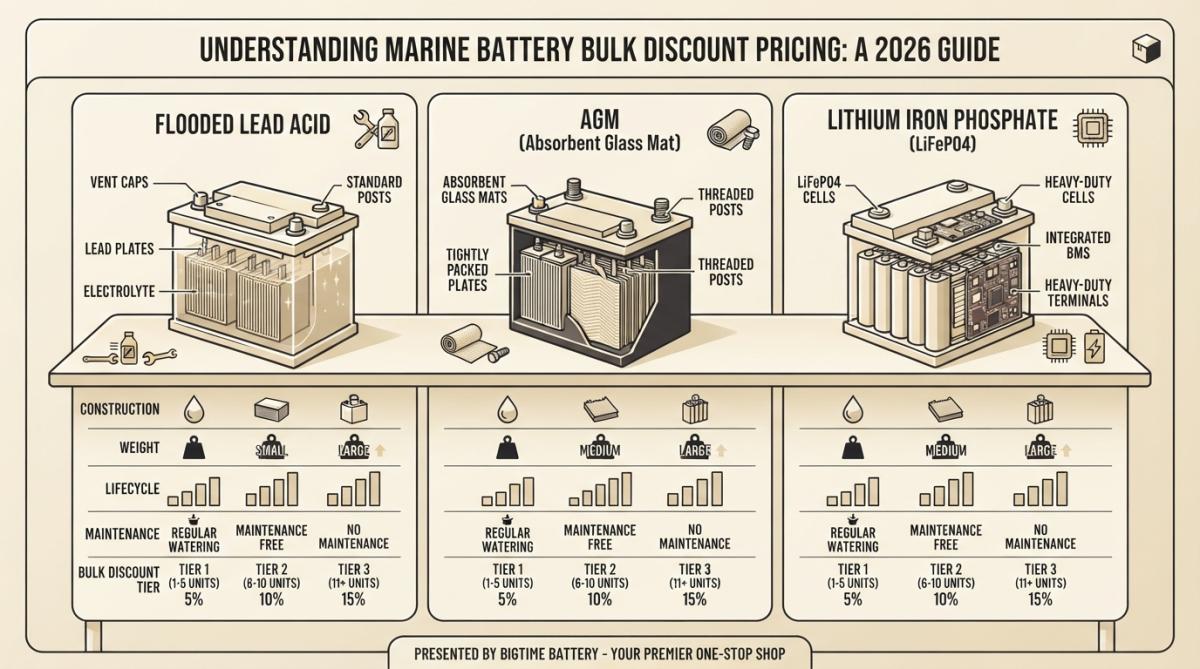
Volume-based pricing typically follows a stepped structure: small orders pay full retail, orders of 5-10 units trigger a first discount tier, orders of 20+ units unlock deeper discounts, and orders of 50+ units qualify for wholesale pricing. Lead acid batteries typically see 25-35% bulk discounts because they're commodity products. Lithium marine batteries rarely discount beyond 15-20% because margins are tighter and demand is higher.
Pricing Variables Beyond Unit Cost
Shipping costs, minimum order quantities, payment terms, and return policies all affect real total cost. A supplier offering 25% off batteries but charging $500 to ship a 10-unit order is effectively offering less discount than one charging $100 for shipping.
Lead time matters significantly. If a supplier requires 4-6 weeks for bulk orders while another ships in 2-3 days, the faster option might justify a slightly higher unit price if downtime costs you money. Tax exemption status can add another 5-10% effective discount depending on your jurisdiction. Return policies and warranty coverage vary significantly, a 20% discount becomes worthless if you can't return defective batteries.
Wholesale Marine Batteries: Sourcing Strategy
Sourcing wholesale marine batteries requires understanding the difference between retail bulk orders and true wholesale procurement. These are not the same thing.
Direct-to-Distributor vs. Retail Bulk Orders
Retail bulk orders are large purchases through a retailer's standard system at discounted retail prices. Wholesale direct-to-distributor purchases bypass the retailer and source directly from manufacturers or authorized distributors at substantially lower prices.
A retailer offering 25% off a $150 marine deep cycle battery brings the price to $112.50 per unit. A direct distributor might price the same battery at $95-$105 per unit. However, direct-to-distributor sourcing requires meeting higher minimum order quantities and you handle logistics directly.
Qualifying for Wholesale Pricing
Wholesale pricing requires meeting one or more of these qualifications:
- Business license or reseller permit
- Tax ID or EIN showing commercial status
- Minimum order volume commitment (often 25-50 units per order)
- Established account history or credit references
- Valid business address (not residential)
The qualification process typically takes 1-2 weeks. Once approved, you access wholesale pricing at any volume above their minimum.
Deep Cycle Marine Battery Bulk: Type Comparison & Costs
When buying marine batteries in bulk, you're choosing between three primary chemistries with different cost structures and bulk discount patterns.
AGM vs. Lead Acid vs. Lithium Iron Phosphate
Lead acid batteries are the lowest-cost option with the deepest bulk discounts. A standard 12V lead acid deep cycle battery retails for $120-150 and costs $80-100 per unit at bulk quantities of 25+. They last 300-500 cycles but require maintenance.
AGM (Absorbent Glass Mat) batteries cost 40-60% more than lead acid but offer better performance. Retail pricing runs $200-280 per unit; bulk pricing at 25+ units is $150-200 per unit. They're maintenance-free and last 500-800 cycles.
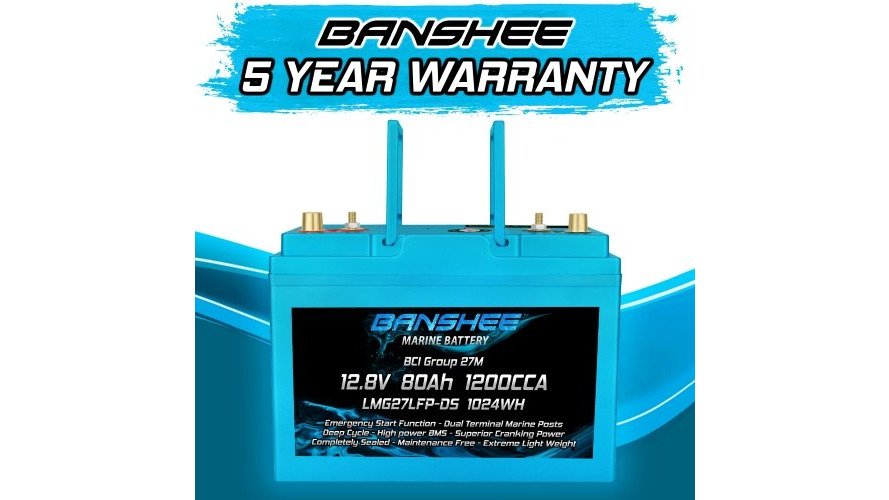
Lithium iron phosphate (LiFePO4) batteries cost 3-4 times more than lead acid. A quality 12V lithium marine battery runs $800-1,200 retail and $650-900 at bulk quantities. However, lithium offers 3,000-5,000 cycle life, zero maintenance, and superior performance. For commercial operations running 24/7, total cost of ownership favors lithium despite higher upfront cost.
Bulk discount percentages reflect manufacturing costs: lead acid sees 30-35% discounts, AGM sees 20-25%, and lithium sees 10-15%.
Amp-Hour Ratings and Group Sizes for Fleet Operations
Marine deep cycle batteries come in standardized group sizes (24, 27, 31, 8D, 4D) and amp-hour ratings (100-300+ AH). Your bulk order needs to match actual power requirements, not just chase the lowest price.
When buying for a fleet, standardizing on one or two group sizes simplifies logistics and reduces inventory complexity. A 20-boat fleet using mixed battery sizes creates maintenance nightmares.
| Battery Type | Typical Retail | Bulk Price (25+ units) | Cycle Life | Best For |
|---|---|---|---|---|
| Lead Acid (100 AH) | $120-150 | $80-100 | 300-500 | Budget-conscious operators |
| AGM (130 AH) | $200-280 | $150-200 | 500-800 | Performance-focused fleets |
| Lithium (100 AH) | $800-1,200 | $650-900 | 3,000-5,000 | High-use commercial ops |
Lithium Marine Battery Wholesale Options
Lithium marine battery wholesale pricing operates differently than lead acid or AGM because the market is newer and supply is more constrained.
Premium Pricing vs. Total Cost of Ownership
Lithium batteries cost 3-4 times more upfront, but that's not the right comparison. A lead acid battery costing $100 at bulk pricing and lasting 400 cycles costs $0.25 per cycle. A lithium battery costing $700 at bulk pricing and lasting 4,000 cycles costs $0.175 per cycle.
The real advantage goes deeper. Lithium charges faster, discharges more efficiently, and maintains consistent voltage. For commercial marine operations, faster turnaround times between jobs directly translate to revenue. A charter boat operation using lead acid might get 3-4 trips per day. With lithium, that same boat might achieve 5-6 trips daily because charging time drops from 8 hours to 2 hours.
Cycle Life and Warranty Coverage in Bulk Purchases
Lithium marine batteries typically come with 5-10 year warranties. When buying bulk, confirm warranty coverage applies to the entire order. Some suppliers restrict bulk warranty coverage, a red flag. Legitimate suppliers warranty all units equally regardless of order size.
Verify cycle life specifications. A manufacturer might claim 4,000 cycles at 80% depth of discharge (DoD), which is different from 4,000 cycles at 100% DoD. Bulk purchases sometimes include extended warranty options for $50-100 additional per unit, which often makes sense for commercial operations.
Finding Reliable Marine Battery Suppliers
A supplier offering the lowest bulk discount pricing might have terrible customer service, long lead times, or quality issues that make savings meaningless.
Evaluating Supplier Inventory and Lead Times
Reliable suppliers maintain inventory and ship within 1-2 weeks. Suppliers requiring 4-6 weeks are either drop-shipping or have supply chain problems. Check inventory status before placing orders. Lead time matters more than most customers realize, a 4-week lead time means you need 2x the safety stock, and that carrying cost often exceeds bulk discount savings.
Ask about seasonal availability. Many suppliers experience summer demand surges. Ordering in April when demand is low might get 2-week delivery versus 6-week delivery in June.
Return Policies and Replacement Battery Support
A supplier offering 25% bulk discounts but no returns is offering a worse deal than one offering 20% discounts with 30-day returns. Confirm return policies explicitly and get them in writing before ordering.
Replacement battery support is equally important. If a battery fails in the field, how quickly can you get a replacement? Ask about warranty claim processes. A supplier with a simple process (send a photo, they ship a replacement) is worth more than one requiring extensive documentation.
B2B Bulk Procurement Strategy for Marine Battery Discount Pricing
Strategic procurement goes beyond finding the lowest per-unit price. It involves negotiating terms, managing inventory, and building supplier relationships.
Negotiating Terms and Price Matching
Suppliers publish bulk discount pricing as a starting point for negotiation, not the final price. If you're ordering 50 units and a competitor offers better pricing, use that as leverage. Most suppliers will match or beat competitor pricing to win large orders.
Payment terms matter as much as unit pricing. Negotiate net-30 or net-60 terms if possible to improve cash flow. Volume commitments unlock additional discounts. If you commit to ordering 200 units annually, a supplier might offer 5-10% better pricing than standard bulk tiers.
Shipping, Delivery, and In-Store Pickup Options
Compare total landed costs, not just unit prices. In-store pickup eliminates shipping costs entirely and saves 10-15% compared to shipped pricing. Freight consolidation reduces per-unit shipping costs if buying from multiple suppliers. Split shipments sometimes make sense, ordering 50 units with 25 shipped immediately and 25 shipped in two weeks reduces inventory carrying costs while maintaining bulk pricing.
Total Cost of Ownership and Environmental Disposal Incentives
Real bulk discount pricing analysis requires calculating total cost of ownership across the battery's entire lifespan, including disposal and recycling.
Calculating TCO Across Battery Types
Total cost of ownership includes purchase price, installation costs, maintenance costs, and disposal costs. Lead acid batteries might require $5-10 annual maintenance per unit. Lithium requires zero maintenance but costs more to dispose of properly ($30-50 versus $10-20 for lead acid).
Efficiency losses also factor into TCO. Lead acid batteries lose 15-20% of energy to heat during charging and discharging. Lithium loses only 5%. For high-use applications, that efficiency difference translates to real operating cost savings.
Recycling Programs and Tax-Exempt Bulk Purchases
Many states offer recycling incentives for marine batteries. Some suppliers provide free recycling when you buy replacements or offer $5-10 core credits for returning old batteries. Tax-exempt bulk purchases are available to commercial operators and resellers in most states, adding another 5-10% effective discount depending on your state's sales tax rate.
Technical Compatibility Checklist for Bulk Orders
Ordering the wrong batteries is expensive. A bulk order of incompatible batteries creates downtime, installation costs, and return headaches.
Matching CCA, MCA, and Voltage Requirements
CCA (Cold Cranking Amps) and MCA (Marine Cranking Amps) must match or exceed your equipment's requirements. A marine engine rated for 600 MCA requires a battery capable of delivering 600 amps at 32°F. Voltage requirements are equally critical, most marine applications use 12V systems, but some larger vessels use 24V or 36V systems.
Amp-hour (AH) ratings determine how long a battery can power your equipment. When buying bulk, create a compatibility matrix documenting each vessel's requirements to prevent ordering errors.
Preventing Downtime with Proper Battery Selection
Downtime costs money. A charter boat unable to operate costs $500-1,000 in lost revenue per day. Battery age matters, ask suppliers about manufacturing dates. Batteries should be less than 6 months old. Installation compatibility prevents downtime from installation delays. Warranty support affects downtime, a supplier offering overnight replacement shipping prevents days of downtime.
Finding the right marine battery bulk discount pricing requires balancing unit cost against total cost of ownership, supplier reliability, and compatibility with your fleet's requirements. The lowest per-unit price often isn't the best deal when you factor in shipping, lead times, warranty coverage, and lifecycle costs.
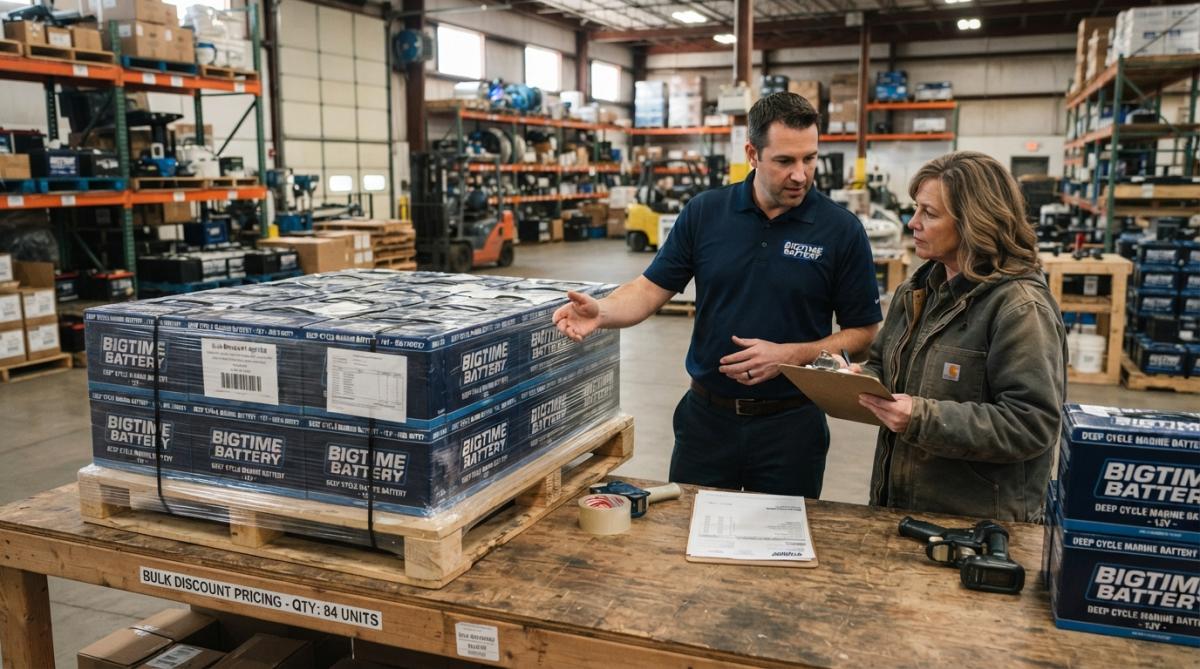
Bigtime Battery specializes in sourcing marine batteries for commercial operations and fleets. Our high-quality replacement batteries are available at competitive bulk pricing, with reliable inventory, fast shipping, and comprehensive warranty coverage. Whether you're replacing a single boat's batteries or outfitting an entire fleet, Bigtime Battery delivers the power you need at prices that make sense for your operation.
Frequently Asked Questions
What factors influence marine battery bulk discount pricing?
Marine battery bulk discount pricing depends on several variables: order quantity and volume tier, battery type (lithium iron phosphate commands higher prices than lead acid), amp-hour capacity, group size, shipping method, delivery timeline, and supplier inventory levels. Seasonal demand, tax-exempt status for business purchases, and price-match policies also affect final costs. Request quotes from multiple marine battery suppliers to compare pricing across different bulk thresholds and battery specifications for your fleet or operation.
How do I qualify for wholesale marine battery pricing?
Most marine battery suppliers offer wholesale pricing to businesses with bulk orders, typically starting at 5-10 units, though thresholds vary. You may need to provide a business license, tax ID, or proof of resale certificate. Some suppliers require account setup or minimum order values. Contact your marine battery suppliers directly with your anticipated volume and use case, fleet operations, retail shops, and marine service centers often qualify immediately. Ask about volume tiers and whether you can lock in pricing for repeat orders.
What is the total cost of ownership for lithium versus lead acid marine batteries in bulk?
Lithium iron phosphate batteries cost more upfront but deliver superior total cost of ownership (TCO) due to longer cycle life (3,000-5,000 cycles vs. 300-700 for lead acid), minimal maintenance, higher depth of discharge, and faster charging. Over a 5-10 year horizon, lithium's lower replacement frequency and reduced downtime often offset the premium price. Lead acid remains cost-effective for short-term, low-demand applications. Calculate TCO by dividing total investment (purchase + maintenance + disposal) by expected cycles or years of service to compare battery types fairly for your marine craft operation.
Do marine battery suppliers offer recycling incentives or tax-exempt bulk purchases?
Many marine battery suppliers participate in lead acid battery recycling programs and may offer core credits (refunds for returning old batteries). Some states offer tax incentives for lithium battery adoption. Business bulk purchases may qualify for tax-exempt status if you provide a valid tax ID or resale certificate, confirm this directly with your supplier. Environmental disposal programs vary by region and supplier; ask about recycling options when placing bulk orders. Proper recycling reduces your environmental footprint and can offset procurement costs through core credits or state incentive programs.