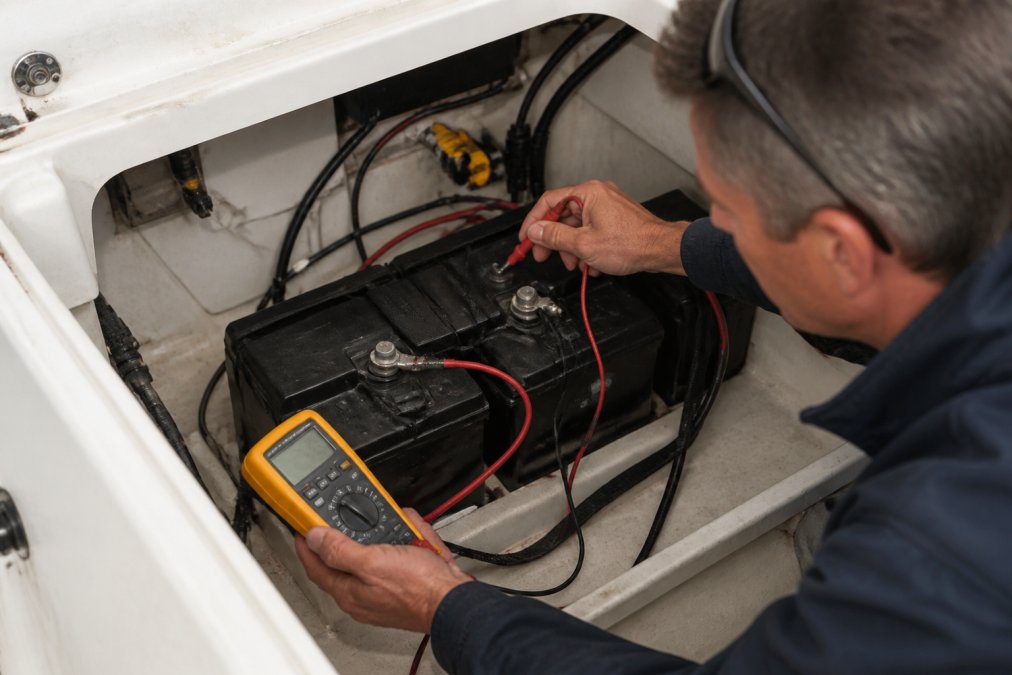
 how-to
Calculating Amp Hour Requirements for Marine Electronics
Table of Contents
- The Amp Hour Formula Behind Every Marine Power Budget
- Amp Draw vs Amp Hours Explained for Boat Electronics
- Calculating Total Daily Amp Hour Consumption on Your Boat
- Using a Marine Battery Runtime Calculator (and Where It Falls Short)
- Depth of Discharge, Battery Chemistry, and Usable Capacity
- Sizing the Battery Bank, Wiring, and Circuit Protection Together
- Frequently Asked Questions
Last Updated: September 19, 2026
The Amp Hour Formula Behind Every Marine Power Budget
Calculating amp hour requirements for marine electronics starts with one simple formula: total current draw in amps multiplied by hours between charges. A modest electronics package drawing 8 amps over a 10-hour day needs 80 amp-hours of capacity, according to Fishfinder Power Management analysis. That number is your starting point, not your final answer.
Below, we'll walk through the calculation, the chemistry that changes it, and the wiring that protects it.
Amp-hour requirements describe the total energy storage your battery bank needs to run your electronics for a set period. The basic math is easy. The real-world math is where most people stumble.
Why Simple Math Is Only the Starting Point
The formula ignores battery chemistry, depth of discharge, and voltage drop. Those three factors can cut usable capacity by a third or more, according to Fisheries Supply marine power guidance. Run a 90Ah battery at 50 amps of constant load and you get about 1.8 hours, not the 1.8 hours the label implies once chemistry limits kick in (LiTime battery runtime analysis).
So the formula gives you a floor. Everything else in this guide builds the margin on top.
Amp Draw vs Amp Hours Explained for Boat Electronics
Amp draw is how much current a device pulls right now; amp hours is how much total current it uses over time. A fish finder drawing 1.5 amps for 6 hours consumes 9 amp hours.
The confusion comes from mixing the two.
Continuous Load, Peak Current, and What Each One Does to Your Bank
Continuous load is the steady draw your electronics run all day; peak current is the short spike when a motor, pump, or radio transmitter kicks on.
- Continuous load: sizes your battery bank
- Peak current: sizes your wiring and fuses
- Both: determine whether your system holds voltage under stress
Calculating Total Daily Amp Hour Consumption on Your Boat
Total daily amp hour consumption is the sum of every device's draw multiplied by its runtime. Here's how to build that list.
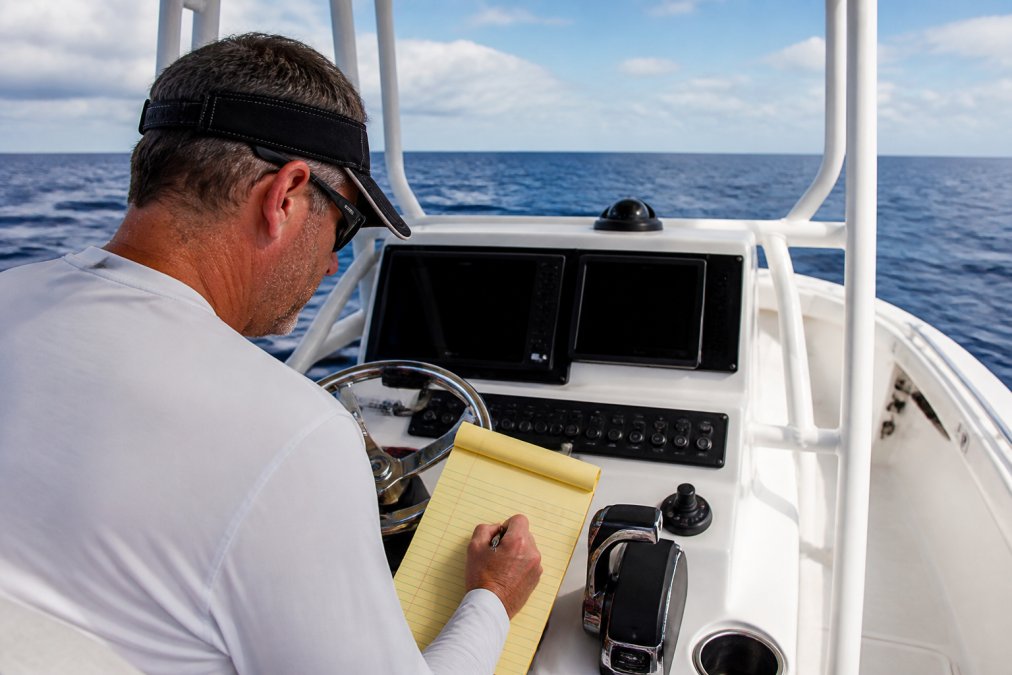
- Write down every electronic device on your boat
- Find the amp draw for each one (label or manual)
- Estimate hours of use per trip
- Multiply draw by hours for each device
- Add every result together
| Device | Amp Draw | Hours/Day | Daily Ah |
|---|---|---|---|
| Fish finder | 1.5A | 8 | 12.0 |
| Chartplotter GPS | 0.5A | 8 | 4.0 |
| VHF radio | 0.3A | 8 | 2.4 |
| Livewell pump | 5.0A | 4 | 20.0 |
| Stereo | 3.0A | 3 | 9.0 |
| Total | 47.4Ah |
Using a Marine Battery Runtime Calculator (and Where It Falls Short)
Use the calculator to model, then add 20-30% buffer for aging, cold weather, and wiring losses. Professional fishing teams have moved to measured on-water data instead of estimates for exactly this reason (LiTime tournament battery guidance).
Depth of Discharge, Battery Chemistry, and Usable Capacity
Depth of discharge (DoD) is how much of a battery's rated capacity you use before recharging. It matters more than any other spec, because it sets both your usable power today and how many cycles the bank survives.
- Flooded lead-acid: keep DoD at 50% for reasonable cycle life; deeper discharges shorten life sharply
- AGM and gel: also plan around 50% DoD for a working bank, though they tolerate deeper occasional draws better than flooded
- Lithium iron phosphate (LiFePO4): safe to 80-90% DoD, and many manufacturers publish cycle ratings at 100% DoD
Peukert's Law and Why a 100Ah Battery Rarely Gives You 100Ah
Effective capacity = Rated capacity × (Rated discharge rate ÷ Actual discharge rate)^(k − 1)
Typical Peukert constants by chemistry:
-
Flooded lead-acid: roughly 1.3 to 1.4
-
AGM: roughly 1.1 to 1.2
-
LiFePO4: roughly 1.01 to 1.05 (effectively flat)
-
Ratio of rates: 5 ÷ 50 = 0.1
-
With k = 1.3: 0.1^(0.3) ≈ 0.50
-
Effective capacity: 100Ah × 0.50 = about 50Ah
-
0.1^(0.03) ≈ 0.93
-
Effective capacity: 100Ah × 0.93 = about 93Ah
What This Means for Your Bank Size
Put DoD and Peukert together and the gap between rated and usable capacity can exceed 50% on a lead-acid bank under heavy load. A bank that looks like 200Ah on the label may deliver only 80-90 usable amp hours in your real duty cycle. Size to usable Ah, not rated Ah, and the bank you buy will run your electronics for the hours you planned.
Sizing the Battery Bank, Wiring, and Circuit Protection Together
Battery bank sizing, wiring, and circuit protection are one system, not three decisions. Size them apart and you get voltage drop, heat, nuisance trips, and premature failure, the step most amp-hour guides skip, and where correctly sized banks still underperform.
Work in this order:
- Calculate daily Ah using the device table method above
- Apply a Peukert correction if you run lead-acid under heavy load
- Add 20-30% margin for aging, cold weather, and wiring losses
- Pick chemistry based on DoD and cycle life needs
- Size the bank to usable Ah, not rated Ah
- Match wire gauge to peak current and one-way run length
- Install fuses or breakers at the battery end of every positive conductor
Wire Gauge: Size to Peak Current, Not Average Draw
Wire gauge is set by the highest current the conductor will ever carry, the peak, not the average. A livewell pump pulling 5A continuous can spike to 15-20A at startup, and a transmitting VHF pulls several times its receive draw. Size for the spike and the average takes care of itself.
| Peak current | Minimum AWG (short run) |
|---|---|
| Up to 15A | 14 AWG |
| 15-25A | 12 AWG |
| 25-40A | 10 AWG |
| 40-60A | 8 AWG |
| 60-100A | 6 AWG |
Voltage Drop: The Hidden Capacity Killer
Voltage drop is the voltage lost to resistance in the wire itself. It doesn't show up in your amp-hour math, but it shows up in whether your electronics work.
-
Resistance: 40 ft × 0.0025 Ω/ft = 0.10 Ω
-
Drop: 3A × 0.10 Ω = 0.30V
-
That is 2.5% of 12V, acceptable, but close to the limit
-
Drop: 10A × 0.10 Ω = 1.0V
-
That is 8.3% of 12V, well past the 3% target, and enough to make a chartplotter reboot or a radio drop out
Fuses and Breakers: Protect the Wire, Not the Device
Overcurrent protection protects the conductor, not the electronics. A fuse sized to the device won't protect a wire too small for the fault current.
- Size the fuse or breaker to the wire's ampacity, then confirm it is above the device's peak draw
- Install it at the battery end of the positive conductor, as close to the terminal as practical, ABYC standards call for within 7 inches of the battery connection, or within 40 inches if the conductor is sheathed and protected
- Use marine-rated ignition-protected components in engine spaces
- Match the interrupt rating to your system voltage and available fault current
Tinned Copper and Marine-Grade Terminations
Bigtime Battery stocks deep cycle marine batteries built for this workload, plus the replacement batteries boat owners need when a bank gives out. Our one-stop selection covers marine, specialty, and single-cell needs at competitive prices.
Frequently Asked Questions
How do you calculate amp hour requirements for marine electronics?
Add up the amp draw of every device, then multiply that total by the hours you run them between charges. A package drawing 8 amps over a 10-hour day needs 80 amp-hours. Add a buffer for aging, cold weather, and voltage drop, since real-world capacity is lower than the label suggests.
What is the difference between amp draw and amp hours?
Amp draw is how much current a device pulls right now, measured in amps. Amp hours measure energy over time, so a fish finder pulling 3.5A for 8 hours consumes 28Ah. Amp draw tells you what the device needs at any moment; amp hours tell you how long your battery bank can feed it.
How many amp hours do I need for a fish finder and GPS?
A sonar and GPS combo drawing roughly 3.5A over an 8-hour trip needs at least 28Ah, and more once you account for depth of discharge. If you run a 50% discharge limit on lead-acid, plan for about 56Ah of rated capacity so the usable half covers the load.
What is the 50% rule for deep cycle marine batteries?
Most lead-acid deep cycle batteries should not be discharged below 50% of their rated capacity if you want a reasonable cycle life. That means a 100Ah lead-acid battery gives you about 50 usable amp-hours. LiFePO4 batteries tolerate deeper discharges, often 80% or more, so the same rated capacity goes further.
Sizing a marine battery bank is a calculation problem, not a guessing game. Get the daily amp hours right, add margin for chemistry and voltage drop, and size your wiring to match. Bigtime Battery carries the deep cycle marine batteries, replacement cells, and specialty power solutions to back up that math, with low prices and a wide selection for boat owners, mechanics, and fleet managers. Get started with Bigtime Battery and build a power system that holds voltage from launch to haul-out.