 ultimate-guide
Bulk Discount for Marine Batteries: Complete Buyer's Guide
Table of Contents
- Understanding Bulk Discount for Marine Batteries
- Marine Battery Types for Bulk Procurement
- 12V Marine Battery Collections and Specifications
- Lithium Marine Battery Bulk Options and Advantages
- Total Cost of Ownership for Bulk Marine Battery Orders
- Wholesale Marine Battery Suppliers and Where to Buy
- Marine Battery Lifespan and Maintenance for Fleet Operations
- Negotiating Better Bulk Discount Deals on Marine Batteries
- Frequently Asked Questions
Bulk Discount for Marine Batteries: Complete Buyer's Guide
Last Updated: July 22, 2026
A bulk discount for marine batteries can reduce per-unit costs by 20-40% depending on order volume, but only if you understand how wholesale pricing works. This guide covers volume pricing mechanics, battery types suited for bulk procurement, total cost of ownership analysis, and negotiation strategies to maximize value without sacrificing quality or warranty protection.
Understanding Bulk Discount for Marine Batteries
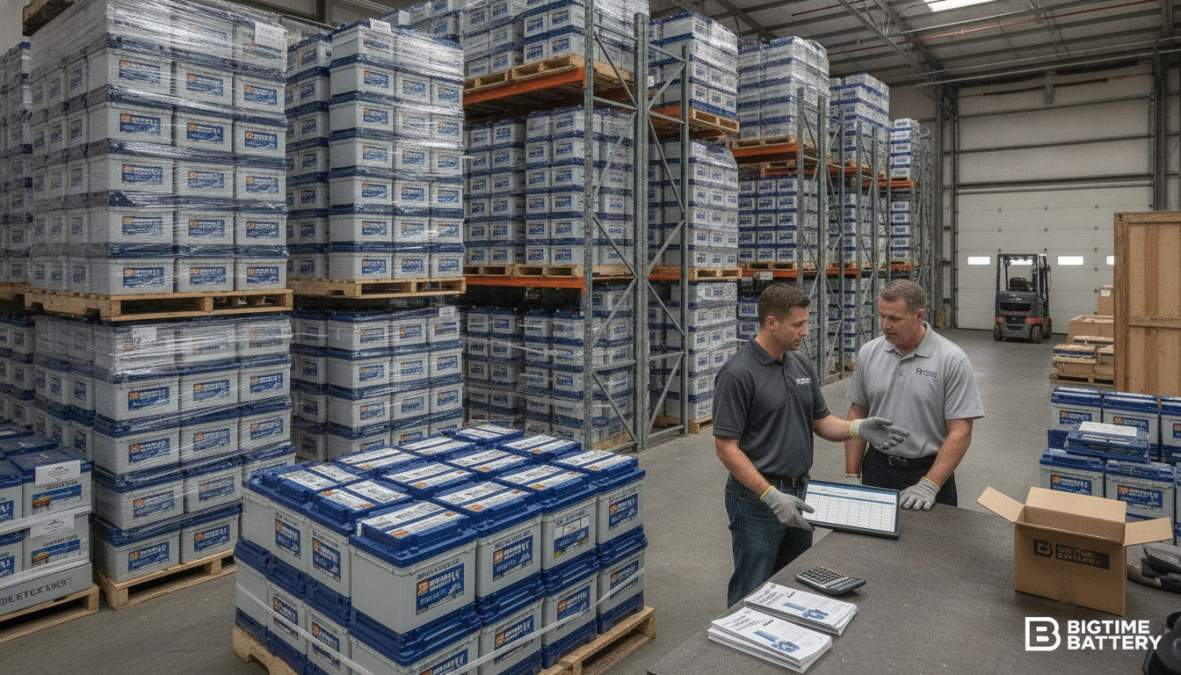
Volume pricing depends on order size, payment terms, delivery logistics, and your supplier relationship. Most wholesale distributors tier pricing at 10, 25, 50, and 100+ units. Moving from 10 to 25 units yields 10-15% savings; reaching 50+ units unlocks an additional 10-20% discount.
Distributors reduce prices at volume because they move inventory faster and lower per-unit transaction expenses. When you order 50 batteries at once instead of five units monthly, you solve their cash flow problem, that's where negotiation begins. Avoid asking "What's your bulk price?" without specifics. Instead, provide clear forecasts: "We need 60 starting batteries delivered over 12 months, with 20-unit shipments quarterly."
How Volume Pricing Works
Tiered structures assign price levels to minimum order quantities. The first tier (10 units) typically offers 8-12% off MSRP; the second tier (25-50 units) adds another 8-15%; at 100+ units, custom pricing can reach 35-45% below retail.
However, unit price alone doesn't tell the full story. Request all-in quotes showing unit price, shipping, taxes, and fees. A distributor offering 25% off batteries but charging $500 to ship a 25-unit pallet is less attractive than one offering 20% off with free shipping. Payment terms also impact effective pricing. Net-30 or net-60 terms at higher volumes mean you don't pay for 30-60 days after delivery, reducing your cost of capital.
Discount Tier Structures
Most distributors use one of three models. Tiered pricing unlocks new discounts at each quantity threshold, transparent and easy to compare. Volume-based rebates earn credits based on annual spending rather than per-order quantities, offering flexibility for variable demand. Contract pricing locks in fixed per-unit rates for 12-24 month commitments, delivering the lowest costs but requiring accurate forecasting.
| Pricing Model | Best For | Pros | Cons |
|---|---|---|---|
| Tiered (per-order) | Predictable demand | Simple, transparent | Incentivizes overordering |
| Volume rebates (annual) | Variable demand | Flexibility, no overstock pressure | Rebates delayed, requires tracking |
| Contract pricing (12-24 months) | Large committed fleets | Lowest per-unit cost | Forecasting risk, underbuying penalties |
Marine Battery Types for Bulk Procurement
Bulk procurement strategies differ significantly between starting batteries, deep cycle units, and mixed fleets.
Starting vs. Deep Cycle Batteries
Starting batteries deliver large current bursts for engine cranking, prioritizing cold cranking amps (CCA) and reserve capacity (RC) over cycle life. A typical marine starting battery delivers 600 CCA and lasts 3-5 years. These are lighter and less expensive, making them attractive for bulk procurement.
Deep cycle batteries discharge slowly over extended periods and recharge repeatedly without degradation, prioritizing ampere-hours (Ah) and cycle life. A deep cycle battery might deliver 200 Ah and sustain 1,000+ charge cycles. These are heavier, more expensive, and better suited for trolling motors and onboard power systems. Bulk discounts often differ between types. Negotiate pricing separately rather than bundling them into a single order.
Dual-Purpose and Trolling Motor Options
Dual-purpose batteries bridge starting and deep cycle performance, delivering moderate CCA (400-600 amps) and moderate Ah capacity (100-150 Ah). Per-unit costs are 15-25% higher than starting batteries, so the math only works if you have genuinely mixed needs.
Trolling motor batteries require special attention. They draw 40-100 amps continuously for hours, requiring true deep cycle batteries with high Ah capacity. Many distributors don't stock these in volume, forcing special orders. Negotiate trolling motor pricing separately and confirm lead times before committing.
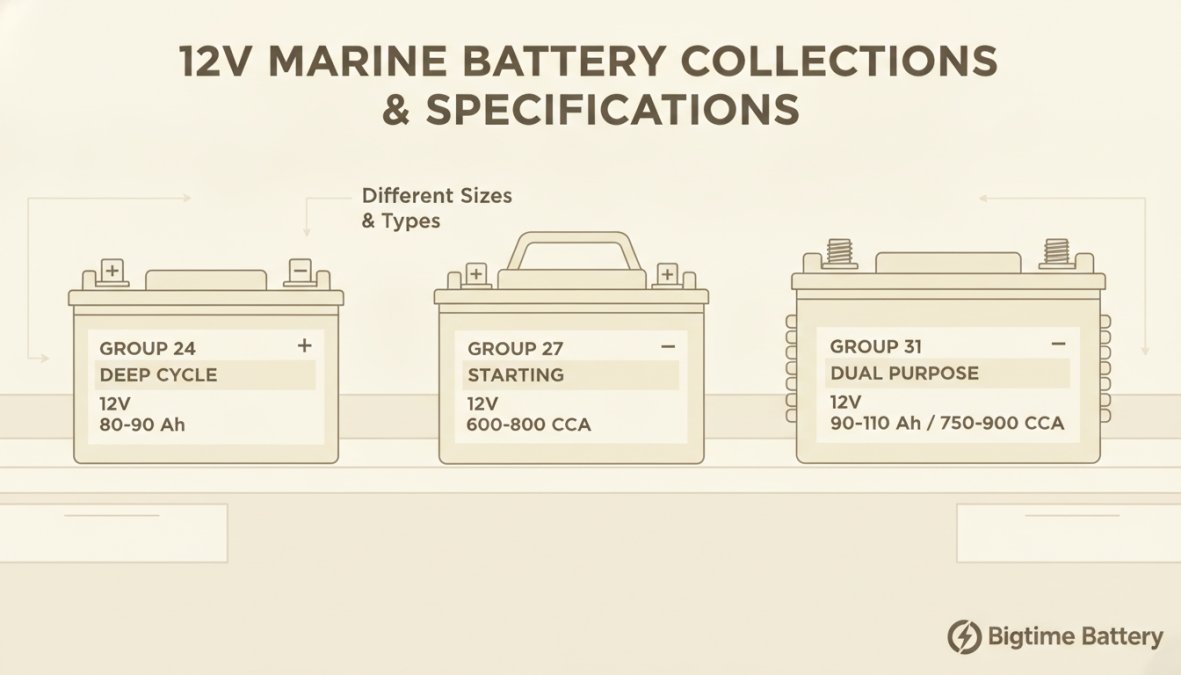
12V Marine Battery Collections and Specifications
The vast majority of marine batteries are 12V units. Understanding CCA, CA, RC, and Ah ratings is essential for comparing bulk offers and ensuring you're buying the right product.
CCA, CA, RC, and Ah Ratings Explained
Cold Cranking Amps (CCA) measures amps delivered at 0°F for 30 seconds while maintaining 7.2 volts. A 600 CCA battery suits engines up to 6 liters; 800 CCA handles larger engines.
Cranking Amps (CA) is measured at 32°F instead of 0°F and is always higher than CCA. Some distributors emphasize CA in marketing because the number looks better, but CCA is more relevant for marine use.
Reserve Capacity (RC) measures minutes a fully charged battery can deliver 25 amps while maintaining 10.5 volts. A 120 RC battery powers navigation systems for about two hours if the alternator fails.
Ampere-hours (Ah) measure total stored charge. A 100 Ah battery can theoretically deliver 5 amps for 20 hours. For deep cycle and trolling motor batteries, Ah is the primary specification.
| Specification | What It Measures | Relevance to Marine Use | Typical Range |
|---|---|---|---|
| CCA | Amps at 0°F for 30 sec | Engine cranking in cold | 400-1,000 amps |
| CA | Amps at 32°F for 30 sec | Marketing number (higher than CCA) | 500-1,200 amps |
| RC | Minutes at 25 amps | Auxiliary power duration | 60-200 minutes |
| Ah | Total charge capacity | Deep cycle / trolling motor use | 50-300 Ah |
Choosing the Right Specs for Your Fleet
Audit your fleet first. Document engine size, model year, and current battery specification for every boat. Group boats by engine type to reveal actual CCA requirements and avoid over-specifying or under-specifying.
Consider boat age. Older engines require higher CCA batteries because they're harder to crank; newer engines with advanced fuel injection tolerate lower CCA ratings. Account for replacement cycles. If you replace batteries every three years, your bulk order should cover 12 months of replacements plus safety stock.
Lithium Marine Battery Bulk Options and Advantages
Lithium marine batteries are lighter, last longer, and deliver consistent power. However, they cost significantly more, and bulk discount strategies differ substantially from traditional lead-acid procurement.
Lithium vs. AGM Technology Comparison
Absorbent Glass Mat (AGM) batteries are the marine industry standard. A typical AGM starting battery costs $80-150 retail; deep cycle AGM costs $200-400.
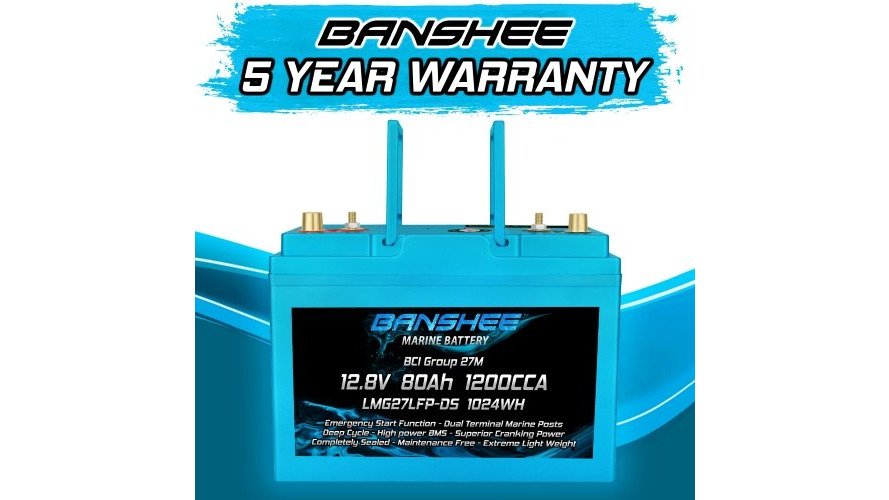
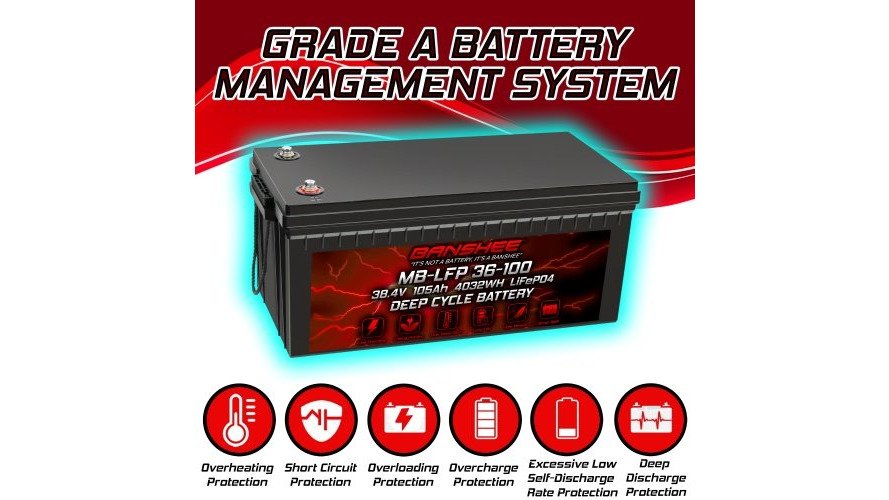
Lithium Iron Phosphate (LiFePO4) batteries weigh 60-70% less, last 3-5 times longer (10,000+ cycles vs. 1,000 cycles), and maintain consistent voltage throughout discharge. However, they cost 3-5 times more. A 100 Ah lithium battery costs $1,500-2,500 versus $400-600 for equivalent AGM.
Lithium suppliers rarely offer tiered volume discounts. Instead, they negotiate contract pricing based on annual commitments. AGM still dominates bulk procurement due to cost. A fleet can stock 100 AGM batteries for the same price as 20 lithium batteries.
When Lithium Makes Financial Sense
Lithium becomes attractive in demanding conditions: high vibration, extreme temperatures, frequent deep discharges. A trolling motor battery lasting 10,000 cycles instead of 1,000 pays for itself through reduced replacement frequency.
If your fleet has limited weight capacity, lithium's lightweight design eliminates reinforced battery trays and wiring. A 100 Ah lithium weighs 30 pounds; equivalent AGM weighs 120 pounds. If your operation values reliability and minimizes downtime, lithium's consistent voltage and longer lifespan reduce unexpected failures.
For most bulk procurement, AGM remains dominant. Lower upfront costs, proven technology, and steeper bulk discounts make it the better choice unless your specific use case justifies lithium's premium.
Total Cost of Ownership for Bulk Marine Battery Orders
A bulk discount is only valuable if batteries last as long as claimed. Total cost of ownership (TCO) analysis reveals which supplier offers best long-term value, not just lowest per-unit price.
Calculating TCO Beyond Purchase Price
Start with unit price times quantity. Ordering 50 batteries at $100 each with 20% bulk discount equals $4,000. Add shipping ($300-500 for a pallet) and installation labor ($500-1,000), and you're at $4,800-5,500 before warranty and replacement costs.
Factor in battery lifespan. A typical AGM marine battery lasts 3-5 years. Three-year cost: initial purchase ($4,000) plus one replacement cycle ($4,000) equals $8,000 total, or $160 per battery per year.
Add warranty and failure costs. If 5% of batteries fail within warranty, you'll spend 50-100 hours managing claims and replacements. At $50/hour labor, that's $2,500-5,000 in indirect costs. Account for disposal. Most jurisdictions charge $5-15 per battery. For 50 batteries replaced every three years, that's $250-750 in disposal costs.
Warranty and Replacement Costs
Warranty structure dramatically impacts TCO. A 24-month full replacement warranty is more valuable than 12-month pro-rata coverage, even at slightly higher per-unit price. Request warranty terms in writing. Confirm whether warranty covers manufacturing defects only or also performance failures, whether it includes full replacement or credit/refund, and whether shipping costs are covered.
Negotiate evergreen bulk pricing where the distributor honors bulk discount rates for future replacement orders within 3-5 years.
| Cost Component | Typical Range | Impact on TCO | Negotiable? |
|---|---|---|---|
| Unit price (with bulk discount) | $80-150 per battery | 60-70% of total | Yes |
| Shipping | $300-800 per order | 5-10% of total | Yes |
| Installation labor | $500-2,000 | 5-15% of total | Partially |
| Warranty claims (5% failure rate) | $2,500-5,000 | 10-20% of total | Yes |
| Disposal/recycling | $250-750 | 2-5% of total | Yes |
Wholesale Marine Battery Suppliers and Where to Buy
Finding reliable wholesale distributors is critical for securing bulk discounts. The market includes national distributors, regional specialists, and direct manufacturers, each with advantages and disadvantages.
Finding Reliable Distributors
National distributors like Interstate Batteries operate regional warehouse networks, ensuring inventory availability and fast shipping. They offer tiered bulk pricing and established warranty programs but often charge higher per-unit prices due to extensive retail networks.
Regional marine specialists often offer better pricing because they have lower overhead and focus specifically on marine applications. They understand nuances of starting vs. deep cycle batteries and marine-specific warranty claims. A regional distributor might offer 25-30% bulk discounts versus 15-20% from national chains.
Direct manufacturers sell to large fleets, eliminating distributor markup. However, minimum order quantities are often high (100+ units), customer service is limited, and lead times are longer.
Shipping, Delivery, and In-Stock Availability
Shipping costs can eliminate bulk savings. Always request all-in quotes including shipping. Pallet shipping is most economical for 20+ batteries. A full pallet (40-50 batteries) ships for $300-600 depending on distance and carrier.
Confirm in-stock status through multiple channels. Call distributors directly; don't rely solely on website displays. Many claim "in stock" but actually special-order from manufacturers, creating hidden delays. Reliable distributors maintain 20-30% extra inventory for unexpected demand spikes.
Marine Battery Lifespan and Maintenance for Fleet Operations
A bulk discount is only valuable if batteries last as long as claimed. Fleet operators often see premature failures due to neglected maintenance or operating conditions exceeding design parameters.
Extending Battery Life in Commercial Use
Commercial fleets face harsher conditions than recreational boats. Daily charge-discharge cycles, vibration, and temperature extremes reduce battery lifespan by 20-40%.
Proper charging is the single most important factor. Marine alternators should maintain 13.5-14.5 volts at full load. Older boats with mechanical voltage regulators often charge at 14.8-15.2 volts, shortening battery life. Upgrading to modern voltage regulators during bulk battery installation can extend lifespan by 12-18 months.
Temperature management impacts lifespan. Batteries in engine compartments experience 30-50°F temperature swings. Secure battery trays isolating batteries from engine vibration extend life by 15-25%.
Battery Recycling and Disposal Regulations
Marine battery disposal is regulated by federal and state law. The Battery Act requires retailers to accept used batteries when customers purchase new ones. Commercial fleets disposing of 50+ batteries face different regulatory requirements than individual consumers.
Most jurisdictions require hazardous waste permits for large quantities of lead-acid batteries. You must document chain of custody. Failure to comply results in fines of $1,000-10,000 per violation. Some distributors offer battery take-back programs, simplifying compliance and reducing effective costs.
Negotiating Better Bulk Discount Deals on Marine Batteries
The sticker price is rarely final. Effective negotiation can improve bulk discounts by 5-15% beyond published tiered pricing.
Price Matching and Seasonal Promotions
Most distributors will price-match competitors if you provide written quotes. Collect quotes from three to five suppliers, then ask your preferred distributor to match the lowest price. Many have internal policies allowing 2-5% adjustments without management approval.
Seasonal promotions create opportunities. Marine battery demand peaks in spring and summer; distributors offer steeper discounts in winter (November-February) to move inventory. End-of-quarter and end-of-year promotions also present opportunities. Aligning your bulk order with their quarter-end might yield 10-20% additional discounts.
Payment terms affect effective pricing. A distributor offering 2/10 net 30 terms (2% discount if paid within 10 days) effectively reduces cost by 2% if you have cash available.
Building Long-Term Supplier Relationships
The best discounts come from long-term relationships, not one-time negotiations. A distributor will offer better pricing to customers they expect to purchase from repeatedly.
Share your multi-year fleet strategy. Explain that you anticipate purchasing 50 batteries annually for three years. This visibility allows the distributor to plan inventory and offer volume commitments at reduced pricing. Three-year commitments often yield 5-10% better pricing than single-year orders.
Establish clear communication channels. Assign a single point of contact to manage the relationship. Consolidate purchasing with one or two primary distributors rather than spreading orders across many suppliers. Provide testimonials and referrals. Distributors often reward referral sources with loyalty discounts or exclusive pricing tiers.
Securing the best bulk discount for marine batteries requires understanding volume pricing mechanics, matching specifications to your fleet's needs, and calculating total cost of ownership beyond purchase price. Contact Bigtime Battery for a custom bulk quote tailored to your fleet's requirements and start cost-effective marine battery procurement.
Frequently Asked Questions
What factors influence bulk discount pricing for marine batteries?
Bulk discount for marine batteries depends on several factors: order quantity (higher volumes typically unlock deeper discounts), battery type (lithium commands premium pricing compared to lead-acid), specifications like CCA and Ah ratings, delivery location and shipping speed, and supplier inventory levels. Seasonal demand also plays a role, off-season orders may qualify for better pricing. Most wholesale suppliers offer tiered discount structures that increase as your order quantity grows, so requesting a formal quote ensures you get accurate pricing for your specific fleet needs.
Where can I buy marine batteries in bulk with the best wholesale pricing?
Wholesale marine battery suppliers typically include dedicated marine distributors, industrial battery dealers, and specialized online retailers that cater to commercial fleets and boat dealers. When evaluating suppliers, verify they maintain in-stock inventory to avoid delays, offer fast shipping options, provide clear warranty information, and are willing to price match competitors. Request bulk quotes directly, pricing depends on quantity, dates, and delivery, rather than relying on retail website pricing. Many distributors offer volume discounts and may provide additional support like technical assistance for fleet maintenance.
How does marine battery lifespan affect total cost of ownership in bulk purchases?
Marine battery lifespan directly impacts TCO because longer-lasting batteries reduce replacement frequency and labor costs over time. Deep cycle batteries typically last 3-5 years in commercial use, while lithium options may extend this to 7-10 years, offsetting their higher upfront cost. When calculating TCO for bulk orders, factor in not just purchase price and shipping but also warranty coverage, maintenance requirements, potential downtime costs, and eventual battery recycling or disposal expenses. A slightly higher-priced battery with superior lifespan and warranty often delivers lower total cost than cheap batteries requiring frequent replacement.
What's the difference between AGM and lithium marine batteries for bulk fleet orders?
AGM (Absorbent Glass Mat) batteries are lead-acid technology offering proven reliability, lower upfront cost, and compatibility with existing marine electronics. Lithium marine batteries provide superior energy density, longer lifespan, lighter weight, and better performance in demanding applications like trolling motors. For bulk fleet purchases, AGM suits traditional commercial operations prioritizing cost control, while lithium works better for high-use fleets where weight savings and extended battery life justify premium pricing. Evaluate your specific voltage requirements (typically 12V), onboard power demands, and replacement cycles to determine which technology delivers better value for your operation.